
I WILL never forget that fateful morning in September 2006. I had just checked into my hotel in central Bangkok when I received a frantic call from my wife in Kuala Lumpur, asking if I was safe.
A military coup was unfolding, with tanks already encircling the Prime Minister’s office. I immediately turned on CNN to watch the coverage, then glanced out my window to see a completely different reality; the streets were packed with their usual traffic jams, as ordinary Thais calmly went about their day. An elected government had just been toppled, yet it was business as usual in the city.
Fast-forward 20 years to February 2026: I returned to our northern neighbour as an official election observer representing the Malaysian Senate, at the invitation of Thailand’s Election Commission. Only this time, the contrast was striking. I witnessed the Thai public patiently queueing at polling stations to cast their ballots for a new parliament and a historic constitutional rewrite.
Beneath the vibrant energy of election day, the shadow of 2006 still looms large. That fateful day did not just topple a popular prime minister, Thaksin Shinawatra, from office, but also sparked a two-decade cycle of military interventions, dissolved political parties and judicial overreach. I did not return to Bangkok just to watch another election, but to see if Thailand could finally break this exhausting cycle.
On Feb 8, over 50 million eligible voters were handed a dual choice: electing a new government amidst heightened regional tensions, and deciding the fate of the nation’s military-drafted 2017 Constitution.
As I worked alongside our own Election Commission officials and the international observation team, I could see just how massive an undertaking this election really was.
However, the democratic exercise was not without its procedural turbulence. Overall voter turnout dropped to 65.31%, down significantly from the youth-driven momentum of 2023. As widely reported in the media, citizen groups flagged several glaring concerns, ranging from unsealed ballot boxes to the controversial handling of millions of QR-coded ballots. Watching these issues unfold was a stark reminder of a simple truth: if you want people to trust the results, count every vote in ‘broad daylight’.
But in Thailand, the mechanics of voting are only half the story.
Just days before the polls, I attended a panel discussion at the Foreign Correspondents’ Club of Thailand (FCCT). There, the country’s top political minds laid bare a sobering reality – when it comes to Thai politics, the ballot box rarely has the final say. Experts highlighted how the democratic will of the people is routinely tested by what political scientist Dr Thitinan Pongsudhirak calls the “custodial agencies” like the Constitutional Court, whose rulings on party survival and leadership qualifications continue to shape Thailand’s political landscape.
One panelist pointed to a Financial Times report that warned endless political gridlock risks turning Thailand into the “sick man of Asia”.
Sitting in the audience, where I was graciously acknowledged by the FCCT President, Panu Wongcha-um, I realised that observing this election is not merely about watching ballots being counted. It is also about understanding the delicate environment in which our neighbour’s democracy continues to survive.
This democratic fragility was vividly evident on the campaign trail. While the reformist ‘orange wave’, which swept the nation in 2023, remained massively popular by winning all 33 constituencies in the capital, it had suddenly slammed into a formidable nationalist wall.
For the conservative establishment, recent border clashes with Cambodia became the ultimate rallying cry. As the People’s Party engaged voters on systemic reforms and military cuts, Prime Minister Anutin Charnvirakul was out working the crowds in a sea of Thai flags. Swearing to protect Thailand with his life, he promised to build a security wall and keep the Cambodian borders firmly shut.
This intense ‘rally-around-the-flag’ fever completely hijacked the election narrative. For ordinary voters suddenly anxious about their national sovereignty, the relentless focus on border security easily drowned out the progressive reform agenda. It proved again that when a crisis hits, fear and patriotism often silence the loudest calls for change.
The results delivered a sharp conservative pivot. Anutin’s Bhumjaithai Party captured a commanding 193 seats, leaving the People’s Party a distant second and the Shinawatra-aligned Pheu Thai Party with its poorest showing of 74 seats. Ultimately, this victory marks a retreat to the familiar among ordinary Thais who opted for immediate stability and a safe pair of hands. While it represents a temporary setback for reformers, it ironically promises a degree of short-term stability, potentially pausing Thailand’s relentless cycle of coups.
Despite this conservative shift in parliament, the Thai public still managed to send a clear, defiant message. Over 65% of voters approved the referendum to begin redrafting the 2017 Constitution, its fourth constitutional rewrite since the landmark 1997 charter. While this is a monumental victory, the hard part is just beginning. The Constitutional Court has mandated a complex, three-referendum process.
Furthermore, the 200-member Senate remains a powerful gatekeeper.
This political reality became clear during my official visit to the majestic Sappaya-Sapasathan, Thailand’s colossal new parliamentary complex, where I called upon my counterpart, Boonsong Noisophon, the Second Vice-President of the Thai Senate.
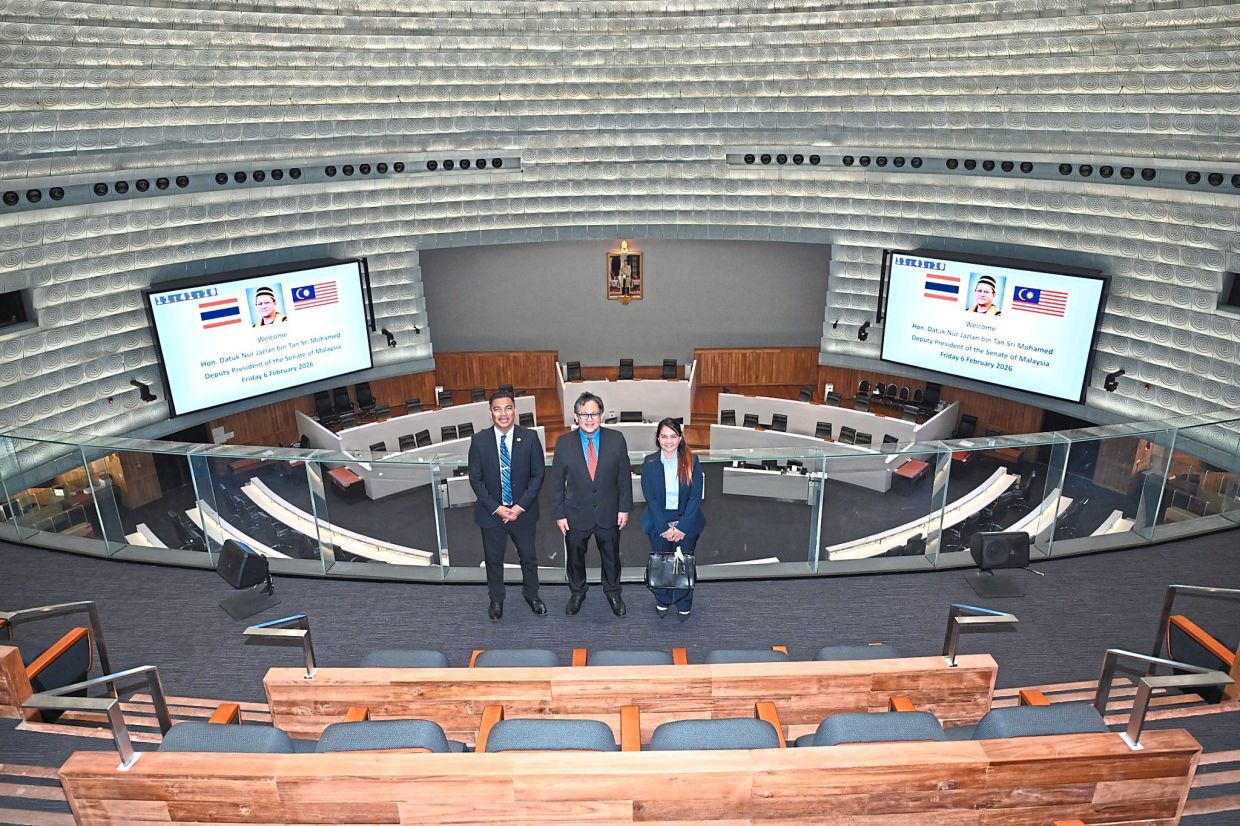
Walking through the spectacular Senate Chambers, it struck me just how different our two systems really are. In Malaysia, our Dewan Negara serves primarily as a house of review and inclusive representation, which is embodied by leaders like Senator Niran Tan Kran, who sits in our chamber to champion the Malaysian-Siamese community.
In Thailand, however, the Senate wields a very different kind of leverage. By retaining a key constitutional role in the appointment of Constitutional Court judges and holding a crucial one-third veto over any constitutional amendments, the Thai Senate continues to anchor the country’s political architecture. As the experts at the FCCT event observed, this institutional design guarantees that no matter which way the political winds blow, the Senate remains firmly entrenched as a stabilising force.
For Malaysia, having a stable government next door carries profound bilateral implications. An administration led by Anutin is expected to prioritise policy continuity, which is welcome news for Putrajaya. Having attended bilateral meetings between then prime ministers Datuk Seri Najib Razak and Prayut Chan-o-cha – as Deputy Minister of Home Affairs (2015–2018) – I know firsthand that this continuity is vital for managing our complex shared agenda, spanning trade, communication, cross-border crime, human trafficking and the protracted conflict in Thailand’s Deep South.
Still, there are also delicate regional sensitivities we must actively navigate. The intense nationalist posture regarding the Cambodian border will deeply test Asean’s diplomatic cohesion in the months to come. This is no longer merely a bilateral dispute, but a glaring fracture in Asean unity. South-East Asia simply cannot afford a frozen conflict in its own backyard.
Ultimately, observing Thailand’s 2026 elections reaffirmed my belief that the democratic spirit in South-East Asia remains vibrant, even as it adapts to the unique, often frustrating complexities of our region. As history has repeatedly proven, our enduring friendship with “the Land of Smiles” is not built during times of quiet, but is forged through sustained, principled engagement amidst the flux.
Senator Datuk Nur Jazlan Mohamed is a politician from Umno and has been serving as the deputy president of the Senate, Parliament of Malaysia, since June 2023. He was the deputy Home Affairs minister from 2015 to 2018. The views expressed here are solely the writer’s own.