Bear scare in Akita


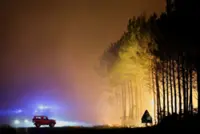
A village near Kita-Akita and Ani districts close to forests shared by humans and bears, in Akita prefecture, northern Japan. Residents in northern Akita are on edge after a surge in bear attacks, prompting the deployment of riot police and the army. — Kentaro Takahashi/The New York Times

IT was a crisp autumn morning in Japan’s northern Akita region, and residents were on edge.

Commuters – some wearing bells, others carrying cans of repellent spray – walked cautiously down leaf-strewn streets.

Children were warned to stay indoors.

Parks were cordoned off with yellow tape, a menacing silhouette warning of danger.

Troops patrolled nearby mountains, ­setting traps and brandishing shields, while drones hovered overhead.

Local officials, police and hunters at a bear safety workshop in the mountainous town of Chizu, Tottori prefecture. — Kentaro Takahashi/The New York Times

Akita was on a war footing against a 180kg, persimmon-loving foe: the Asiatic black bear.

The animal has been linked to more than 50 attacks and four deaths in the region this year, part of a nationwide surge that is challenging Japan’s tradi­tio­nal belief in harmony with nature.

Bears have injured elderly residents ­taking out trash or delivering newspapers, ambushed mushroom hunters and rice farmers, broken into supermarkets and been spotted on school grounds.

One widely circulated video showed an 82-year-old woman attacked from behind during her morning walk.

“When you cross the street in Akita now, you look right, you look left and then you look for bears,” said Akihiro Suzuki, 65, a retired government worker, on a recent walk to the library. “You never know when a bear might be around.”

Akita prefecture, home to about 880,000 people, is at the forefront of Japan’s bear crisis.

Masaru Ito (left) and Suzuki, traditional hunters known as matagi, roaming the forests of the Akita region in Akita prefecture. — Kentaro Takahashi/The New York Times

Across the country, nearly 200 people have been attacked this year and 13 have died, a record.

Bears have been seen in northern ski towns, southern villages and even on the outskirts of Tokyo and Kyoto.

The United States, Canada and the United Kingdom have issued travel warnings about Japan’s bears.

Experts point to climate change as a key factor, with storms damaging beech trees, a vital food source for bears. In their search for calories, bears have grown bolder, venturing into urban areas.

Demographic changes have worsened the problem.

Once-buffering farming communities have thinned as Japan’s population shrinks and ages, with younger people moving to cities. Bears are moving in, creeping closer to settlements.

Mountains and forests cover around 70% of Japan, and bears are considered sacred.

In Hokkaido, the northernmost island, the brown bear is revered as a deity living among humans.

Encounters are likely to continue, ­particularly in autumn and spring when bears are hungriest before and after hibernation. The population now exceeds 50,000 in a country of about 124 million people.

A warning sign of bear sightings at the entrance of the closed Senshu Park in Akita City, Akita prefecture. — Kentaro Takahashi/The New York Times

In Akita, residents are adapting. Stores open later and close earlier. Mail delivery has been suspended in some areas.

Commuters carry pocket-sized bells and bear spray, which contains chilli pepper extract that can stop a charging bear within seconds. Children no longer walk to school alone.

The fall foliage season, usually a time of vibrant forests and tourist selfies, now carries an undercurrent of fear.

“People have to live their daily lives not knowing when they, their family, co-wor­kers or friends might be attacked,” said Maki Koyama, 50, of a cultural centre in Akita. “The current situation is one of fear and confusion.”

The government’s culling effort – setting live traps and then shooting bears – has troubled traditional hunters, or matagi, who perform ceremonies to return bears’ spirits to the heavens.

Bear meat remains a local delicacy and bear parts were once sold as medicine.

“Both we and the bears are in trouble,” said Hideo Suzuki, 78, a matagi hunter. “I feel sorry for the bears.”

The ranks of hunters have dwindled.

Suzuki’s group once numbered hundreds; now only about three dozen remain. Recruiting young hunters has been difficult as rural areas hollow out.

The arrival of reinforcements in Akita aimed to restore security.

Bears dominate national news, with safety videos routinely broadcast on television. Victims are also speaking out.

Keiji Minatoya, a confectionery store owner, was attacked by a bear in his garage two years ago. The animal tore part of his earlobe, leaving a visible portion of his skull exposed. Four others in his neighbourhood were also attacked that day.

Minatoya, who still experiences numbness and tingling, called culling the bear population a “necessary evil”.

“They’re more aggressive than I thought and incredibly strong for their size,” he said. “They’re extremely fast, powerful and aggressive.”

In Akita, business owners report decli­ning foot traffic. Tourists still visit but shorten itineraries or stay indoors.

“It’s not worth the risk of being eaten,” said Teresa Liu, a visitor from Taiwan. — ©2025 The New York Times Company

This article originally appeared in The New York Times

Get 20% OFF The Star Digital Access

Monthly Plan

RM 13.90/month

RM 11.12/month

Billed as RM 11.12 for the 1st month, RM 13.90 thereafter.

Best Value

Annual Plan

RM 12.33/month

RM 9.87/month

Billed as RM 118.40 for the 1st year, RM 148 thereafter.

Follow us on our official WhatsApp channel for breaking news alerts and key updates!

Next In Focus

Planning for a fit take-off
Different risks with little travellers
Holiday hiccups
Ukraine ruins Crimean summer
Open war, closed border
The world’s unlikeliest EV frontier
Where the birdsare the business
Plight of the mothers who search
Bowhunting ‘Frankenfish’
City in the kill zone

Others Also Read