



YOU could say Rapa Nui is in the middle of nowhere, but it’s even less central than that.
Moored in the empty South Pacific, this barren outcrop – also known as Easter Island – is some 2,100km southeast of its nearest inhabited neighbour and roughly 3,540km west of mainland Chile.
For centuries, scholars have wrestled with a question that seems as heavy as the moai themselves: how did the Rapa Nui move their monolithic stone figures, representing deified ancestors, across the island?
Between AD1200 and 1700, the statues were hewn from compacted volcanic ash in a quarry inside Rano Raraku, an extinct crater.
They were transported as far as 18km over rugged terrain, with some reaching 10m in height and weighing up to 86 tonnes.
Around 950 moai have been found, most facing inland with their backs to the ocean to watch over the villages.
Yet seven on the western slopes of Terevaka volcano are aligned precisely to catch the equinox sunset, hinting the site doubled as an astronomical observatory.
Some 400 moai remain in the quarry, while 62 lie along the route to ceremonial platforms on the coast – though whether these were abandoned en route or intentionally placed there remains a matter of debate.
A recent study in The Journal of Archaeological Science by Carl Lipo of Binghamton University and Terry Hunt of the University of Arizona revived the “walking statues” hypothesis.
Fourteen years ago, their 18-person crew shuffled a 4.35-tonne concrete replica 100m in just 40 minutes using ropes attached to its head. Tugging the ropes made the sculpture rock side to side, gradually advancing forward.
“This experiment called into question existing theories about moai transport,” Hunt said, reinforcing ideas from their 2011 book The Statues That Walked: Unravelling the Mystery of Easter Island.
The notion that moai could “walk” originates in oral tradition and was first successfully tested in 1986 by Czech archaeologist Pavel Pavel and Norwegian ethnographer Thor Heyerdahl.
Critics, however, argued that the method could damage the statues’ bases, was impractical on uneven ground, and relied on a 15-tonne replica not representative of all moai.
Yet Heyerdahl’s fame and Pavel’s engineering skills drew serious attention.
Using 3D modelling, Lipo and Hunt examined how the statues’ shapes and proportions affected transport.
They found that moai along the “roads” typically had wide, D-shaped bases and forward-leaning postures – ideal for rocking forward in a zigzag motion.
Damage such as side fractures, they suggested, could result from falls during these walks, while concave road designs helped keep the statues on course.
“Every time the Rapanui moved a statue, it looks like they made a road,” Lipo said. “The road was part of moving the statue.”
Their work, framed as “a vindication of experimental archaeology and a case study of scientific resistance to paradigm change”, has not been without dissent.
Nicolas Cauwe of the Royal Museums of Art and History in Brussels argues that many statues along the paths appear to have cracked while lying down, rather than falling during transport.
He also noted erosion patterns suggesting the statues stood upright along the trails for decades, possibly more than a century.
Popular understanding of Rapa Nui was long influenced by Jared Diamond’s 2005 Collapse: How Societies Choose to Fail or Succeed.
Diamond suggested that competition for resources drove the construction of increasingly massive moai, which in turn required widespread deforestation for transport, leading to soil erosion, famine and societal collapse.
However, researchers gradually discredited this “ecocide” narrative.
“Scientifically, the collapse theory was dead by 2015,” said Jan Boersema, an environmental scientist at Leiden University.
Lipo and Hunt, in a 2007 paper, argued that the society was thriving when the Dutch arrived, with no archaeological evidence for widespread warfare or famine.
Obsidian tools indicated agricultural activity, and “the most deadly objects found on Rapa Nui... are large rocks thrown at heads”, Lipo noted.
Ethan Cochrane, an anthropologist at the University of Auckland, praised the research: “It has exposed the public parable of Easter Island and turned it on its head to demonstrate the people of Rapa Nui to be resourceful and inventive, making one of the most unlivable places on Earth habitable for centuries.”
Alternative theories persist.
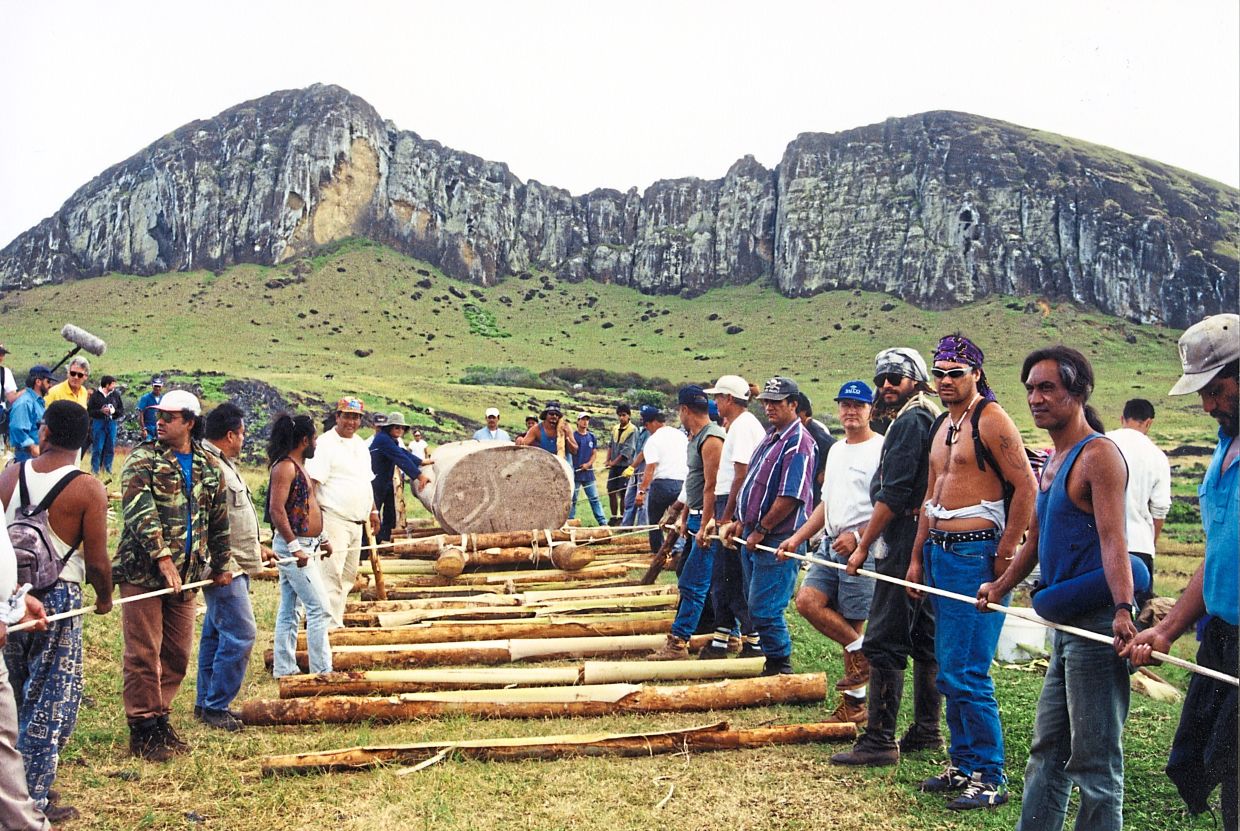
Jo Anne Van Tilburg of UCLA, leading the Easter Island Statue Project, supports horizontal transport – moai moved lying down using a V-shaped wooden frame as both sledge and lever.
In a 1998 experiment, her team moved a 10-tonne, 4.5m-tall concrete moai over flat ground and up an incline using 50 people, then raised it with levers.
Adjustments included lashing rollers to the sledge and sliding the rig over rails, inspired by Polynesian canoe-ladder technology.
“Just because something could be done, doesn’t mean it was,” Van Tilburg said, noting the Rapanui may also have used maritime transport for coastal relocation.
She emphasised that no single theory can capture the full complexity of a rich island culture surviving on a marginal, isolated environment.
Rapa Nui remains a land of mysteries – statues that rock, roads that guide and theories that evolve as rapidly as the tides.
Whatever method was used, the ingenuity and resilience of its people endure, etched into every moai that still watches the island, silent but monumental, across the centuries. — ©2025 The New York Times Company
This article originally appeared in The New York Times
