
PEOPLE in South-East Asia appear generally supportive of climate action, but think that measures that could result in higher costs of living should be pushed back, a new report released recently found.
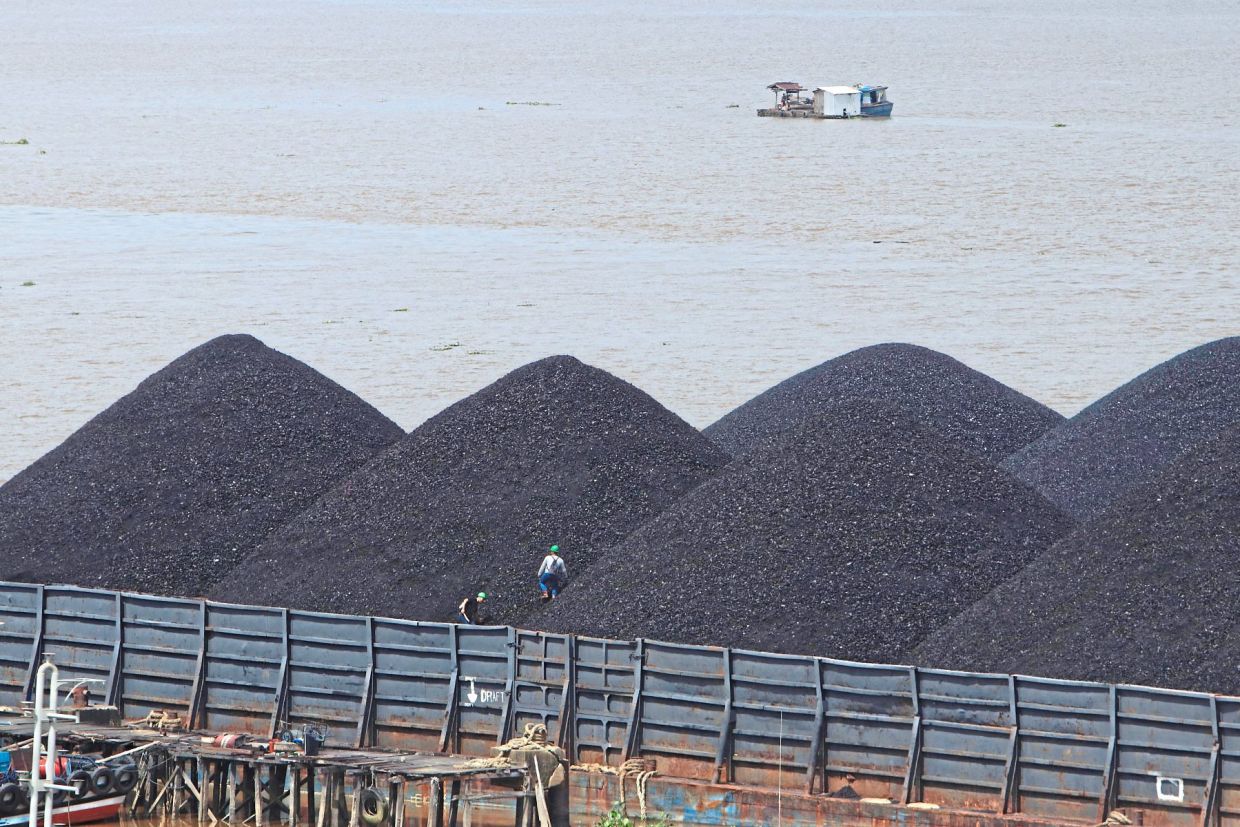
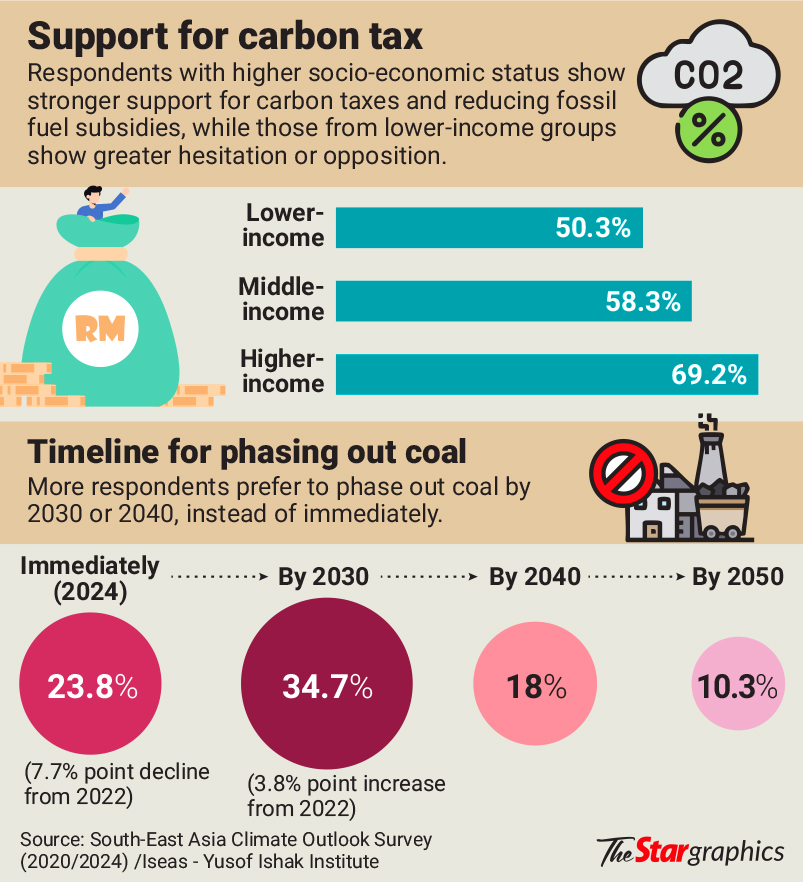
For one thing, regional support for the immediate phase-out of coal declined steadily between 2022 and 2024. Instead, support for delaying the transition to 2030 and 2040 rose.
Coal is the dirtiest form of fossil fuel, but accounted for 80% of Asean’s power sector emissions in 2023. In 2022, energy prices worldwide soared on the back of Russia’s invasion of Ukraine, which raised the cost of living in South-East Asia and other parts of the world.
The report by Singapore researchers also found that those from lower income groups in the region were more hesitant about carbon taxes and the reduction of fossil fuel subsidies in their countries, as they worry about higher energy prices.
These were among the key findings after five years of surveying more than 7,600 respondents across 10 Asean nations that aimed to gauge regional attitudes towards climate change.
These climate mitigation strategies – phasing out coal, removing fossil fuel subsidies and putting a price on carbon – have been globally touted as solutions to reducing the release of planet-warming greenhouse gas emissions.
But the regional sentiment towards these strategies show the trade-offs that will be felt by communities across developing Asean, where many still lack access to electricity, or have other pressing cost-of-living issues weighing on their minds.
The surveys between 2020 and 2024 were led by the Iseas-Yusof Ishak Institute. The Lee Kuan Yew Centre for Innovative Cities at the Singapore University of Technology and Design contributed to the report.
The report was released at a seminar by the Iseas-Yusof Ishak Institute on Nov 28, barely a week after the COP30 UN climate change conference concluded on Nov 22 with no commitment from global leaders to phase out fossil fuels.
Rising costs and climate impacts
Rising costs remain a worry among respondents, the survey found, even as climate impacts continue to affect the lives of people in the region, from floods and typhoons to erratic weather affecting food production.
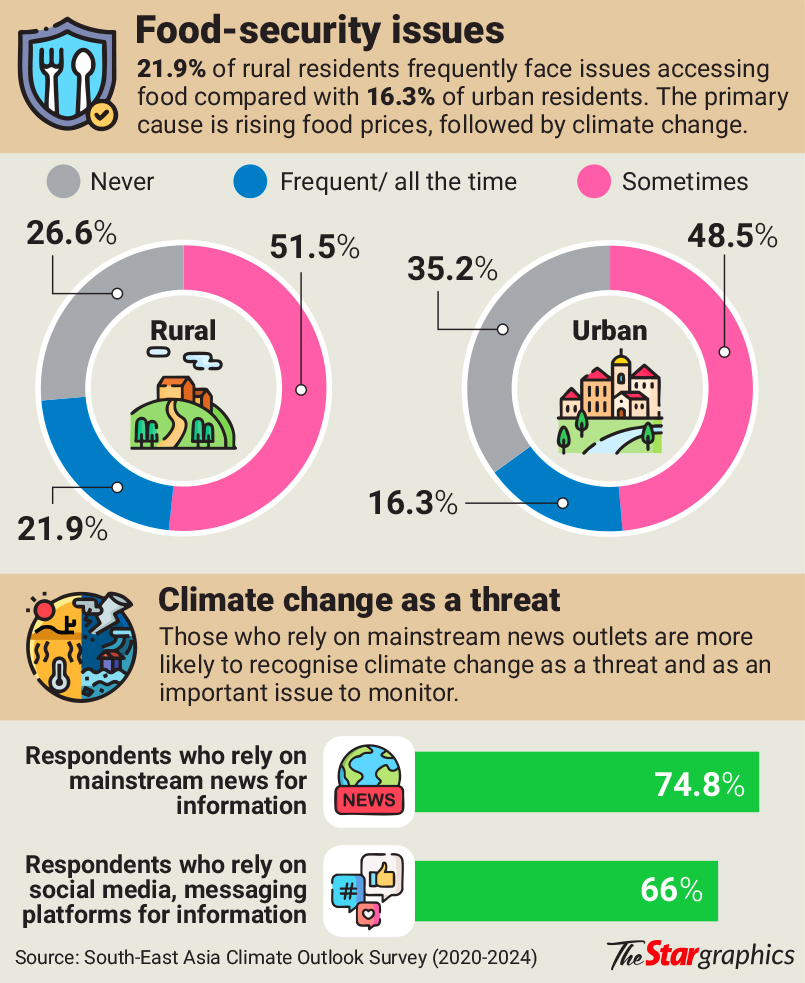
For instance, the survey found that despite being located closer to farms, rural residents experience greater difficulties with access to food compared with urban residents.
More than 21% of rural residents experience food insecurity, compared with 16% of urban residents. The primary cause for this is rising food prices, followed by climate change impacts and limited agricultural investments.
“While respondents appreciate the importance of a near-term phase-out, the entrenched use of coal in the region’s economies, combined with a multitude of domestic and international developments, have led to increasing hesitancy for immediate action,” said the report.
The sentiment to delay the phase-out of coal spanned all 10 countries, even those with low dependence on coal like Singapore and Myanmar.
Around 1% of Singapore’s energy comes from coal, while Myanmar relies on it for around 5% of its electricity. But respondents from both countries were the least supportive of phasing out coal in 2022 and 2024, preferring a 2030 timeline instead, the report found.
In 2024, 14% of respondents from Myanmar opted for an immediate phase-out, down from 20% in 2022.
For Singapore, the figure dropped from 24% in 2022 to 18% in 2024.
With relatively lower levels of electricity access compared with its neighbours, Myanmar respondents may be more hesitant to advocate an immediate coal phase-out, the report noted.
As Singapore is a global economic hub, respondents here may be more sensitive to the impact of geopolitics on energy supplies and prices, prompting them to opt for a 2030 phase-out, it added.
Countries highly dependent on coal, such as Cambodia and Vietnam, likewise recorded a sharp drop in support for the immediate phase-out of coal.
The researchers said a potential reason for this was that both countries had to grapple with the unreliability of hydropower – a renewable energy resource – caused by the impact of climate change on water supplies.
In 2023, for example, droughts in Vietnam forced the authorities to temporarily shut down 11 hydropower dams, removing 5,000 MW from the power grid, which is enough to power two million homes annually.
Blackouts in Cambodia and Vietnam caused small businesses to suffer losses, and citizens sought refuge in shopping malls due to the extreme heat.
View on carbon tax
The differing impact of climate policies across socioeconomic groups also showed up in the regional response to perceptions of carbon taxes and the reduction of fossil fuel subsidies.
Across the region, nearly 70% of higher-income respondents were willing to accept a carbon tax, compared with around 50% of lower-income folks.
A carbon tax puts a price on greenhouse gases to force polluting firms to slash their emissions. This can affect the ordinary person when a power plant’s additional costs from the tax trickles down to home electricity bills.
From S$5 (RM15.90) per tonne of emissions in 2019, Singapore’s carbon tax rose to S$25 (RM79.40) per tonne from 2024. It was previously reported that the tax hike could raise a four-room HDB flat’s monthly utility bills by S$4.
This will increase further to S$45 per tonne in 2026 and 2027. By 2030, the tax rate could be S$50 to S$80 (RM254) per tonne.
Transparent communication about the use of tax revenues or reallocated subsidy savings would help gather support for these policies, said the report, stressing that emission reduction policies must take vulnerable groups and cost pressures into account.
Speaking at a dialogue at the institute, Singapore’s Senior Minister of State for Sustainability and the Environment Janil Puthucheary noted that the government has a role to engage people to “deal with the tensions, trade-offs and anxieties as we go through energy transition and climate adaptation transitions”.
“The climate transition cannot be dealt with on its own without some consideration to socio-economic policy,” he said.
Janil added: “Singaporeans are not shy to contact their politicians... What I am more likely to hear about is requests from my constituents, perhaps, who would like to have more climate vouchers. Who would like a little bit more assistance for their business in the transition.”
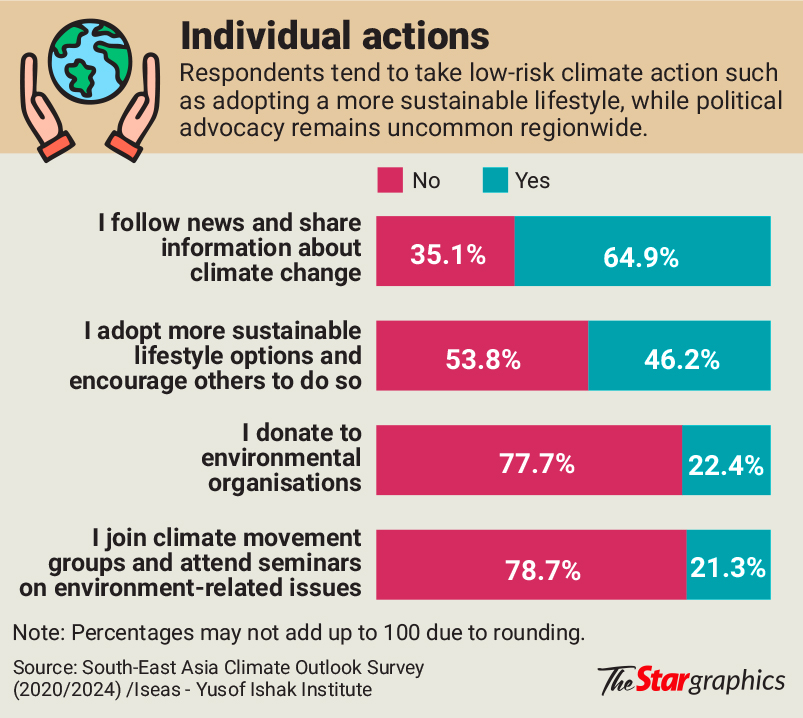
Despite cost concerns, the report showed that people were willing to take steps for a greener future. But they preferred to stick to low-risk actions instead of political advocacy or donating to organisations.
Climate action and communication
Across all 10 countries, the most common action taken by respondents was to follow climate news and share information about climate change, with around 65% of respondents saying they do so.
Some 46% of them said they switched to a more sustainable lifestyle. But only 5.8% of them attend protests and 11.9% lead projects on climate change awareness.
The paper also noted that when the government is seen to act, people do too.
To get more people taking action, policies should be made visible and credible, with easier ways for the public to contribute, said the report.
There is also a need to protect proper civic participation so that citizen action can complement, rather than substitute for, government leadership, the report added.
The report also touched on how South-East Asia can shape its climate future, given the geopolitical climate that may dampen financial flows from other developed nations. Specifically, the report highlighted the importance of Asean working with “all partners who are committed and can provide the resources to support the bloc’s climate goals”.
But it should not rely fully on external support, the report noted, adding that Asean should also set strategic priorities, improve governance and activate resources and improve cooperation within the region while securing the public’s support.
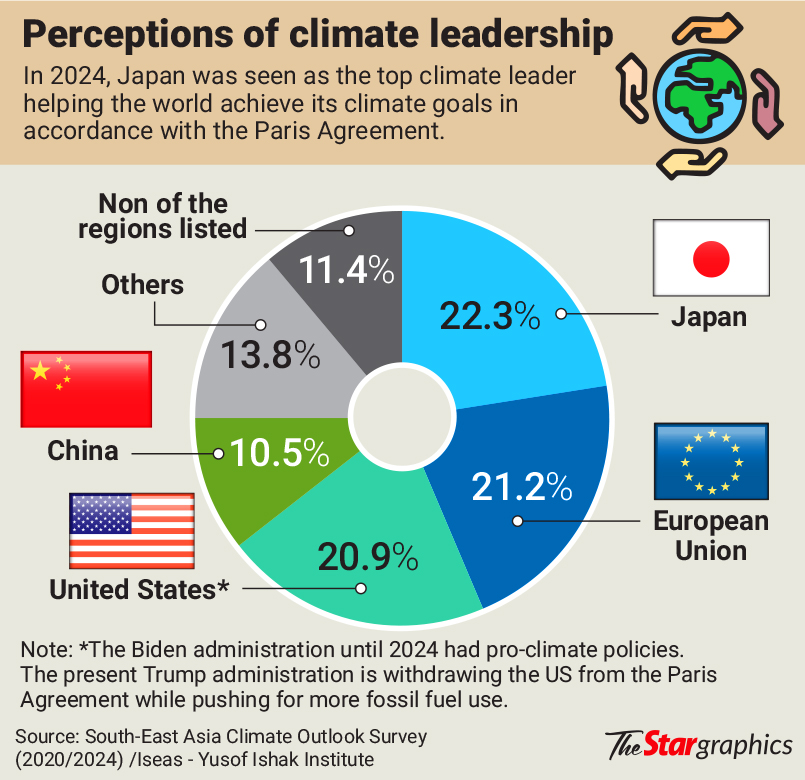
In 2024, Asean residents considered Japan a climate leader. Japan’s long history of providing aid and development assistance to South-east Asia since the end of World War II likely contributed to this perception, added the report.
Between 2020 and 2023, Japan channelled more than US$23 billion (RM94.7 bil) in climate aid to the region, largely through loans. Other countries and economies ranked after Japan as climate leaders are the European Union, the United States and China.
But the report also observed that Japan’s position as the grouping’s climate leader may be short-lived, and identified China as a potential front-runner on this.
For one thing, Japan’s Official Development Assistance scheme faces fiscal pressures. The East Asian giant has also pledged new large-scale investment in the US economy.
“China is well positioned to expand its influence through its financial initiatives, growing capacity as a clean technology powerhouse, as well as its focus on South-South (regional) cooperation,” added the paper. — The Straits Times/ANN