



WE’VE all seen the trope in TV shows and movies.
A kid bullies another in school, the parents of both kids are called in, and nine times out of 10, the bully’s parents turn out to be just as nasty, making it clear where the child got his/her behaviour from.
But in real life, things are not so clear-cut.
Sometimes the bully could be the quiet or friendly well-behaved offspring of model, loving parents.
Children can start bullying for a myriad of reasons, say experts in childcare and child psychology, and imitating their parents’ behaviour is just one.
What is clear, however, is that our kids do not appear to be all right.
Bullying is an age-old problem, but in recent years, it has escalated in both frequency and severity in Malaysia to the point of raising alarm nationwide.
Based on the Education Ministry’s Student Discipline Management System, the number of bullying cases reported has been steadily increasing over the past few years, going from 3,883 cases in 2022 to 6,528 cases in 2023, and then jumping up to 7,681 cases last year.
The National Health and Morbidity Survey 2022 also found that 26.7% of the over 33,000 children aged between 13 and 17 who were polled reported being teased about their physical features while 16% were subjected to jokes, remarks or gestures of a sexual nature.
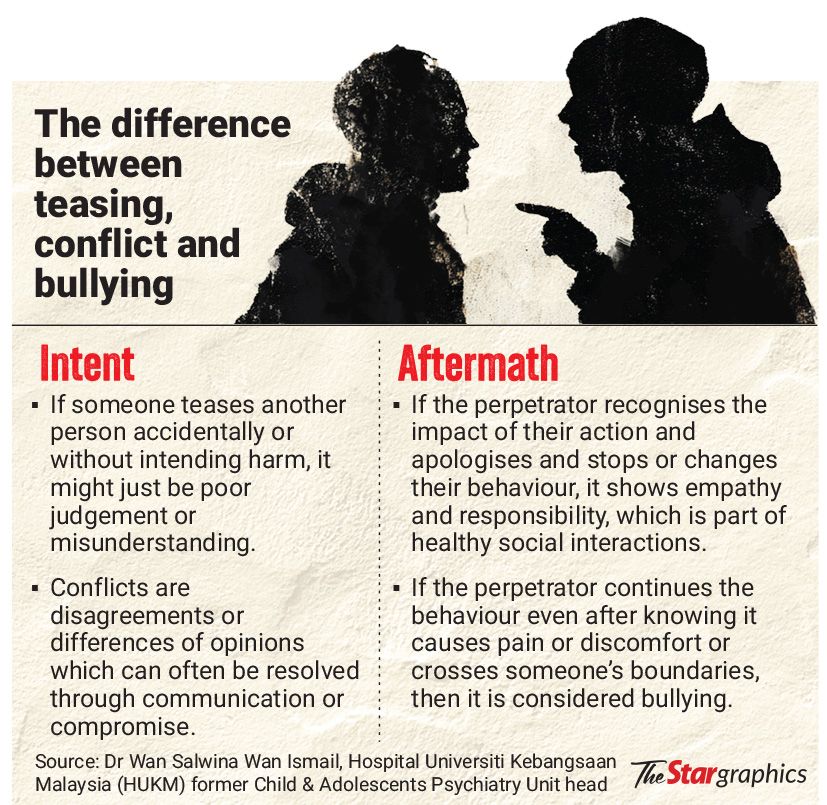
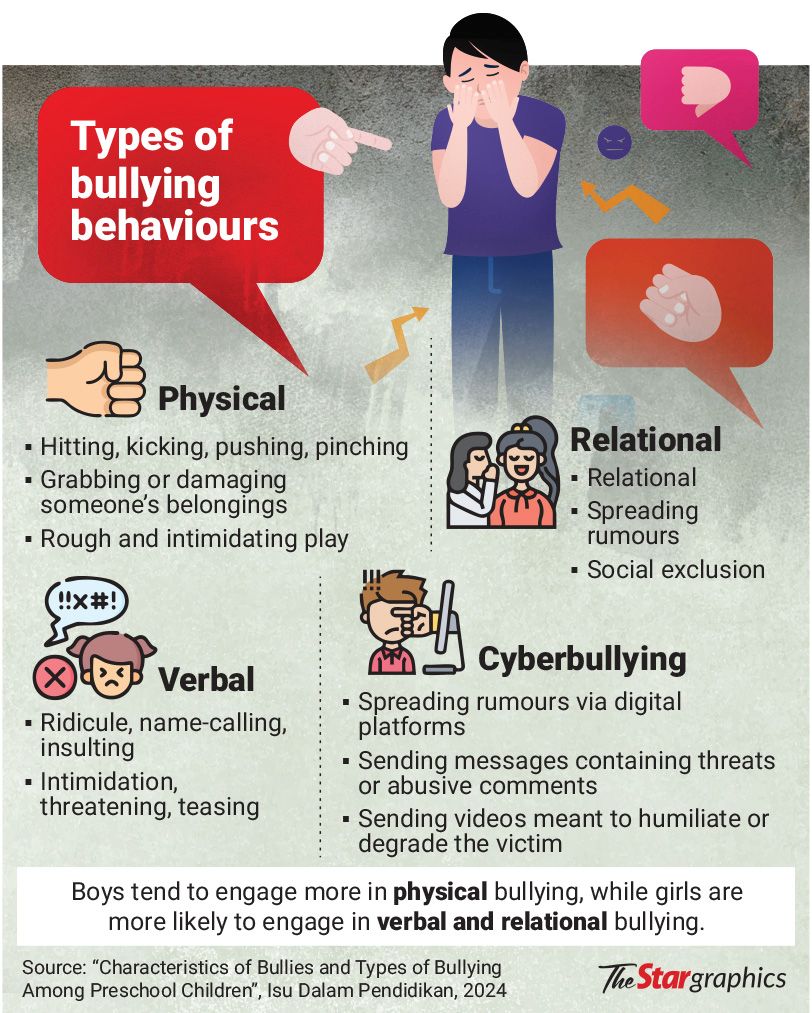
Bullying among children can manifest as physical, verbal, relational or cyber behaviours that cause physical, emotional or social harm to targeted students, characterised by an imbalance of power between the perpetrator and victim.
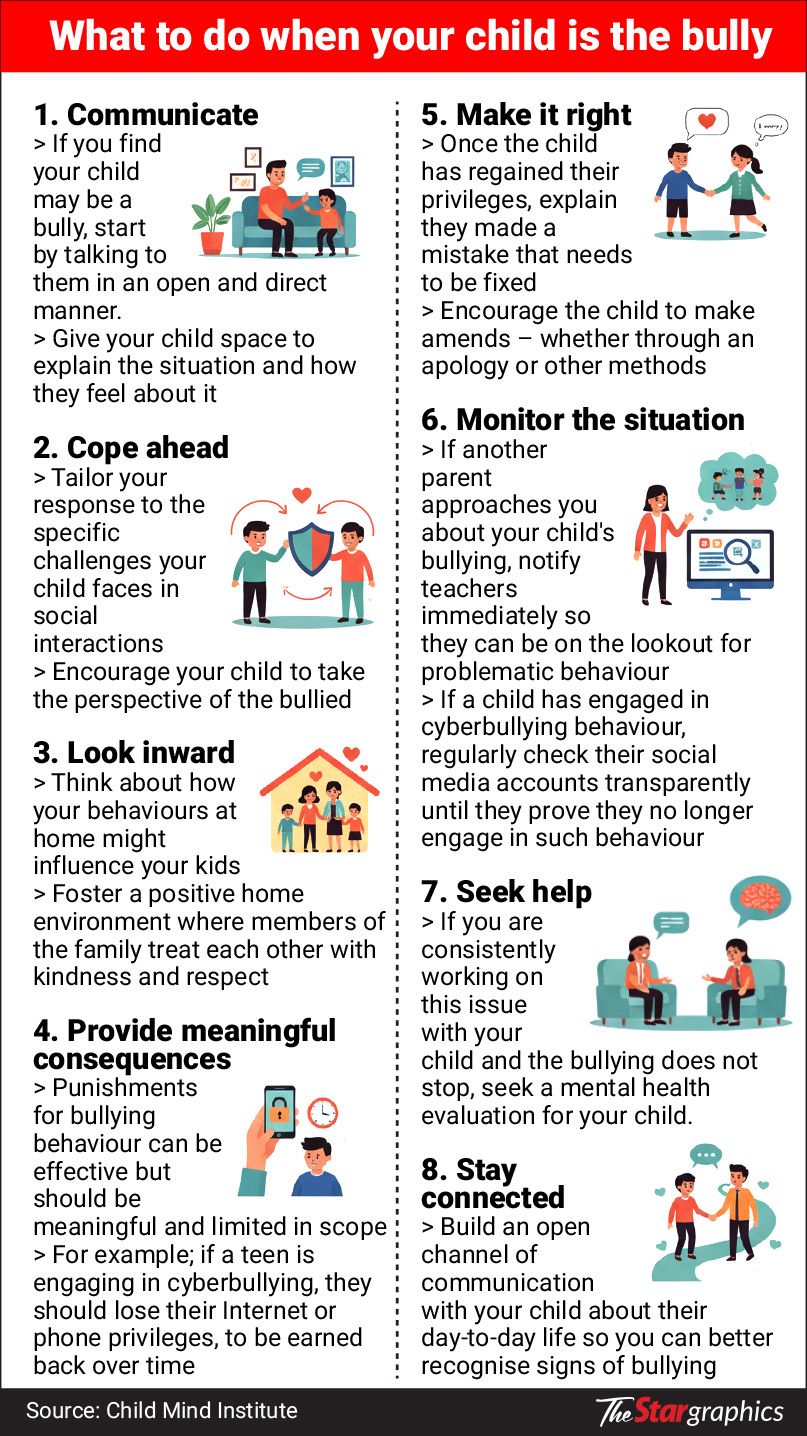
To address the increasingly dire issue, it is imperative we look at both accountability and rehabilitation, striking a balance between them, says Parent Action Group for Education Malaysia chairman Datin Noor Azimah Abdul Rahim.
“Punishment alone may stop the behaviour temporarily, but it doesn’t change attitudes.
“Schools should combine firm disciplinary action with counselling and mentoring, so the student understands the harm caused and learns empathy.
“The goal should be to correct the behaviour and reintegrate the child positively – not to stigmatise or isolate them,” she says.
But in order to rehabilitate such children effectively, it is important we look at what motivated them to start bullying in the first place.
A bully’s psyche
As Noor Azimah says, bullying rarely happens in isolation and is often a reflection of deeper emotional or environmental issues.
First, we have to look at the individual themselves and their psychological or personality traits as well as any psychiatric disorders they may have, says Dr Wan Salwina Wan Ismail, former head of the Child and Adolescent Psychiatry Unit at Hospital Universiti Kebangsaan Malaysia.
“Bullies may have low self-esteem, suffer from insecurity, have a lack of guilt or empathy, or have difficulty controlling their emotions, leading them to act aggressively to feel powerful or to mask their own fears or insecurity.”
They may also be experiencing mental disorders such as anxiety, depression and attention deficit hyperactivity disorder (ADHD), which can all contribute towards bullying behaviours.
“Anxiety and depression can be externalised, causing children and adolescents to respond aggressively to situations.
“Children and adolescents with ADHD may have difficulty controlling impulsive behaviour and may struggle to navigate social situations appropriately, leading to bullying behaviour,” explains Wan Salwina.
But children don’t exist in isolation so we also have to look at their peer groups.
Peers are important for children’s development, particularly during adolescence, but peer pressure can be a significant issue, she says.
“Bullying may stem from peer influence or pressure, a desire to fit in and gain a sense of belonging, or the need for attention or power to improve social status or assert control over others.”
There is, however, no denying the effects the parents and their parenting styles have on the children.
Registered counsellor Raymund Jagan says children who bully are often the outcome of poor parenting.
For example, children who experience overly strict parenting where misdeeds are punished severely often think that disagreements and problems can only be solved with violence; on the other hand, children who experience very lenient parenting, where they often get their way and have a strong sense of entitlement, can get so disappointed that they resort to violence to address disagreements with others.
Meanwhile, children who experience neglect at home often have difficulties forming healthy relationships with other students and struggle to control their emotions, so they may resort to aggression to solve their problems.
“A common thread running through these children who undergo dysfunctional parenting is a strong need to experience power and control over others.
“This helps them feel good about themselves,” he says.
Beyond the family, children also absorb what they see and feel in their surrounding environments.
Children are more perceptive than we give them credit for, and they can notice discrimination in places such as schools, pre-schools, childcare centres and the community they are surrounded by.
The children accumulate frustration from not having their needs, such as love and attention, met and eventually these frustrations will be released, explains Early Childhood Care & Education Council president Datuk Dr Chiam Heng Keng.
If there happen to be peers who lack confidence nearby when a child releases his/her pent-up frustration, an opportunity to bully presents itself.
“If there are peers with similar bullying natures, the environment is more conducive [for a child to start bullying],” she says.
No more safe spaces
Increasingly, a child’s environments aren’t just physical ones; they’ve also expanded into the boundless world of the Internet.
It used to be that children spent most of their time in schools, childcare centres or at home, which was why most traditional anti-bullying measures focused on these locations.
But the advent of social media and online gaming has changed the rules.
Many kids are now spending hours on the Internet every day, doing everything from studying to playing games to building whole communities online.
And in tandem, bullying has also found the new medium.
Psychotherapist Nirali Bhatia, founder of anti-cyberbullying organisation Cyber-Bullying Awareness, Action and Prevention (Cyber BAAP) says bullying that occurs in the physical world now often spreads to the digital world, and vice versa.
“I think in today’s age, there is no bullying which is not moving into cyberspace.
“In fact, most of the time, what starts in a classroom or within a peer group immediately moves to the digital platform because every child has a smartphone today.”
Children can no longer escape their bullies by simply walking away because there are no more safe spaces, says Dr Park Yuhyun, founder of the DQ Institute which works with international organisations to set global standards for digital intelligence.
“Physical bullying can stop once you leave the school, but cyberbullying can actually happen right next to the parents as well.
“So 24/7, children cannot escape bullying,” she says.
The cyberworld doesn’t just provide bullies with easier access to potential victims, it could also be influencing these children towards committing acts of bullying.
Experts consistently point to social media and violent online games as a potential influence on children behaving in anti-social ways such as bullying.
“Today’s students are growing up in a fast-paced digital world that exposes them to aggressive language, teasing and even violence online, which can sometimes spill over into real life.
“Many more are outspoken, but also more easily influenced by what they see on social media.
“There’s less empathy and patience compared with before, partly because so much of their interaction happens behind screens rather than face-to-face,” says Noor Azimah.
Online communities such as the “manosphere” can also encourage unhealthy behaviours, such as pushing boys and men to build themselves up by putting others down.
“Since adolescence is a critical time when young people seek belonging and validation, even toxic online communities can provide a sense of identity or purpose.
“If these groups frame aggression or control as ‘strength’, young people desperate for acceptance may adopt these attitudes to fit in, thereby reinforcing cycles of bullying and dominance,” Wan Salwina says.
Child bully, violent adult
Research has shown that delinquency in adolescents is linked to their early years, says Chiam, which is why it is important to nip the issue in the bud.
Otherwise, if left to fester unchecked, children who bully may display aggression and violence in other aspects of their lives and end up with unexpected consequences.

Cyberbullying, for example, can escalate very quickly, says Park.
“A lot of kids actually think of it as part of play and they don’t think it is a big deal. The problem is that it doesn’t stop at children online. It can escalate very fast and in a very viral way if it goes wrong.
“So once it spreads, it’s like a wildfire,” she says.
Outside the digital world, counsellor Jagan says children who bully to experience power and control over others have similar motivations as an adult who commits domestic violence.
It’s also widely reported that research shows overlaps and links between bullying perpetration and bullying victimisation: bullies are also often victims of bullying in other areas of their lives, and many bully victims become bullies later in life.
“These children are at risk of becoming violent when they have their own families in the future.”
So if we fail to reach the bully early, we may end up meeting them later as violent adults.
