EARLIER this week, I attended the ceremonial send-off for King of Malaysia, His Majesty Sultan Ibrahim’s State Visit to Russia at the Subang Air Base. This visit, the first by a Malaysian head of state since diplomatic relations began in 1967, seeks to strengthen trade and diplomatic ties.
In the three months before His Majesty’s historic visit, a series of high-level interactions with Moscow signalled a significant uptick in bilateral ties. Prime Minister Datuk Seri Anwar Ibrahim visited in May, followed by a Parliamentary delegation I led.
In June, Deputy Prime Minister Datuk Seri Fadillah Yusof continued the momentum with his official visit. Additionally, Datuk Seri Johari Abdul Ghani was appointed coordinating minister for Russia, tasked with addressing trade challenges exacerbated by Western sanctions.
Taken together, these developments suggest more than routine diplomacy. We are clearly elevating our game, and the trajectory appears to point north, towards Moscow.
Is Malaysia pivoting to Russia?
As this question becomes prominent, it is worth examining what recent global trends reveal about Malaysia’s shifting geopolitical posture. For example, in Europe, superpower rivalries have driven nations to double military spending to address the heightened risks of war. Similar tensions in South-East Asia could compel Asean countries, including Malaysia, to strengthen military capabilities to navigate this uncertainty.
Amid a challenging international order and shifting trade dynamics, the heightened engagements with Moscow reflect Anwar’s strategic ambition to recalibrate Malaysia within the BRICS framework and diversify our global alliances. Through Russia and BRICS, we seek to pursue autonomy and forge partnerships beyond traditional Western allies.
The rationale behind it is simple. Malaysia cannot rely on any single country, especially one whose policies may shift unpredictably, as we pursue long-term economic stability and resilience.
When I was a Member of the Dewan Rakyat, I visited Moscow several times and have come to appreciate Russia’s distinct worldview and the strategic ways it seeks to shape the global order.
My trip in May was my first as the deputy president of the Senate at the Dewan Negara, and it offered a valuable opportunity to explore deeper institutional ties with Russia’s parliamentary leaders. With Malaysia chairing the Asean Inter-Parliamentary Assembly this year and Russia present as an observer, the timing was significant.
In Malaysia, the mention of Russia often evokes thoughts of global controversies, particularly its actions in Ukraine. This has cast Russian President Vladimir Putin as a distant, hardline figure viewed through the lens of geopolitical tensions and critical media scrutiny. However, something unexpected challenged this perception.
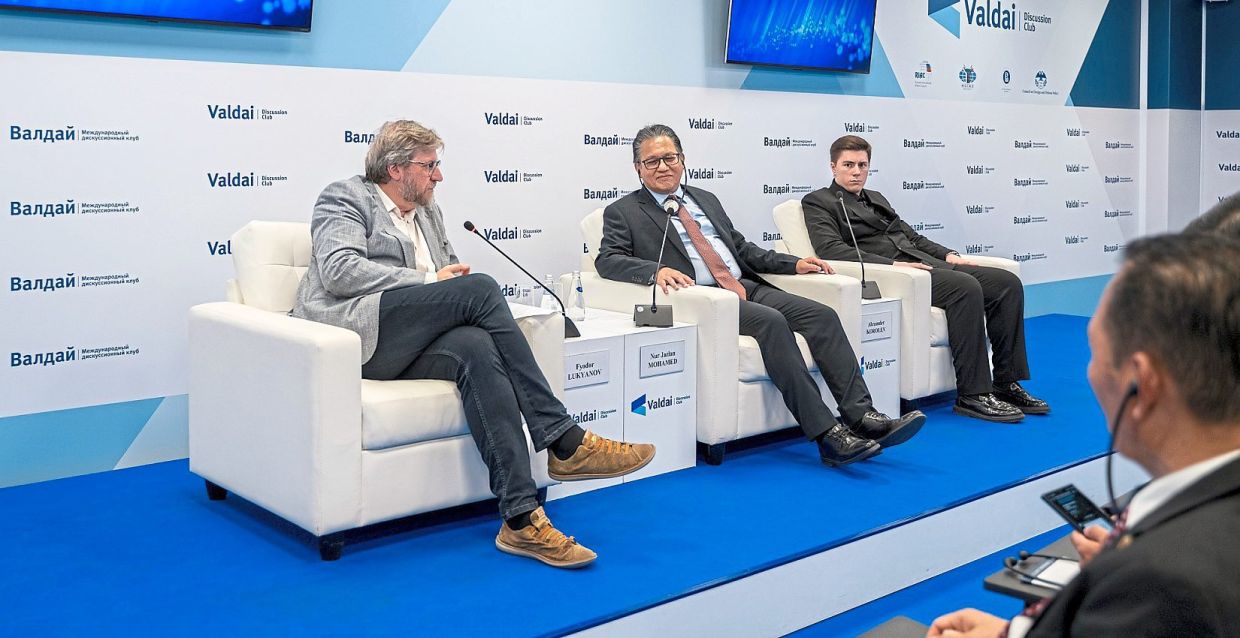
While in Moscow, I was invited to address the prestigious Valdai Discussion Club, a leading forum for global policy discussions, and engage with Russia’s policy elites.
My session was moderated by Fyodor Lukyanov, a prominent foreign policy expert close to President Putin. During the session, Lukyanov referenced a viral moment from the May Kremlin press conference, Putin’s amusement with Anwar’s “second wife” reply to a question on who occupies one of three ceremonial thrones once used by Russia’s imperial family. That unique moment delighted Malaysians and Russians alike on social media.
In response, I smiled and remarked: “Thanks to that event, President Putin is now a very famous man in Malaysia!”
This lighthearted exchange broke the ice, revealing a warmth rarely seen in Putin and fostering a fresh bond between our leaders. Beyond the laughter, it opened doors for stronger Malaysia-Russia ties and advanced our BRICS aspiration, setting the stage for my subsequent Moscow meetings.
Trade and business were central to my dialogue with Russia’s Economic Development Ministry. Aeroflot’s plan to reinstate direct flights to Malaysia will enhance connectivity, strengthen economic ties, and boost our appeal as a premier destination for Russian tourists, ahead of the Visit Malaysia 2026 campaign.
Collaboration in natural disaster management, where Russia possesses substantial expertise, also emerged as a key partnership area.
My meeting with Alexander Kurenkov – their Civil Defense, Emergencies and Elimination of Consequences of Natural Disasters Minister – underscored our commitment to disaster management cooperation as a model of effective bilateral engagement. This initiative has progressed rapidly, thanks to Deputy Prime Minister Datuk Seri Dr Ahmad Zahid Hamidi’s leadership of our Central Disaster Management Committee and proactive efforts during Kurenkov’s June visit to Malaysia.
Discussions with Russia’s Energy Ministry explored collaboration as Malaysia refines its National Energy Transition Roadmap. Moscow’s expertise in nuclear technology, through its state-owned corporation Rosatom, offers solutions for sustainable energy by advancing the peaceful use of nuclear power for electricity generation and reducing reliance on fossil fuels. This collaboration would modernise Malaysia’s power grid while supporting Asean-wide initiatives, like the Asean Power Grid, for sustainable regional energy collaboration.
Malaysia’s defence relationship with Russia, established by the landmark MiG-29 purchase in 1994, remains a cornerstone of our relationship. Today, the focus has shifted to artificial intelligence (AI), critical to modern defence. His Majesty’s visit to Moscow’s Tochka Kipeniya Technology and Innovation Centre, which showcases advanced AI systems, highlights their rapid advancements in this field, offering Malaysia opportunities to enhance its defence capabilities.
Russia’s cutting-edge innovation presents Malaysia with a timely opportunity to explore drone technology and AI-driven security solutions. Malaysia could cautiously pursue calculated collaboration in autonomous warfare drone technology by leveraging Russia’s expertise in autonomous systems. Through joint research and technology exchange, such efforts would strengthen national security and underscore our commitment to innovation. However, given concerns over autonomous weapons and geopolitical sensitivities, such engagements must align with Malaysia’s strategic interests and international norms.
While my meetings were marked by optimism, a key challenge persists in navigating the network of international sanctions, which hinders these opportunities.
Amid increased Western scrutiny and the threat of secondary sanctions, Malaysian industries are cautious and seek to minimise exposure at the expense of trade growth. However, practical solutions exist, such as alternative payment mechanisms for lawful economic engagement. My talks with senior members from the Kremlin administration affirmed that our concerns are resolvable.
Business magnates often ask, “What’s the deal?”
With Russia, the answer is clear. As long as cooperation remains legitimate, respects international regulations, and aligns with Malaysia’s foreign policy, we can make a deal.
At the Valdai Discussion Club, I was asked a pointed question on the US-China power dynamics and Malaysia’s stance if faced with choosing sides. My response was direct: “Choose your neighbour.”
The room chuckled, knowing I implied Russia, whose eastern region places it firmly within Asia.
Yet Russia is more than a geographical neighbour. It is a partner in shared priorities such as economic growth and stability. In a period of intensifying great power rivalry, our BRICS alignment reflects a pragmatic choice for regional proximity.
In choosing and trusting our “neighbour”, we are not turning our backs on our friends. Like a good neighbour who respects your right to design your own home, our friends should understand Malaysia’s choice for balance, economic resilience and independent future.
Datuk Nur Jazlan Mohamed is the Dewan Negara deputy president and former Pulai member of Parliament. The views expressed here are entirely the writer’s own.