
SOUTH Korea is navigating a turbulent political crisis following President Yoon Suk-yeol’s impeachment and suspension from office.
The fallout has left the nation without a strong elected leader to address critical challenges, including tensions with North Korea and increasing political polarisation.The National Assembly’s decision to impeach Yoon delivered a sharp rebuke to a president who had remained deeply unpopular throughout his term.
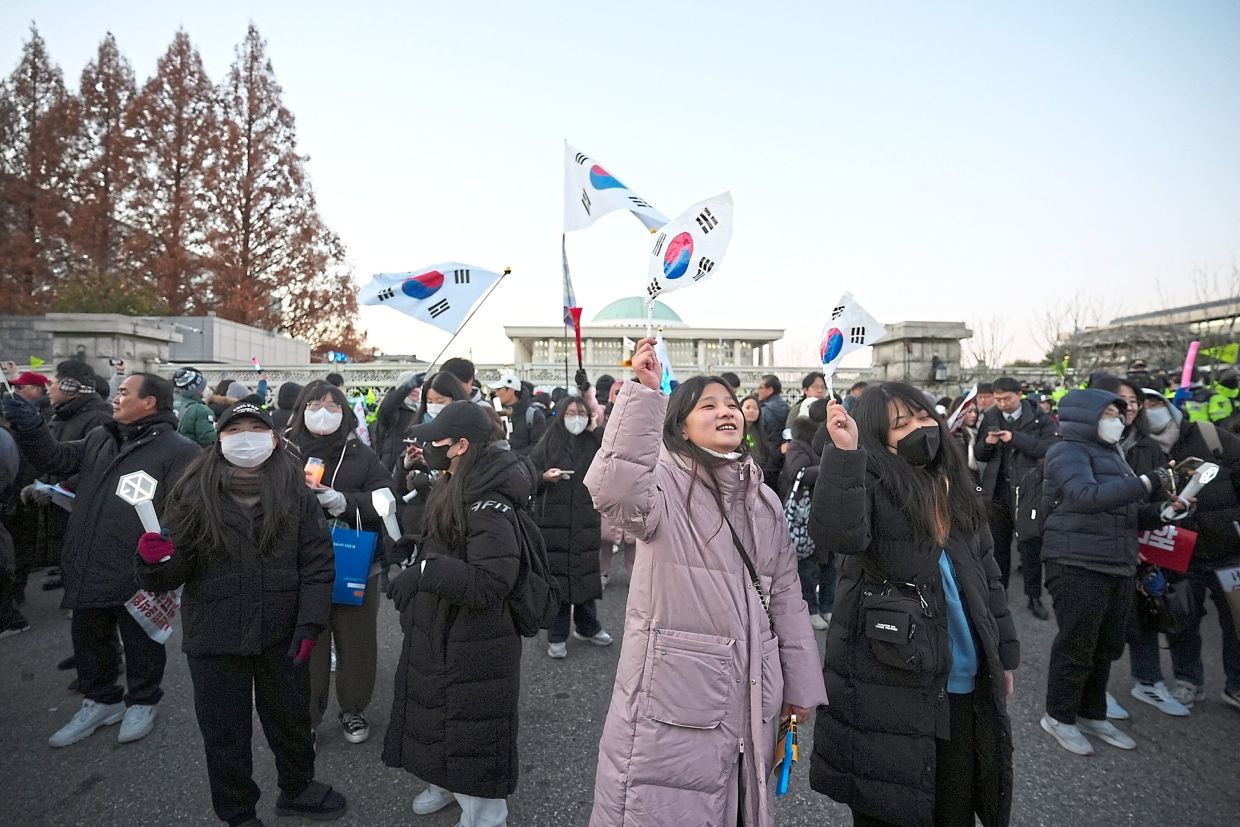
Public celebrations marked his removal, seen by many as a testament to the resilience of South Korea’s democracy, especially in the wake of his controversial declaration of martial law.
Despite the euphoria, the nation faces significant uncertainty.
Yoon’s impeachment has created a leadership vacuum. With his ouster, South Korea must hold a presidential election within two months, adding further delays to political stability.
Yoon, for his part, has vowed to “never give up” his fight to return to office.
However, he faces mounting legal troubles, including allegations of insurrection.
Prosecutors have accused him of deploying troops to block the Assembly from voting down his martial law and detaining political opponents.
Senior government, police and military officials linked to the insurrection have already been arrested.
The political upheaval has far-reaching implications, including strained relations with the incoming Donald Trump administration in the United States.
Trump’s rhetoric has cast doubt on the strength of the US-South Korea alliance, threatening higher costs for stationing American troops and increased tariffs on South Korean exports.
“We won’t have strong leaders who can actively negotiate with the Trump administration to sort these things out,” said Sung Deuk-hahm, a political science professor at Kyonggi University.
“The acting president’s role is to maintain the status quo,” said Lim Ji-bong, a constitutional expert at Sogang University in Seoul.
“Enforcing significant new policy is beyond his power.”
South Korea’s main opposition Democratic Party has proposed establishing a consultative body of political parties and government representatives to stabilise the nation.
Party leader Lee Jae-myung, a favourite to win if a presidential election is held, has urged the Constitutional Court to expedite its decision.
“The most urgent thing is to normalise the country,” Lee said.
Yoon’s impeachment follows a presidency marked by controversy.
While he earned praise abroad for strengthening ties with the United States and Japan to counter China and North Korea, his domestic tenure has been plagued by allegations of corruption and abuse of power.
Critics accuse him of silencing dissent and using state prosecutors to target opponents.
The declaration of martial law was widely seen as a catastrophic misstep, damaging Yoon’s reputation and raising questions about South Korea’s commitment to democratic norms.
“He blew away his foreign policy achievements – which could have been his most important legacy – through his self-destructing terror,” said Hahm.
For many South Koreans, the current political uncertainty is preferable to retaining an unpopular leader accused of undermining the country’s democratic image.
Yoon’s supporters, however, remain vocal. Messages of support line the streets near his office, reflecting deep political divisions.
South Korea now stands at a crossroads. While the nation’s democratic institutions have shown resilience, the path to stability remains fraught with challenges.
Observers hope that the Constitutional Court’s decision will bring clarity, allowing the country to move forward and focus on pressing issues, including economic disparities and social tensions. — ©2025 The New York Times Company