



ON Aug 1, a ship deployed three orange drones into the waters some 110km northwest of San Francisco.
Shaped like torpedoes, the 6m-long robots autonomously scanned the ocean floor, covering nearly 130 square kilometres.
Approximately 1,000m below the surface, the robots’ sonar detected a surprising find.
They had located the wreck of the “Ghost Ship of the Pacific,” the USS Stewart (DD-224), a US Navy destroyer captured by Japanese forces during World War II.
Resting within the Cordell Bank National Marine Sanctuary, the ship, long thought lost, had finally been found.
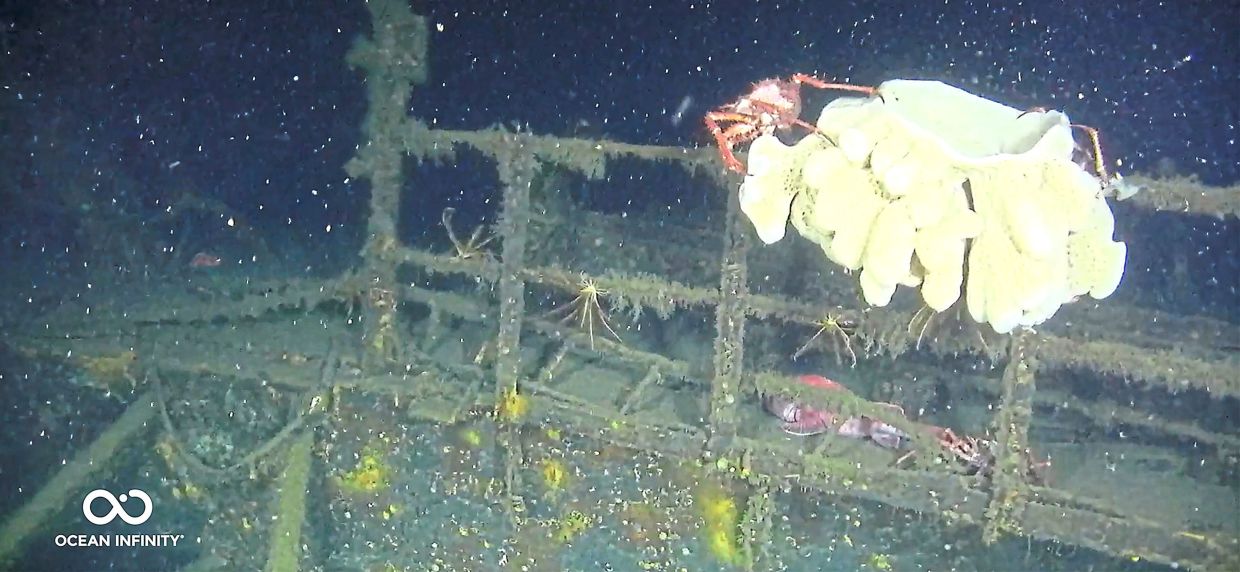
Three days later, more robots captured images of the wreck.
Encrusted with decades of marine growth, sponges, and crabs, the 95m-long destroyer remained remarkably intact and upright on the seafloor.
“This level of preservation is exceptional for a vessel of its age and makes it potentially one of the best-preserved examples of a US Navy ‘four-piper’ destroyer known to exist,” Maria Brown, superintendent of both the Cordell Bank and Greater Farallones national marine sanctuaries, said in a statement.
The discovery, made during a technology demonstration, showcases the power of modern robotic ocean exploration.
Ocean Infinity, the marine robotics firm that operated the drones, owns the world’s largest fleet of autonomous underwater vehicles, used to map the seafloor.
This technology is invaluable not only for archaeological research but also for planning offshore construction projects such as wind farms, pipelines, and undersea cables.
Ocean Infinity’s robotic fleets have previously assisted marine archaeologists in locating other historic wrecks.
In 2020, they helped find the wreck of the USS Nevada. In 2022, the company contributed to the rediscovery of the Endurance, which sank during Ernest Shackleton’s 1915 expedition.
“We’re in the midst of, I think, a radical change in ocean discovery,” said Jim Delgado, senior vice-president at SEARCH, Inc, a maritime archaeology firm involved in the DD-224 find.
Delgado began searching for the USS Stewart a decade ago as director of maritime heritage for the National Oceanic and Atmospheric Administration (NOAA), which oversees over 1.6 million square kilometres of underwater parks in the United States.
The destroyer’s story has long intrigued marine archaeologists due to its unusual history. Sunk and abandoned off Java in 1942, DD-224 was later raised by Japanese forces, who used it to escort their naval convoys. Allied pilots were surprised to spot one of their own ships behind enemy lines.
After the war, the US Navy recommissioned the ship, brought it back to California, and ceremonially sank it in target practice on May 24, 1946.
The ship endured two hours of fire before sinking, ending its decades-long journey.
“The history of that ship was exceptionally well documented,” said Russ Matthews, president of the Air/Sea Heritage Foundation, who was part of the discovery team.
“The only part missing was, what does it look like today?”
Matthews spent years tracking the ship’s last known coordinates.
A breakthrough came when his colleague, Lonnie Schorer, unearthed a 1946 US Navy communiqué that narrowed the search to what is now the Cordell Bank sanctuary.
However, none of the NOAA vessels passing through the area found the ship, and Matthews’ team couldn’t secure funding for their own expedition.
Things changed in April this year when Matthews met Andy Sherrell, director of maritime operations at Ocean Infinity.
The company needed a large area to test its autonomous drones and offered to help locate the destroyer.
Matthews had recently obtained coordinates from the tugboat that had towed DD-224 to its resting place. With NOAA’s permission, Ocean Infinity set out to the site.
Underwater mapping typically takes weeks, especially in a 130-square-kilometre search area like this one. But the Ocean Infinity drones found the ship within hours.
“We covered it very quickly, and in high resolution,” Sherrell noted.
The terabytes of data collected now make up the most detailed map of that part of the Cordell Bank sanctuary.
This data also closes the eight-decade saga of a ship whose significance extended far beyond the steel corroding on the ocean floor.
After DD-224’s recovery during World War II, the American crew who brought the ship home preferred to call it RAMP-224, an acronym for “Recovered Allied Military Personnel,” used for liberated prisoners of war.
“This ship, in its own way, was humanised by the navy,” Delgado said. “People pour so much into ships — and we have since the beginning of time. They represent us.” — ©2024 The New York Times Company
Already a subscriber? Log in
Get 20% OFF The Star Digital Access
Cancel anytime. Ad-free. Unlimited access with perks.
