



ON a recent morning in Gouda, a small city in the Netherlands, hundreds of wheels of yellow cheese lay out in rows on the cobblestones of the town square, a backdrop to the city’s weekly cheese market, which dates to the Middle Ages.
Ad van Kluijve, a farmer dressed in blue work shirt, red bandanna, blue cap and wooden clogs, haggled with a buyer over the price of his latest batch of jong belegen, famous for its mild caramel flavour. In the rest of the world, it is one of many cheeses named after the city in which it is traded.
The haggling is largely a performance for tourists as the actual price negotiations take place elsewhere.
The cheese industry in the region is very real, though, accounting for about 60% of the national cheese production, with an export value of US$1.7bil annually, according to ZuivelNL, which represents the Dutch dairy sector.
But it’s unlikely the cheese market will be here in 50 to 100 years because of a confluence of a few factors, experts say: the city, built on peat marsh, has always been vulnerable to sinking, and that risk is now greater because increased rainfall and rising sea levels – a consequence of climate change – threaten to flood the river delta in which it sits.
“We’re not in good shape,” said Gilles Erkens, a professor at Utrecht University and the head of a team focused on land subsidence at Deltares, a non-profit research institute. “It’s a very worrisome situation.”
Jan Rotmans, a professor at Erasmus University Rotterdam and author of Embracing Chaos: How to Deal With a World in Crisis? has made projections of rising sea levels in the region and predicts that the Green Heart, as the Gouda region is known, will be inundated, or built on floating cities, by century’s end.
“I wouldn’t expect much cheese from Gouda anymore in 100 years,” he said. “If the land turns into water and the cows disappear, the cheese will have to come from the eastern part of the country, and it won’t be Gouda anymore.”
Much of the Netherlands was built centuries ago on peat marsh, a spongy soil that compresses easily.
In Gouda, it is constantly subsiding under the weight of the city, said Michel Klijmij-van der Laan, a city alderman who focuses on sustainability and subsidence issues.
The oldest part of the city centre subsides at a rate of about 3-6mm each year, he said, and newer parts sink by 1-2cm a year.
“We have until 2040 or 2050 to come up with a new plan,” Klijmij-van der Laan said. “We have to find new solutions, because the solutions we’ve always used are not future proof. Just continuing to pump water out isn’t practical, because eventually it will become too expensive.”
In an effort to tackle the problem, Gouda, which has about 75,000 residents, is spending more than US$22mil a year on water mitigation efforts, including daily maintenance, repairs, system upgrades and pipe replacements.
Klijmij-van der Laan said that amount is expected to increase exponentially.
He helped establish a national knowledge centre in a building on the market square, where policymakers, scientists, architects and other experts discuss possible solutions.
The municipality also recently approved a short-term plan dubbed “Gouda Firm City” to manage the water levels in the city centre by damming a local canal, the Turfmarkt, on both sides, and pumping water out into local rivers. This is expected to gradually lower the water level by 25cm.
But Rotmans said the country needed to develop a radical new approach within 10 years, adding that he was frustrated by the lack of urgency given that the region is low-lying and has such a high density of people, cows and industry.
“There is no other delta area that is so well protected, but also which is so vulnerable,” he said. “That annoys me – that lack of urgency among climate engineers.”
“It would not surprise me if in the next 20 years there will be some kind of disaster. Maybe only then people will respond,” he added.
Klijmij-van der Laan said residents don’t always appreciate the urgency of the problem because they’ve gotten used to it.
“If you live here, it is just a fact of life,” he said. “You raise your garden, level the street, accept that property taxes are higher than the rest of the Netherlands.”
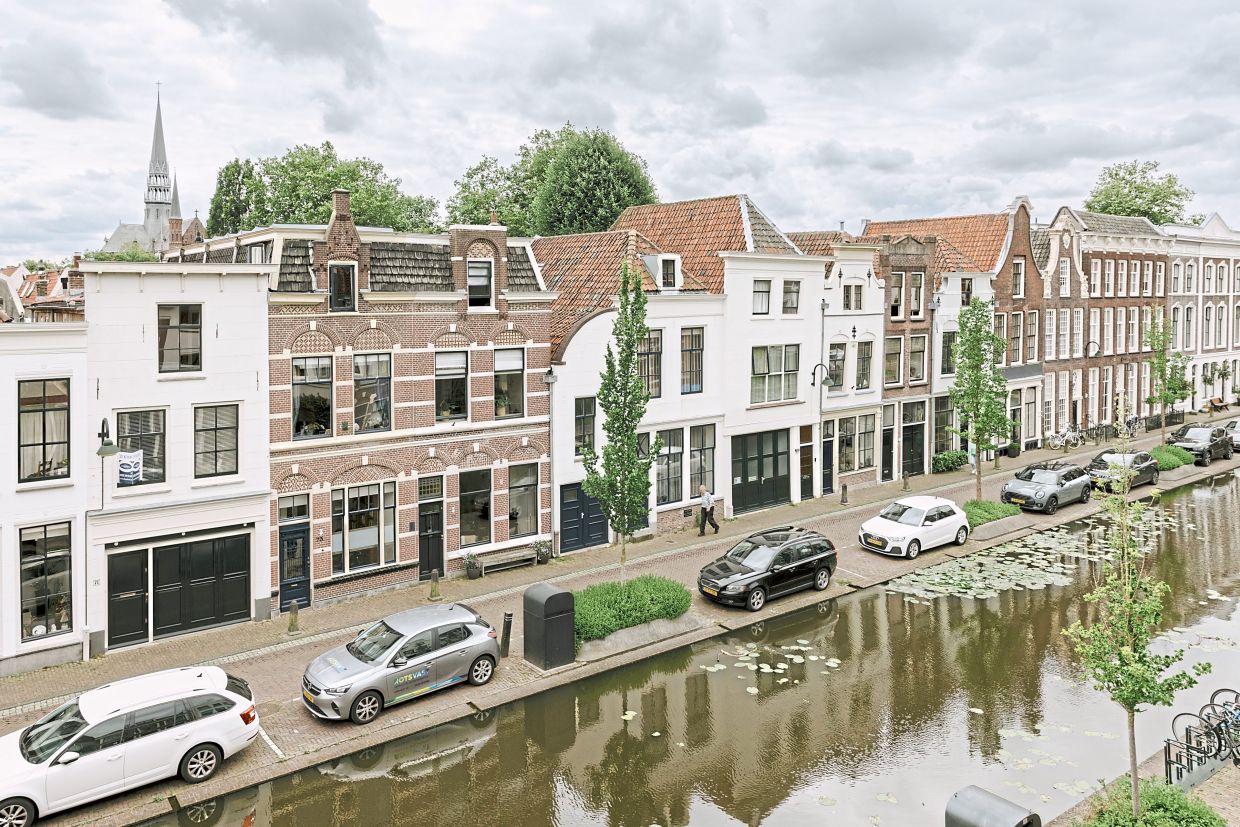
Evidence of water creep is everywhere in Gouda. On the Turfmarkt, the water rises to just inches from the top of the canal walls. The water lilies, blooming on the lily pads that dot the water, are just about at street level.
Buildings in the old centre face frequent flooding, which suffuses the quaint alleyways with sewage water. Cellars regularly become inundated and must be pumped out, while mildew creeps into walls and cracks their plaster surfaces.
Some of the oldest houses have no foundations, and more than 1,000 are built on wood piles, which can rot when there is too much ground moisture, Klijmij-van der Laan said.
“There are many houses in the oldest part of town that have their feet, so to say, in the water,” Erkens said. “A lot of the cellars are filling with water regularly.”
On a recent sunny afternoon, though, few residents seemed concerned about the future. Dutch water engineers are famous for their water management skills because they have built a whole country on marshland, using an intricate system of dams, dikes and canals.
“The houses sink a little every year, but in the end it’s just millimetres, so you don’t notice it,” said Marco van der Horst, owner of DG van Vreumingen, a 187-year old tobacco shop on the corner of the town square.
“We have to take measures, but it’s not like we’re going to drown here in a couple of years.
“In the Netherlands, we have always done water management, and we always will.”
But Rotmans said it was unwise to imagine that the water problem can be managed forever.
“If you look 50 or 100 years ahead at the sea level and the land, it becomes unbelievably costly to manage the water level,” he said. — ©2024 The New York Times Company
