



“DO you know what your children are doing on the Internet?”
Parents are often asked this question when it comes to protecting their children from sexual content and predators online, but there exists another peril that isn’t brought up as much – the pervasive presence of drug dealers in virtual spaces.
Sales of these illicit substances are no longer like the shady dealings in dark alleys, as we used to envision them, or only on the dark web.
Online platforms, especially social media apps, have now birthed a new online marketplace of drugs, open to anyone who has online access, including children.
This means all stakeholders such as the authorities and parents need to play a more proactive role in protecting children from being exposed to drug sales on the Internet.
It was reported that in October last year, authorities blocked access to 1,675 websites selling illegal pharmaceutical products and confiscated over RM500,000 worth of products.
But the Malaysian government needs to be firmer in cracking down on online platforms where sales of drugs may exist, says Fong Choong Fook, executive chairman of cybersecurity consultancy LGMS Bhd.
One of the biggest social media platforms out there, Facebook, is one such place where these illicit dealings are still happening unabated, he says.
“It is still quite rampant on Facebook. You can still find all these drugs there.
“You can even buy ecstasy, pills and liquids on Facebook. And apparently, Facebook does not have a very good mechanism for blocking all these kinds of advertisements.
“So I think the government needs to be more stern in terms of enforcement, to control social media platforms like Facebook or Instagram to prevent the sale of drugs,” Fong says.
Strong regulatory practices from the authorities are crucial when it comes to preventing the sale of illicit drugs online, but parents also play an important role in educating their children on the dangers of drugs.
“It’s never too young to learn the dangers of drugs, so it has to come from education. There isn’t anything else more effective,” Fong adds.
While she agrees that education will provide a good foundation for the children, Parent Action Group for Education (Page) chairman Datin Noor Azimah Abdul says parents should also stay vigilant and observe their children’s behaviour for any sudden, negative changes.
Parents would be justified to investigate their children’s online activities further if their children were to display such behavioural changes, she says.
“Once there’s some proof, make the first move to report to the authorities. Such activity is akin to the dealing of narcotics which carries the death penalty,” she says.
Aside from monitoring their online activities, International Islamic University Malaysia computer science expert Prof Emeritus Datuk Tengku Mohd Tengku Sembok says parents should keep an eye on financial matters too.
“Keeping track of bank statements and transactions on digital payment platforms enables parents to detect any suspicious activity and address it promptly,” he says.
Children should also be educated not only on the dangers of drugs but also on ethical and critical thinking skills to recognise trustworthy information from potential scams, and unsafe websites and to empower them to say no to offers of drugs online, he adds.
Open communication between parents and children is another facet of the multipronged approach required to protect children from online drug sellers.
“(Open communication) lies at the heart of a robust defence against the abuse of drugs. Being tech-savvy parents alone is not enough to combat drug abuse.
“By fostering an environment of trust, parents can communicate the risks associated with drug use by emphasising health consequences, legal ramifications and the impact on future opportunities.
“Parents can open discussion, share knowledge and give advice on this subject to their children. Prevention is better than cure,” Tengku Mohd says.
He also suggests that parents can make use of various technology and parental control tools that can help prevent children from accessing and purchasing drugs online.
Among the examples are Net Nanny which provides content filtering, app blocking and time management features, Oustudio which allows parents to monitor and control their child’s online activity including social media use, Norton Family which offers web monitoring, time supervision and location tracking, Google Family Link which helps parents set digital ground rules, manage app usage and track the location of their child’s device and mSpy which allows parents to monitor text messages, calls and online activities on a child’s device. — By GERALDINE TONG
ALSO READ: Fentanyl: Fatal fandango
DEA: It's a one-stop shop
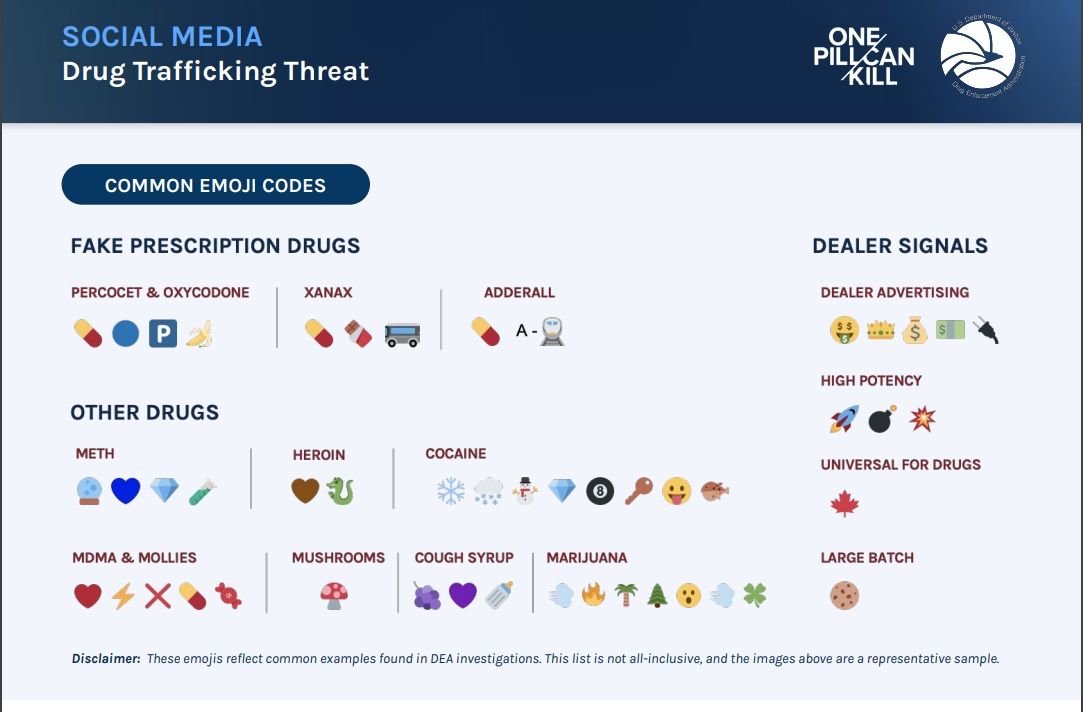
SMARTPHONES can now be a “one-stop shop” to market, sell, buy, and deliver deadly, fake prescription pills and other dangerous drugs, according to the United States’ Drug Enforcement Administration (DEA).
In just three steps, deadly drugs can be purchased and delivered to your home just like any other good or service, the DEA says in its #OnePillCanKill campaign:
1: Advertise
Drug traffickers advertise on social media platforms like Facebook, Instagram, Snapchat, TikTok, X (formerly Twitter) and YouTube. These advertisements are in disappearing, 24-hour stories and posts, which are promptly posted and removed. Posts and stories are often accompanied by known code words and emojis designed to evade detection by law enforcement and by the preset algorithms used by social media platforms.
2: Connect
Prospective buyers contact drug traffickers on social media apps – using direct messaging or by commenting on a post. Once contact is made, drug traffickers and potential buyers often move to an encrypted communications app like WhatsApp, Signal, and Telegram.
3: Pay
After a deal is made, drug traffickers request payment using one-click apps. And the drugs will be ready for delivery or pickup.
Global threat
While this modus operandi is prevalent in the US, it can spread globally.
As the DEA highlights, the proliferation of smartphones worldwide, coupled with the growth of social media, have enabled criminal drug networks to abuse the online platforms and apps "to expand their reach, create new markets, and target new clientele".
Directly connecting social media drug sales to overdose deaths in the US, the DEA warns that while social media drug trafficking impacts all age groups, adolescents and young adults are "particularly susceptible given their high-rates of social media usage".
Source: DEA
Already a subscriber? Log in
Get 20% OFF The Star Digital Access
Cancel anytime. Ad-free. Unlimited access with perks.

