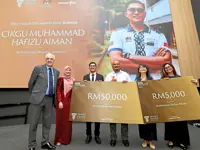
EDUCATION should not stop simply because a community is undergoing change.
That belief has shaped Muhammad Hafizu Aiman Jusoh’s work with the Orang Asli Temiar community in Pos Pulat, Kelantan.
The teacher created a 24-hour learning space to help students continue learning independently as residents prepared to relocate due to the Nenggiri Dam project.
His efforts have earned him the RISE Educator Award 2026, after winning the hearts of both the public and the judges.
“When our community was going through change, I wanted my students to know that their dreams and opportunities did not have to change with it.
“This recognition belongs to my students, their families and the community, who have shown that learning can continue and new possibilities can emerge,” he told StarEdu.
Making room for learning
Muhammad Hafizu Aiman, who teaches at SK Pulat, developed “Rumah Belajar Tanpa Loceng” as a heutagogy-based community learning model that combined science, technology, engineering and mathematics (STEM), artificial intelligence (AI) and digital skills with the Temiar language and heritage.
Among its initiatives were Kampung AI dan Digital, the Digital Temiar Dictionary and AI Storybook Mathematics, which exposed learners to digital and AI tools while keeping them connected to their cultural roots.
The project, which began in 2024, benefited 40 primary school students and 25 adult learners aged between 18 and 73.
The idea came to him during his time as a school warden, when he noticed that the community had few activities to engage in during the evenings.
At the same time, work related to the Nenggiri Dam project had temporarily come to a halt as residents prepared to relocate.
Rather than wait for the move, Muhammad Hafizu Aiman created new learning opportunities for the community.
“I had to create a hub for them to learn, and that was where I needed to make it heutagogy, where they learn independently, including during long holidays.
“Even on days without Internet and other access, they can come and study (previously downloaded materials) without limits,” he said.
New challenge
The community has since moved to a new settlement further inland, while the previous area is set to be submerged by the Nenggiri Dam.
The relocation has now brought a new challenge for Muhammad Hafizu Aiman: rebuilding what he had developed for the community in its new home.
“Everything I built will be demolished, and I have to start building again,” he said, adding that the prize money from the award will be used to rebuild his project.
His school headmaster, Mohd Radzi Mat Yaacob, expressed his hope to expand the use of technology to give students greater exposure to digital learning, particularly as those in remote areas continue to face limited Internet access and infrastructure.
“With funding (from the award), we hope to further strengthen the use of AI and other technologies for our students,” he said.
He also encouraged fellow educators to look beyond what their schools can provide and take the initiative to create more opportunities for their students.
“Effort is important. Even if the school cannot provide certain things, as teachers, we can still give more to our students,” he said.
Going the extra mile
The award ceremony, held at Taylor’s University on Sept 12, was attended by Dewan Rakyat Speaker Tan Sri Dr Johari Abdul, Education Minister Datuk Seri Fadhlina Sidek, Taylor’s University president and vice-chancellor Prof Barry Winn and Taylor’s College campus director Josephine Tan.
During his keynote address, Johari said Malaysia needs to invest in its young people because they are the future leadership pipeline.
“This is why I expose students, especially those from rural areas, to Parliament, let them sit in the chamber and observe debates, and make Parliament feel accessible to ordinary young Malaysians,” he said.
Leadership, he added, has to be deliberately cultivated in young people to build their confidence and sense of responsibility.
Meanwhile, Tan said the work of this year’s finalists reflects the many ways educators are responding to the needs of their students and communities.
“What makes these teachers remarkable is not simply what they have achieved. It is the way they have responded to the needs of their students. They have looked beyond examination results and asked what their students need to thrive.
“They have turned challenges into opportunities, limited resources into creative solutions, and classrooms into spaces where students can discover what they are capable of,” she said.
Celebrating impact
RUN by Taylor’s College, the RISE Educator Award 2026 shortlisted Muhammad Hafizu Aiman and four other exceptional teachers for their inspiring work.
The teachers were featured on the award’s webpage for public voting, which garnered more than 39,000 votes.
Muhammad Hafizu Aiman emerged as the winner, bagging RM5,000, while his school received RM50,000 in sponsorship to enhance its facilities and infrastructure and support a conducive environment for quality education.
The other four finalists were Dr Zul Faizuddin Osman from SK Sungai Rual, Kelantan; Mohamad Safuan Rozak from SK Desa Jaya, Pahang; Veronica Francis from SMK St Bernadette’s Convent, Perak; and Teh Zhen Kiat from SJK(C) Sungai Buloh, Selangor.
They each received RM1,000, with an additional RM10,000 allocated to their schools.
This year’s winner and finalists were selected based on public votes (25% weightage) and a panel assessment (75% weightage).
The panel comprised Tan, Education Ministry Educational Resources and Technology Division deputy director Fadzliaton Zainudin, Edvolution Enterprise chief executive officer Melissa Tanya Gomes and RISE Educator of the Year 2025 Stefanus Lucas.
Since its inception in 2021, the RISE Educator Award has celebrated 23 educators and channelled more than RM290,000 in grants and development support to schools across the country.