Community service a rewarding profession for social worker
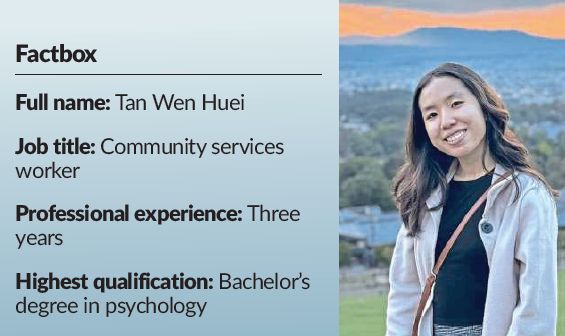
SERVING those in need is at the heart of Tan Wen Huei’s work.
After graduation, she considered several career paths but ultimately found herself drawn to community work.
As an introvert, stepping into the community was challenging at first.
Yet, her passion for serving others became a turning point, pushing her beyond her comfort zone and shaping her into someone who could confidently lend a helping hand.
“I enjoy bringing hope to people; it’s something I’ve carried in my heart for a long time,” the 25-year-old said.
What does a typical workday really look like?
Tan: It’s a mix of administrative work and hands-on work in the community. On some days, I manage case files, follow up with clients and liaise with community members, stakeholders and donors.
Every one to two weeks, I buy groceries for the food parcels that we hand out to clients. Then, we conduct home visits to check in with them and follow up on their situations. This helps us ensure we provide the most suitable assistance based on each client’s needs.
What skills or mindset matter more than grades?
Tan: Attitude and heart matter the most. It’s about having the willingness to stay humble and keep learning every day. No matter how long you’ve been in the field, there are always countless things to learn.
Meeting new people, observing their behaviour and body language, and understanding the reasons they need help all become stepping stones for growth. This can’t happen if your heart isn’t in the right place.
Communication skills also play a huge role in this career. We interact with a wide variety of people, from locals to refugees, and it’s crucial that the guidance and support we provide are clearly understood. Otherwise, well-intentioned help could be misinterpreted as false hope.
What is one common misconception about this job?
Tan: Some people assume that “you help everyone and everything under the sun”. We do our very best to help, but we also have to exercise discernment and wisdom.
Not every situation is straightforward. Sometimes, clients may take resources for granted or their needs may be more complex than they first appear. That’s why we carefully assess each case before offering support, ensuring our help is both effective and sustainable.
Resources are limited, especially for refugees. So even with the best intentions, there are boundaries to what we can provide. The best we can do is provide basic necessities to ease their financial burden and connect them with the organisations that can offer the help they need.
This can be challenging because people may not understand why certain assistance cannot be extended. For us, it requires patience, careful judgement and clear communication to ensure our resources reach those who need them most without creating false hope.
What is the most challenging and most rewarding part of the work?
Tan: The most challenging part of this job is working directly with the community. Every day, people come to us with different needs and expectations, and it’s crucial that we communicate clearly about the support we can provide. Otherwise, they might take our words the wrong way.
Beyond that, it can be difficult to witness the extent of need in the community. Seeing so many people in challenging situations is a sad reality.
At the same time, the most rewarding part of this job is being a blessing to the community, no matter how small the contribution may be.
What advice would you give to students considering this path?
Tan: If you never try, you’ll never know. Be patient and have a genuine love for people.
Sometimes, the skills you think you have – or don’t have – can make a meaningful difference in someone else’s life. Stay humble, and treat every experience as part of the learning process.
When your heart is set on helping the community, challenges become easier to overcome, knowing that you can bring joy to others. So, be brave and remember that every community needs a light – even a small one can be a blessing in someone’s life.
*Individuals are featured in their personal capacity. Views expressed do not represent any organisation.
Evangelene, 18, a student in Selangor, is a participant of the BRATs Young Journalist Programme run by The Star’s Newspaper-in-Education (Star-NiE) team. This feature is part of a series highlighting young working adults who share insights into their jobs and offer practical tips on thriving in the workplace. For updates on the BRATs programme, follow @starbrats on Instagram.
With the theme of the article in mind, carry out the following English language activities.
1 Are you more of an extrovert or an introvert? What is one area you would like to improve, and how could you work on it? Discuss with your classmates.
2 Imagine a scenario where a friend needs your help, but there are limits to what you can do. How would you explain this to your friend so they understand how you can support them without giving them false hope? Role-play the scenario in class.
The Star’s Newspaper-in-Education (Star-NiE) programme promotes English language learning in primary and secondary schools nationwide. For Star-NiE enquiries, email starnie@thestar.com.my.