
WHILE schools provide counselling services, stakeholders are calling for greater access to professional psychologists who can offer specialised assessment, early intervention and support for students with more complex needs.
They say district-based school psychology teams serving clusters of schools could complement existing counsellors.
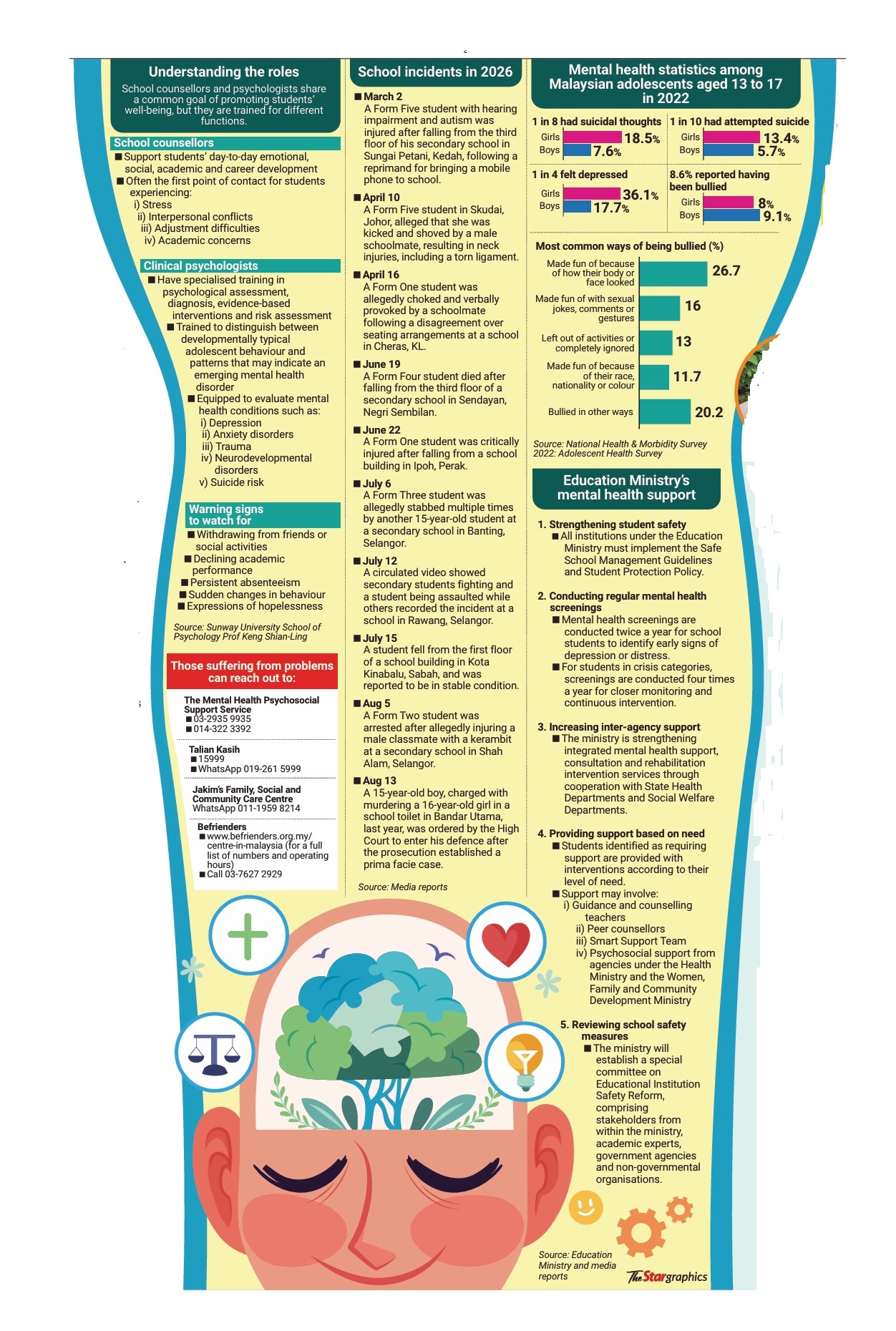
Their calls come amid recent incidents involving school-aged children – from falls and bullying to serious acts of violence (see infographic) – raising concerns over whether schools have adequate systems to identify vulnerable students early and provide timely mental health support.
Prof Keng Shian-Ling, of Sunway University School of Psychology, said the mental health needs of young people have become increasingly complex.

“Counsellors today are managing not only academic and career guidance, but also concerns related to anxiety, depression, self-harm, bullying, family conflict, trauma, cyberbullying and, in some cases, suicide risk.
“It is therefore unrealistic to expect school counsellors alone to meet all these needs,” she told StarEdu.
National Union of the Teaching Profession secretary-general Fouzi Singon said many school counsellors already shoulder administrative responsibilities and are frequently assigned relief teaching duties.
“This leaves them with less time for counselling, preventive programmes and early intervention,” he said.
Agreeing, Malaysian Mental Health Association president Prof Datuk Dr Andrew Mohanraj said having one counsellor for hundreds of students limits opportunities for intensive psychological assessment or long-term intervention.
Sharing the load
Prof Andrew suggested establishing district-based school psychology teams that serve clusters of schools, rather than placing one psychologist in every school.
“Given current manpower shortages and financial realities, assigning one psychologist to every school is unlikely in the immediate future.
“Perhaps one psychologist could support 10 to 20 schools, depending on enrolment and geographical accessibility,” he said.
Prof Keng said this approach has been implemented in many education systems internationally and allows specialist expertise to be shared more efficiently.
Early psychological assessment, she added, is important because mental health problems often develop gradually rather than appearing suddenly.
“Identifying concerns early allows schools and families to intervene before difficulties escalate into crises such as repeated self-harm, aggressive behaviour, school refusal or long-term disengagement from studies,” she said.
However, both Prof Andrew and Prof Keng cautioned that psychologists should complement, rather than replace, existing school counsellors.
“School counsellors are often the first to notice that a student is struggling.
“Meanwhile, psychologists provide more specialised assessment and intervention when concerns exceed the scope of routine counselling,” Prof Keng explained.
She, however, stressed that no assessment can predict every tragic event with certainty.
“The goal is not prediction but identifying students who may benefit from additional support and intervention as early as possible,” she said.
Broader role
Beyond supporting students experiencing mental health difficulties, school psychologists can also play other roles.
Prof Keng said they could advise schools on developing positive school climates, strengthen bullying prevention initiatives, train teachers to recognise early warning signs of emotional distress, support crisis response following traumatic incidents and help design well-being programmes.
“Psychologists can use data to evaluate whether school well-being initiatives are improving student outcomes, allowing schools to invest in programmes that are supported by evidence rather than intuition alone,” she added.
In many ways, psychologists can help schools move from responding only when problems arise towards building systems that promote resilience and psychological well-being among all students, she said.
Addressing the barriers
Prof Keng highlighted several barriers that need to be addressed before psychological services can be effectively integrated into schools, including workforce capacity, funding, mental health stigma and coordination between services.
“Malaysia has relatively few registered clinical psychologists compared to population needs, making large-scale deployment challenging.
“Secondly, sustainable psychological services require investment not only in personnel but also in clinical supervision, professional development and service evaluation,” she said.
Stigma, she added, could also prevent some students and families from seeking psychological support if they fear being labelled or misunderstood.
At the system level, effective school mental health support also requires clear referral pathways between schools, healthcare providers and community services, Prof Keng said.
“Without good coordination, students identified as needing specialist care may face delays in receiving appropriate treatment,” she said.
Addressing these barriers, she noted, requires coordinated policy planning rather than relying on individual schools to develop services independently.
Building a system
Fouzi suggested that psychologists assigned to schools should work closely with the Health Ministry and public hospitals to establish a seamless referral and treatment pathway for students requiring specialised mental health care.
“Collaborating with clinical psychologists from government hospitals would strengthen early detection and provide expert intervention for high-risk students, while allowing teachers and counsellors to perform their respective roles more effectively,” he said.

Under this model, he added, school counsellors should be able to refer students displaying serious emotional, behavioural or psychological concerns directly to educational or clinical psychologists.
“Where necessary, psychologists should facilitate referrals to the Health Ministry’s hospitals and specialist mental health services for comprehensive assessment, diagnosis and treatment,” he said.
Teens weigh in

"Schools should have access to psychologists who can diagnose and treat students struggling with complex, long-term conditions like depression, self-harm and aggression before it is too late.
However, there is still a stigma in schools that seeking mental health support means you are vulnerable or weak. To address this, schools should normalise reflection and open conversation about feelings and concerns.
Sharing sessions and programmes like Mental Health awareness Week could help students better understand their emotions and recognise that mental health issues are nothing to be ashamed of. Students need to know that it is okay to seek help, and that doing so is an important choice for their personal well-being."
Leticia Liew En Qi, 16

"I have never visited the counselling department at my school, although I know a number of friends who visit it
regularly for support.
It is important for schools to teach students that taking care of their mental well-being should not be seen as
something only for those who are struggling, but as a form of self-care that everyone can practise when needed. My friends’ experiences clearly emphasise how crucial accessible support is for students’ overall well-being.
As school counsellors handle matters ranging from career guidance to mental health support, it is logical
to integrate qualified psychologists into schools, giving students greater access to specialised care. a
psychologist’s clinical training would allow them to assess and support students with more severe cases, while allowing counsellors to focus on their core counselling responsibilities."
Swastik Ram, 17