FOR Malaysia to meet workforce demands in sectors such as semiconductors, renewable energy and biotechnology, it is not enough to increase student enrolment in science, technology, engineering and mathematics (STEM) subjects alone.
Instead, schools should step up enrolment in STEM Package A pure science subjects, namely, Physics, Biology, Chemistry and Additional Mathematics, say experts.
Citing Education Ministry data showing STEM enrolment rose to 50.83% in 2024 from 41.84% in 2019, National STEM Association president and founder Emerita Prof Datuk Dr Noraini Idris said the headline figure does not necessarily reflect growth in pure science participation.
She noted that while enrolment figures use a broad definition of STEM subjects, the proportion of students taking the full combination of Physics, Chemistry and Biology remains much lower.

“Pure science enrolment is closer to 19% by some academic estimates.
“This is the cohort from which our future engineers, medical researchers and physical scientists are drawn, and it is far too narrow a base for an aspiring high-income, technology-driven economy,” she said.
As part of efforts to strengthen the national STEM pipeline, the Education Ministry, in a parliamentary written reply dated Nov 6 last year, said all secondary schools are required to offer at least one STEM Package A class starting in 2025.
According to Prof Noraini, who is also Universiti Malaya (UM) STEM Centre adviser and honorary professor, a single STEM Package A class in a large school does not automatically translate into universal opportunity.
“In some schools, demand may exceed available places, which means students who are genuinely interested in pursuing science could still miss out due to capacity constraints,” she said.
Resource gaps
Prof Noraini also identified three major bottlenecks that could hinder effective implementation: teacher shortages, unequal infrastructure and student selection processes (see infographic).
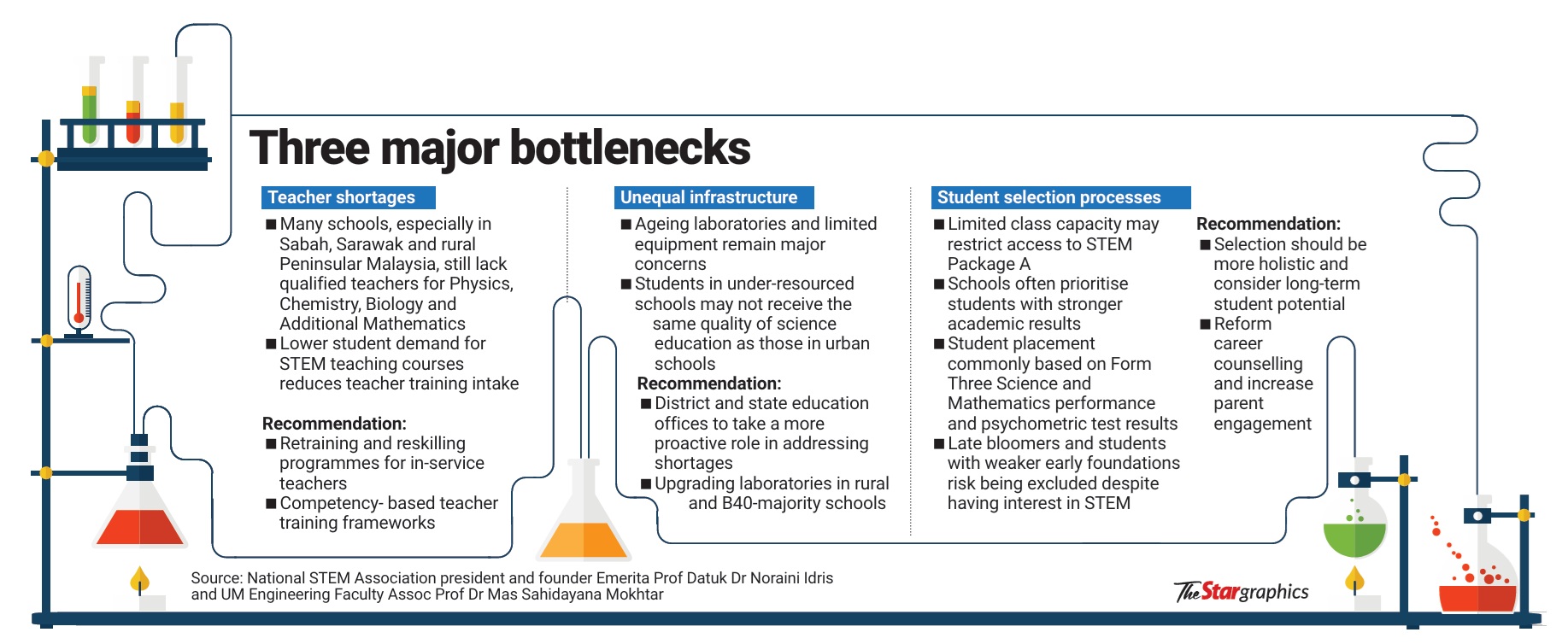
“Many schools - especially in Sabah, Sarawak and rural parts of Peninsular Malaysia - still lack sufficient option-trained teachers in all four Package A subjects,” she said, adding that a child taking Physics in a school with an ageing lab is not receiving the same quality of education as one in a well-resourced urban school.
UM Engineering Faculty Assoc Prof Dr Mas Sahidayana Mokhtar, who is also the varsity’s STEM Centre director, said the teacher shortage reflects a wider cycle affecting teacher training and STEM demand.
“This is essentially a chicken-and-egg issue,” she said, explaining that higher education institutions often prioritise teacher training intake based on student demand.
“When there is lower demand for Physics, Chemistry, Biology and Additional Mathematics teachers, intake is shifted towards courses with larger student populations,” she said.
She added that teacher training programmes should be expanded to include retraining and reskilling opportunities for in-service teachers to address shortages in pure science subjects.
“In addition, it is timely to implement a systematic, competency-based teacher training framework to ensure teachers’ subject knowledge and pedagogical skills remain current and aligned with evolving educational needs,” she said.

Guidance beyond grades
On student placement, Mas Sahidayana said the process should be reviewed more holistically.
“Admission into STEM Package A classes is often determined by students’ Science and Mathematics performance in Form Three, alongside psychometric test results.
“This approach should take into account not only academic scores, but also what best supports the students’ long-term future,” she said.
Pointing to schools often prioritising students with stronger academic results, Prof Noraini said this creates a quiet form of rationing.
“A late bloomer may find the door closed just as they begin to develop interest,” she said.
Both experts stressed that parents and school counsellors continue to play a major role in shaping students’ decisions.
Mas Sahidayana urged parents not to focus solely on grades when evaluating STEM pathways.
“Do not be overly concerned if students achieve less-than-excellent results in STEM subjects.
“What matters most is the knowledge and skillsets they acquire, which will remain valuable and applicable to their future careers,” she said.
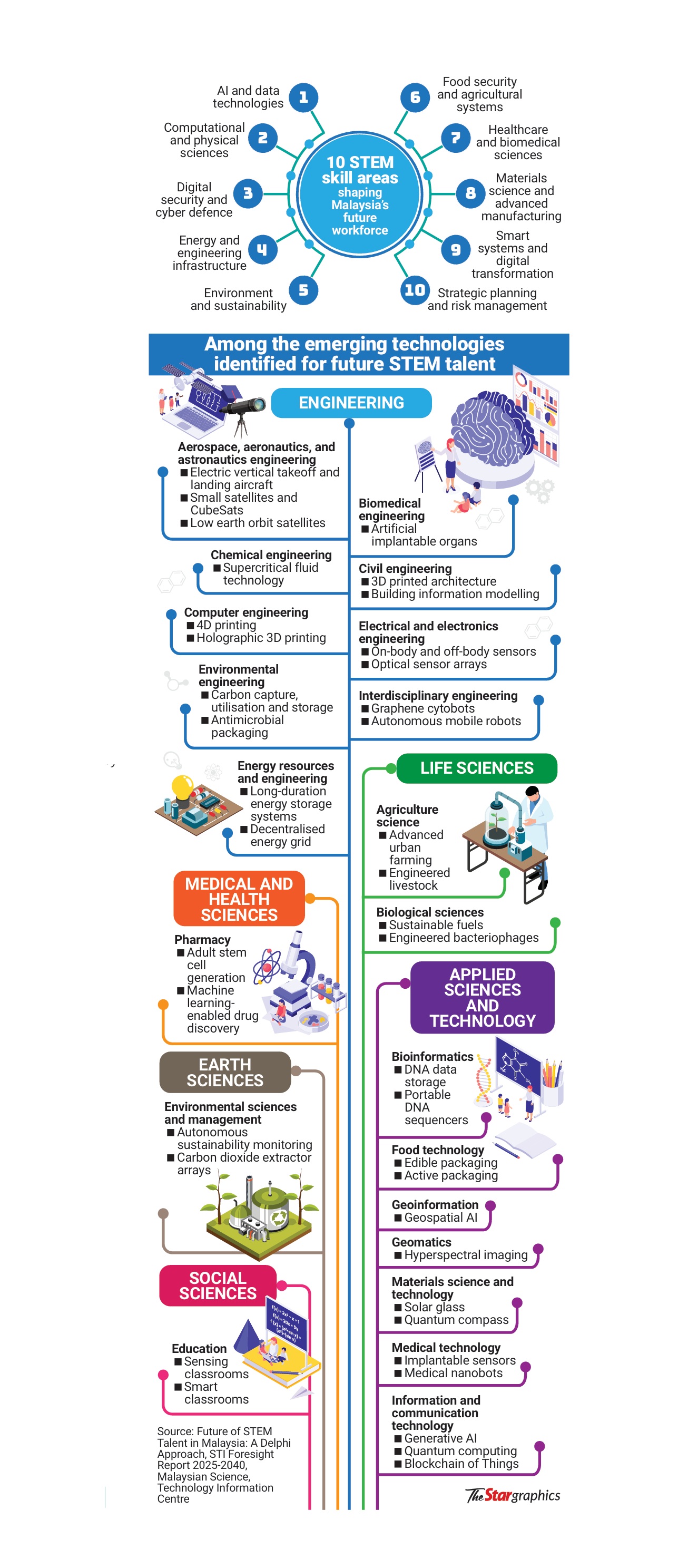
She also called on counsellors to expose students to STEM pathways from Form One and move beyond relying solely on psychometric testing.
“Counsellors must understand how STEM skills are applied in higher education courses to offer meaningful and informed advice.
“The role of counsellors is critically important. They must remain informed about the latest developments and labour market needs,” she said, noting that about 90% of occupations listed in Malaysia’s Critical Occupations List require mathematics-related knowledge or a STEM background.
Prof Noraini added that many parents still associate STEM with a narrow range of professions, such as doctors or engineers, without recognising opportunities in fields including data science, climate technology and advanced manufacturing.
“When a parent who did not study Science themselves is asked to advise a 15-year-old on Physics versus Commerce, the safer answer often wins,” she said.
She also pointed out that career guidance in schools is often under-resourced and treated as a one-off exercise instead of a continuous process beginning in lower secondary.
“A child cannot meaningfully aspire to pursue a pathway they have never been properly exposed to,” she concluded.
Why we chose STEM

Pure science was my first choice in Form Four because I had a clear goal about what I wanted to pursue in the future. I’ve always wanted a career in healthcare. Hence, that interest ultimately influenced my decision in class streaming. Beyond that, I always thought the science stream was the “safer” option as it keeps more doors open for career choices. For those who have not made up their minds on their future careers, the science stream provides flexibility. -Shannon Loong, 17

Choosing the STEM package felt natural to me because growing up, I genuinely enjoyed solving problems with definitive answers. There was always a sense of motivation and satisfaction in figuring things out logically. At the same time, I cannot deny that there were external influences like peer pressure, societal expectations and even subtle pressure from teachers. It’s something along the lines of STEM subjects being essential for sustaining life, but non-STEM subjects are often what we live for. That perspective helped me appreciate education more holistically, instead of viewing STEM as “superior” to other fields. -Hermione Ooi Yung, 22
I was fascinated by how Physics explains the world around us. Even though I eventually transitioned into a different field for my degree (I’m currently a final-year student in English for Global Communication), that STEM foundation has been incredibly valuable. The analytical mindset you gain from a STEM package is a “universal key”, as it prepares you for success even if you don’t end up in a traditional lab or engineering role. -Fiona Flonika Joshman, 23