
High retirement rates are prompting calls for reforms in policy planning, school leadership and career progression
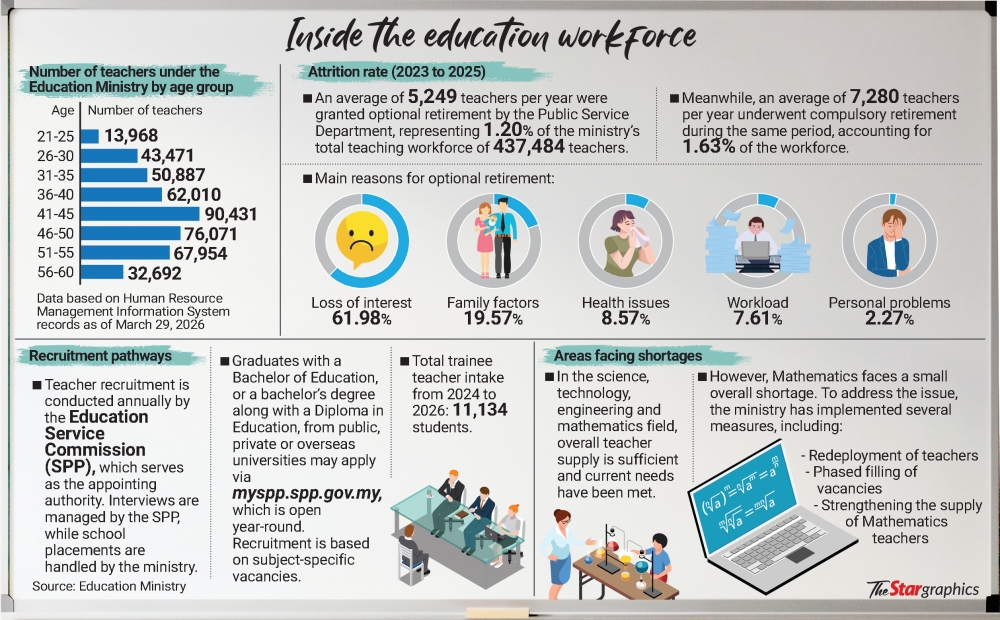
WITH the Education Ministry continuing to see a significant number of educators leaving the profession through early and mandatory retirement each year (see infographic), stakeholders are voicing concerns about the teacher pipeline for the next generation.
A system that includes teachers in the policy planning process, offers support and rewards teachers is crucial to ensuring more educators remain in the profession with passion and purpose, they say.
Pointing to an average of 5,249 teachers taking optional retirement each year, National Union of the Teaching Profession (NUTP) secretary-general Fouzi Singon said while “loss of interest” (see infographic) is often cited as the main reason, the explanation oversimplifies a far more complex and layered reality.
He noted several underlying factors driving experienced educators to leave the system prematurely.
One of the contributing factors, he said, is the management of the education system itself.
“At one point, teachers raised serious concerns about the inefficiencies of the ministry’s software applications, which forced them to stay up late at night just to complete administrative tasks,” he told StarEdu.
ALSO READ: Passion behind the profession
Such systemic weaknesses, Fouzi added, have significantly contributed to teachers’ emotional stress, particularly when previously submitted data would occasionally disappear, forcing them to re-enter information from scratch.
Another growing challenge is the rapid pace of digital transformation within schools.
“The education system today demands a high level of digital competency. Some senior teachers struggle to keep pace with evolving technologies and may feel uncomfortable repeatedly seeking assistance from younger colleagues, which can gradually erode their confidence and influence their decision to leave,” he said.
ALSO READ: Learn first, teach better
Beyond technological shifts, increasing pressure stemming from school management practices may also be contributing to the issue.
“There are concerns regarding leadership styles perceived as overly rigid or autocratic, with insufficient emphasis on empathy and human-centred management.
“Such environments can create unnecessary stress and negatively affect teachers’ morale as well as their emotional well-being,” he said.
He added that the demanding nature of the profession, prolonged workplace stress and widening generational gaps between senior and younger teachers have further discouraged experienced educators from remaining in the profession.
From policy to practice
Despite Malaysia having various policies aimed at supporting educators, Fouzi said the reality on the ground often places teachers under immense pressure to ensure these policies are successfully implemented in classrooms.
“There have been instances where certain policies had to be withdrawn because they proved impractical or ineffective during implementation.
“In this regard, NUTP strongly believes that teachers must be actively involved in the policy planning process. Their input is crucial, and they should be properly briefed with clear and comprehensive guidance on how each policy is meant to be carried out,” he said.

Fouzi further stressed that policy formulation must take into account the diverse realities faced by schools and students nationwide, including differences in locality, cultural background and socio-economic circumstances.
As part of broader reforms, he called for the implementation of a 360-degree evaluation system for school leaders to strengthen accountability and foster healthier school environments.
He also said school leaders should undergo basic counselling training to better support teachers with empathy and understanding
More importantly, Fouzi stressed that the “little Napoleon” culture within school administration must be addressed urgently to create a more respectful and supportive workplace culture for educators.
The “little Napoleon” culture refers to leadership behaviour that is overly authoritarian, rigid and power-driven, often creating unhealthy and intimidating workplace environments.
Strengthening support
Meanwhile, Dr Syar Meeze Mohd Rashid, a special education lecturer at Universiti Kebangsaan Malaysia, said meaningful change must also focus on creating conditions that allow educators to grow sustainably.
“In practice, the level of support is not always well aligned with teachers’ actual needs.
“Some teachers receive strong development opportunities, but others still face constraints such as time limitations, workload, inconsistent access to training and training that is too general to be effectively applied in the classroom,” he said.

According to Syar Meeze, professional development should move beyond one-off training sessions and become more continuous, contextual and closely aligned with the actual challenges teachers face in classrooms.
In the context of inclusive education, for instance, he noted that many studies continue to show gaps in teachers’ knowledge, skills and confidence, highlighting the need for more systematic and targeted support.
At the same time, he said schools and the wider education system must provide teachers with the space to learn and adapt without feeling overwhelmed by excessive workloads.
“Good support is not just about offering courses, but also about providing time, a culture of collaboration, consultation, mentoring, access to resources and recognition of teachers’ efforts to grow,” he said.
Merit-based recognition
Beyond that, Teach For Malaysia chief executive officer Chan Soon Seng believes retaining quality educators also requires clearer career growth opportunities and stronger recognition for high-performing teachers.
“To achieve this, progression should be based on merit rather than solely on years of service.

“We also need to create more fast-track opportunities for high-performing teachers,” he said.
Chan added that greater flexibility within the profession is needed, allowing teachers to leave and later return to the civil service, or even join the profession mid-career.
He also highlighted the importance of following through on plans outlined in the Malaysia Education Blueprint 2026–2035, including strengthening exit policies for consistently underperforming teachers.