
MULTIPLE major reforms have happened over the past three years, improving the lives of teachers and students in Malaysia alike, thanks to the Education Ministry (MoE).
Education Minister Fadhlina Sidek said many new measures have been introduced in this short period to make the education system more dynamic, inclusive and relevant to future challenges.
“We have also witnessed positive achievements in providing more equitable and diverse access to education, including for students in urban, rural, interior, Orang Asli and Peribumi communities, students with special needs, and students from low-income families.
“From the outset, these reforms focused on addressing multidimensional educational disparities, including issues of dropouts, unequal access, infrastructure constraints and long-standing systemic issues,” she said.
She added that various improvements have been carried out within schools, including the construction of new facilities and the provision of more conducive learning spaces.
A targeted approach was used to tailor reforms for each school, she said, taking into account their individual needs and avoiding a one-size-fits-all model.
The result, she noted, is that more schools are showing improvement, while the number of schools requiring intensive intervention is decreasing.
“We often hear claims that the MoE is doing nothing. The truth is that reforms are moving forward every day through work that is not always visible, but whose impact on students and teachers is becoming increasingly clear,” she said.
Among the many successes, she said the most significant was the passing of the Education (Amendment) Bill 2025 in Parliament, which made secondary education compulsory up to Form Five.
“This is a bold policy that demonstrates the country’s commitment to more equitable educational rights,” she added.
Separately, in Bukit Mertajam on Dec 14, Fadhlina announced that the MoE had decided to abolish the MoE Malaysia Training Management System (SPLKPM) to reduce teachers’ workload.
She said the system was often a topic of discussion among teachers, who wanted to ensure they were not bound by its requirements to the point of disrupting the focus on teaching and learning in the classroom.
She added that the abolition of the system was meant to give teachers the space to focus fully on classroom teaching, especially ahead of the implementation of the new school curriculum and the Education Development Plan scheduled for next year.
“We want teachers to be able to concentrate in the classroom, enhance the quality of teaching and learning, and carry out reforms in their teaching practices,” she said at a press conference after the handover ceremony of the SMK Agama Sheikh Tahir Jalaluddin project.
Moving forward, Fadhlina said the 2027 school curriculum, 2026 preschool curriculum and the 2026-2035 Education Blueprint will be important milestones in shaping the direction of the country’s education system for the next decade.
“Everything is arranged based on current realities and future needs, but always anchored to the National Education Philosophy.
“The road to education reform is still long, and we still have a long way to go.
“However, with shared commitment, strong spirit and a clear direction, I am confident that national education will continue to produce a generation of knowledgeable, moral and integrity-minded people.
“We will do better,” she said.
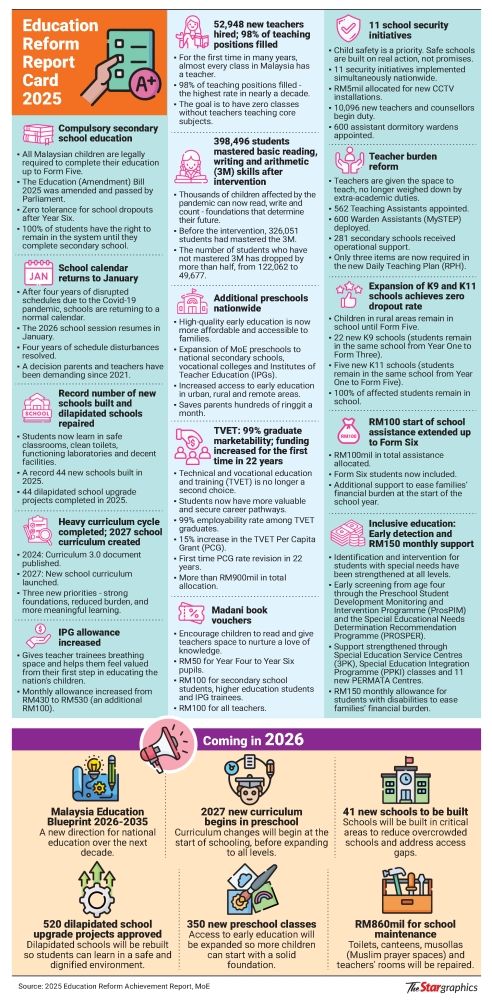
Education Reform Report Card 2025
1) Compulsory secondary school education
> All Malaysian children are legally required to complete their education up to Form Five.
> The Education (Amendment) Bill 2025 was amended and passed by Parliament.
> Zero tolerance for school dropouts after Year Six.
> 100% of students have the right to remain in the system until they complete secondary school.
2) 52,948 new teachers hired; 98% of teaching positions filled
> For the first time in many years, almost every class in Malaysia has a teacher.
> 98% of teaching positions filled - the highest rate in nearly a decade.
> The goal is to have zero classes without teachers teaching core subjects.
3) 11 school security initiatives
> Child safety is a priority. Safe schools are built on real action, not promises.
> 11 security initiatives implemented simultaneously nationwide.
> RM5mil allocated for new CCTV installations.
> 10,096 new teachers and counsellors begin duty.
> 600 assistant dormitory wardens appointed.
4) School calendar returns to January
> After four years of disrupted schedules due to the Covid-19 pandemic, schools are returning to a normal calendar.
> The 2026 school session resumes in January.
> Four years of schedule disturbances resolved.
> A decision parents and teachers have been demanding since 2021.
5) 398,496 students mastered basic reading, writing and arithmetic (3M) skills after intervention
> Thousands of children affected by the pandemic can now read, write and count - foundations that determine their future.
> Before the intervention, 326,051 students had mastered the 3M.
> The number of students who have not mastered 3M has dropped by more than half, from 122,062 to 49,677.
6) Teacher burden reform
> Teachers are given the space to teach, no longer weighed down by extra-academic duties.
> 562 Teaching Assistants appointed.
> 600 Warden Assistants (MySTEP) deployed.
> 281 secondary schools received operational support.
> Only three items are now required in the new Daily Teaching Plan (RPH).
7) Record number of new schools built and dilapidated schools repaired
> Students now learn in safe classrooms, clean toilets, functioning laboratories and decent facilities.
> A record 44 new schools built in 2025.
> 44 dilapidated school upgrade projects completed in 2025.
8) Additional preschools nationwide
> High-quality early education is now more affordable and accessible to families.
> Expansion of MoE preschools to national secondary schools, vocational colleges and Institutes of Teacher Education (IPGs).
> Increased access to early education in urban, rural and remote areas.
> Saves parents hundreds of ringgit a month.
9) Expansion of K9 and K11 schools achieves zero dropout rate
> Children in rural areas remain in school until Form Five.
> 22 new K9 schools (students remain in the same school from Year One to Form Three).
> Five new K11 schools (students remain in the same school from Year One to Form Five).
> 100% of affected students remain in school.
10) Heavy curriculum cycle completed; 2027 school curriculum created
> 2024: Curriculum 3.0 document published.
> 2027: New school curriculum launched.
> Three new priorities - strong foundations, reduced burden, and more meaningful learning.
11) TVET: 99% graduate marketability; funding increased for the first time in 22 years
> Technical and vocational education and training (TVET) is no longer a second choice.
> Students now have more valuable and secure career pathways.
> 99% employability rate among TVET graduates.
> 15% increase in the TVET Per Capita Grant (PCG).
> First time PCG rate revision in 22 years.
> More than RM900mil in total allocation.
12) RM100 start of school assistance extended up to Form Six
> RM100mil in total assistance allocated.
> Form Six students now included.
> Additional support to ease families’ financial burden at the start of the school year.
13) IPG allowance increased
> Gives teacher trainees breathing space and helps them feel valued from their first step in educating the nation’s children.
> Monthly allowance increased from RM430 to RM530 (an additional RM100).
14) Madani book vouchers
> Encourage children to read and give teachers space to nurture a love of knowledge.
> RM50 for Year Four to Year Six pupils.
> RM100 for secondary school students, higher education students and IPG trainees.
> RM100 for all teachers.
15) Inclusive education: Early detection and RM150 monthly support
> Identification and intervention for students with special needs have been strengthened at all levels.
> Early screening from age four through the Preschool Student Development Monitoring and Intervention Programme (ProsPIM) and the Special Educational Needs Determination Recommendation Programme (PROSPER).
> Support strengthened through Special Education Service Centres (3PK), Special Education Integration Programme (PPKI) classes and 11 new PERMATA Centres.
> RM150 monthly allowance for students with disabilities to ease families’ financial burden.
Coming in 2026
1) Malaysia Education Blueprint 2026-2035
A new direction for national education over the next decade.
2) 2027 new curriculum begins in preschool
Curriculum changes will begin at the start of schooling, before expanding to all levels.
3) 41 new schools to be built
Schools will be built in critical areas to reduce overcrowded schools and address access gaps.
4) 520 dilapidated school upgrade projects approved
Dilapidated schools will be rebuilt so students can learn in a safe and dignified environment.
5) 350 new preschool classes
Access to early education will be expanded so more children can start with a solid foundation.
6) RM860mil for school maintenance
Toilets, canteens, musollas (Muslim prayer spaces) and teachers’ rooms will be repaired.
Source: 2025 Education Reform Achievement Report, MoE