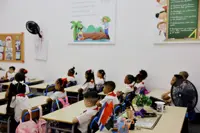
KUALA LUMPUR: Schools are ready and have the capacity to handle the influx of six-year-olds entering Year One, says Fadhlina Sidek (pic).
The Education Minister said that her ministry was fully prepared, with planning based on maximum capacity to ensure no child who registers on time is turned away.
She said that although entry at six was optional, the ministry’s planning was driven by actual demand and conditions on the ground.
“Everyone who applies will be taken into account as a whole, and our preparations are based on maximum capacity,” she said, adding that there would be no situation of “who is rejected and who is allowed in.”
Fadhlina said parents who opt to send their six-year-old straight into Year One do not need to also register them for preschool.
“This is optional. We have made it clear that the government guarantees places, and our preparations are at maximum level. This is a commitment we must honour to the people,” she told the Dewan Rakyat, when winding up debate on the Motion of Thanks for the Royal Address on Thursday (Feb 5).
She said the ministry was planning by age cohort, including measures to help private kindergartens adjust to the new entry option.
The ministry has agreed to allow private kindergartens to enrol three-year-olds, whereas previously they were limited to four- and five-year-olds.
“This allows private kindergartens to continue having at least two cohorts of pupils as before. Our preparations must be aligned when we begin the next school year, taking into account all the age cohorts involved,” she said.
Fadhlina also stressed that the policy does not change the overall number of years children spend in school.
“In terms of the education structure, this policy does not change the length of schooling.
“Whether pupils start Year One at six or seven, they still go through six years of primary and five years of secondary education in line with the existing structure.
“So there is no additional year at primary level and no negative impact on their overall education pathway,” she said.
On facilities, she said the government was increasing access to preschool and expanding classroom capacity to support the more flexible entry.
There are currently 10,514 preschool classes in 6,469 institutions. The government added 150 classes in 2025 and plans to build 350 more in 2026.
“Construction of additional classrooms will continue in line with the country’s financial capacity,” she said.
In total, government preschools can accommodate 110,889 children across preschools under the Education Ministry, Kemas and the National Unity and Integration Department, while private preschools take up part of the enrolment.
“We would like to thank all private kindergartens that have supported the early childhood education agenda and continue to back the policies we have implemented to ensure our children receive the best education,” she said.
Looking ahead to the intake of six-year-olds in 2027, Fadhlina said the ministry would first maximise the use of existing facilities.
“The ministry will optimise existing school infrastructure. Some schools will operate in two sessions, depending on the mapping of Year One registration for the 2027 cohort and the readiness of school facilities,” she said.
She said officials could already anticipate which areas would become hotspots for parents registering their six-year-olds.
“Once registration opens, the mapping will be more precise. Right now, we are in the phase of preparing overall capacity and infrastructure,” she said.
Where suitable, special-purpose rooms in schools will be converted into extra classrooms. In the longer term, new classrooms and related facilities will be added in stages using the Industrial Building System (IBS), based on local needs and conditions.
Fadhlina said that in densely populated areas, including parts of Selangor, the ministry would use registration data to decide which schools can open extra classes for six-year-olds and when nearby schools should be used instead.
“When we choose schools to open additional classes for six-year-olds, the first thing we look at is capacity and how we can optimise existing facilities.
“If a school really cannot take any more pupils, even with IBS, then we will use other nearby schools.
“InsyaAllah, after registration begins, we will have a clearer picture of how to arrange and distribute capacity,” she said.
Lawmakers, including Putrajaya MP Datuk Dr Radzi Jidin and Kapar MP Dr Halimah Ali, had earlier raised concerns about whether already crowded schools would have enough classrooms to cope with the influx of six-year-olds under the new policy.