Malaysian pupils possess a competitive reading literacy level and have solid numeracy skills, the latest Southeast Asia Primary Learning Metrics (SEA-PLM) 2024 results show.
Education director-general Dr Mohd Azam Ahmad said despite learning disruptions pupils faced during the Covid-19 pandemic, they performed better than their peers in the region.
“This cohort spent their Years One and Two of primary education under the movement control order in 2020 to 2021, and had undergone PdPR (home-based teaching and learning) during that time.
“The learning disruptions in this early phase of their schooling are a major factor affecting their mastery of basic skills, and provide an important context for interpreting the SEA-PLM findings more accurately,” he said during the announcement of the results on Dec 5 in Putrajaya.
Narrowing the gender gap
While male students need more specific support in Reading Literacy, he said the results indicate that the gender gap has narrowed.
This positive development, he added, is in line with the aspirations of the Malaysian Education Blueprint 2012-2025.
“Besides reading, girls also did better in mathematics but the gap between the two genders is now at 0.
“When examined according to proficiency level bands, male students showed a larger percentage in Bands 8 and 9 for mathematics, which was 17.4%, compared to female students at 14.1%,” he said.
This, he pointed out, shows that efforts to improve numeracy mastery are becoming more effective, especially for male students.
At the same time, measures are being carried out to enhance the performance of female students so that they can achieve higher performance levels, he said.
Academic resilience
A significant achievement gap can be seen between students of low and high socioeconomic status (SES), and it has widened compared to 2019.
“This is the most dominant equity gap in SEA-PLM 2024, not only in Malaysia, but also at the regional level.
“The difference of 23 score points for Reading Literacy and 26 score points for Mathematics is a clear signal that family background still plays a large role in student achievement,” Mohd Azam pointed out.
The three SES measures that were considered are the highest level of parental education, the type of parental occupation, and information on resources and the number of books at home.
“Thus, this gap indicates that students from low SES families not only face digital constraints, but also resource and study space limitations at home and receive less academic support from parents,” he added.
Despite these challenges, Mohd Azam said our pupils have “high potential for academic resilience”, but this must be ignited with targeted, focused and consistent support from all parties.
Stepping up efforts
A total of 62% of Year Five teachers say they are always enthusiastic and motivated to go to school while 75% of pupils have parents who hope their children will pursue higher education.
The findings will spur the Education Ministry to step up efforts to ensure more students excel, while reducing the percentage of students who fall behind in basic literacy skills, Mohd Azam said.
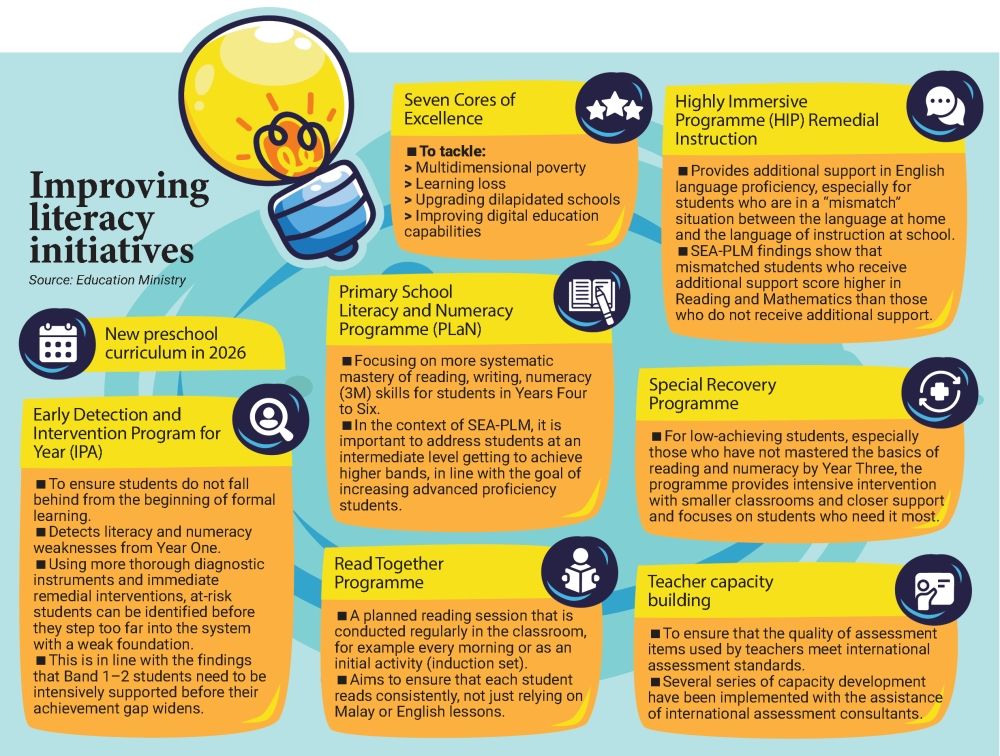
The ministry has taken steps to move forward through various initiatives (see infographics) that have begun to be implemented and are now being strengthened in line with the findings of this study, he said.
Among the initiatives running are the ministry’s Seven Cores of Excellence, the new preschool curriculum that will begin next year, the Primary School Literacy and Numeracy Programme (PLaN), Early Detection and Intervention Programme for Year One (IPA), Read Together Programme, Highly Immersive Programme (HIP) Remedial Instruction, Special Recovery Programme and teacher capacity building.
Mohd Azam also said the SEA-PLM results will be used to identify and share best practices from high-achieving sample schools, and conduct strategic initiatives through brainstorming with the state education departments and district education offices.
“Overall, the findings of SEA-PLM 2024 provide a clear picture that Malaysia not only needs to strive to increase average scores, but also to ensure that every student, regardless of gender, location, or socioeconomic background, receives fair and equitable basic learning opportunities,” he concluded.
WE’RE ON TRACK
Malaysian pupils are doing better compared to some Asean countries in the Southeast Asia Primary Learning Metrics (SEA-PLM) 2024, but more work needs to be done to ensure those who leave primary school do so with literacy and numeracy mastery.
According to the SEA-PLM 2024 results, the nation’s Year Five students scored an average of 314 and 310 in the Reading Literacy and Mathematics domains respectively while across Southeast Asia, the average for Reading Literacy is 300 and Mathematics is 305.
Almost 70% of pupils exceed Band 5 for Reading Literacy while 74% of them exceed Band 5 for Mathematics.
Students need to achieve at least Band 5 and above to ensure they achieve a level of basic literacy proficiency equivalent to Sustainable Development Goals - SDG 4, which is the minimum proficiency level according to international standards.
While Malaysia did relatively well, the results compared to 2019, are lower by five points for each domain.
A total of seven countries took part in 2024 – the Philippines, Cambodia, Laos, Malaysia, Myanmar, Vietnam and Timor-Leste.
SEA-PLM assesses Year Five pupils in four domains – Reading Literacy, Mathematics, Writing and Global Citizenship.
However, only Reading Literacy and Mathematics results, were announced at this time.
A total of 4,379 Year Five pupils from 158 primary schools, including national schools, Chinese schools, Tamil schools, Orang Asli schools, government-aided religious schools and private schools, participated in the assessment.
“The assessment was conducted in four languages Malay, English, Chinese and Tamil, which correspond to the languages of instruction,” said Education director-general Dr Mohd Azam Ahmad.
Additionally, over 70% of students stated that they like reading and show a positive interest in Mathematics.
Overall, girls fared better than boys in reading but the gap between the two narrowed from nine points (2019) to seven (2024).
The findings revealed that 20.2% of male students are still in Bands 2 and 3 compared to 12.8% of female students in those bands, he added.
Mohd Azam said students living in urban areas performed better than students living in rural areas in both domains with the achievement gap between urban and rural students also narrowing.