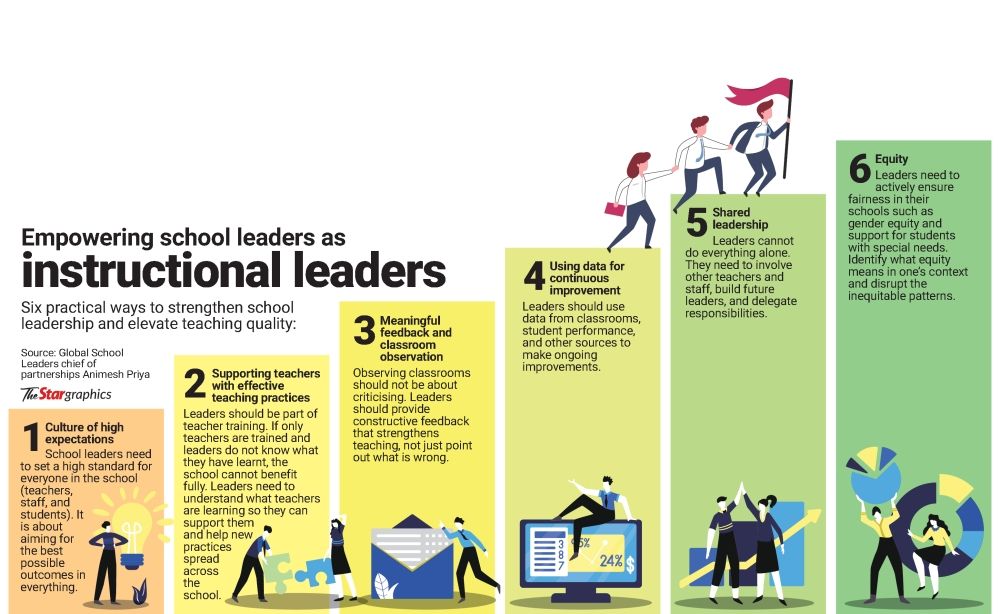
When a company underperforms, its chief executive officer (CEO) is expected to pivot, innovate, and steer the organisation back on course. Yet in education, the role of a school leader is often seen through a narrower lens.
According to Global School Leaders chief of partnerships Animesh Priya, it’s time to shift that mindset.
Global School Leaders is a non-profit organisation that works with partners in low- and middle-school countries to train school leaders, generate evidence about the impact of school leadership training on student outcomes, and create a global network of organisations.
School heads, he said, should be recognised as the CEOs of their institutions - expected to align values, set a clear vision, and deliver measurable results.
“We should identify and trust the right school leaders, appoint them thoughtfully, and hold them accountable for what truly matters - student outcomes,” he said.
However, Animesh - who has worked in the education sector for 15 years - stressed that accountability must not become a “witch hunt”.
“It is not about finger-pointing or demanding reports for the sake of it, but about empowering leaders, supporting them, and treating them with the same dignity afforded to CEOs - because their ‘product’ (successful students) is just as significant,” he added.
Agreeing with Animesh, Dr Jerrylyn Bacroya-Magbuo, dean of the Colleges of Arts, Sciences, and Education at FAITH Colleges in the Philippines, said future leaders must be developed through intentional reflection, real school immersion (not just short-term placements), and strong mentorship.
Actively contributing to policy-level discussions on teacher education curriculum reform in the Philippines, she added that strong leadership begins with strong support as early exposure to managing projects helps identify and prepare the right people.
“Globally, we need to invest less in controlling school leaders, and more on building their capacity,” she said, pointing to how school heads are often left to navigate challenges alone, without targeted development designed specifically for them.
To change this, she stressed the need for training in technology, ethics, and artificial intelligence (AI) literacy - areas that have become indispensable in modern education.
“We need to build ecosystems where leaders are supported by communities, by technology, and by continuous learning.
“When leaders grow, schools grow. And when schools grow, the nation succeeds,” she said.
Meaningful support
While leadership shapes the culture of a school, teachers ultimately determine the day-to-day experiences that drive student success.

They carry a huge workload of managing classrooms, supporting students, dealing with parents, and handling administrative expectations.
Recognising this, Newcastle Australia Institute of Higher Education academic director Peter Duffy stressed that meaningful improvement in education must include better, more intentional support for teachers.
The question, therefore, is not only how to support teachers, but which forms of support truly matter - beyond higher pay or title upgrades.
Of course, pay is the best one, Jerrylyn acknowledged.
“But aside from pay, validation and recognition are incredibly important.
“Even simple gestures or tokens go a long way,” she said.
She added that opportunities for professional growth, such as attending training sessions and conferences, are essential for teachers’ development and sense of connection.
However, financial constraints often make this difficult.
“In the Philippines, it is expensive to send 15 or 20 teachers to conferences overseas. Budgetary support is a real challenge,” she said.
To bridge this gap, her school introduced a grassroots initiative known as the “Bring Your Own Lunch” session - an informal weekly lunch gathering where teachers from various disciplines share best practices, classroom challenges, and solutions.
“It’s a space where teachers can ask questions like, ‘One of your students was crying - what did you do?’ A colleague will share her approach, and senior mentors might reframe it or add guidance,” she explained.

These sessions, she said, foster belonging, affirmation, and peer-driven learning - intangible yet powerful forms of support that uplift morale in ways salary alone cannot.
“When teachers know they belong to a community, that they are supported, and that their colleagues recognise their efforts, it’s incredibly effective.
“It’s something that I believe is effective for teachers, aside from the pay,” Jerrylyn offered.
Career progression
A long-standing issue when it comes to career pathways, is that many education systems lack structured progression routes for teachers and school leaders, Animesh pointed out.
This often results in educators advancing into roles mismatched to their strengths or interests.
Citing the Peter Principle, the idea that individuals rise to their “level of inefficiency”, he said there is often only a single route that pushes teachers into school leadership or district roles, simply because there are no alternative pathways.
This, he argued, limits both effectiveness and job satisfaction.
“Unless we create these separate tracks and make teachers aware of them through mentoring, we’ll continue seeing teachers in leadership roles that may not be their strongest suit,” he explained.
Animesh said that clear competency networks and structured career pathways, supported by good mentorship, are essential to ensuring the right people land in the right roles and thrive.
“By mentoring and guiding teachers early, we can help them make informed decisions about their professional growth - ensuring that the right people are in the right roles, where they can make the most impact,” he concluded.
Note: Animesh, Jerrylyn and Duffy
shared these views during the “Effective School Leadership” panel at the Bett Asia 2025 Leadership Summit on Oct 2. The session examined how principals, department heads, and instructional coaches can drive innovation and sustain improvements in student achievement.