
Kuala Lumpur’s climb to 12th place in the Quacquarelli Symonds (QS) Best Student Cities Rankings 2026 (see infographic) has bolstered Malaysia’s ambitions of becoming a premier global education hub, with education leaders saying the recognition reflects both international confidence and the growing strength of the country’s higher education sector.
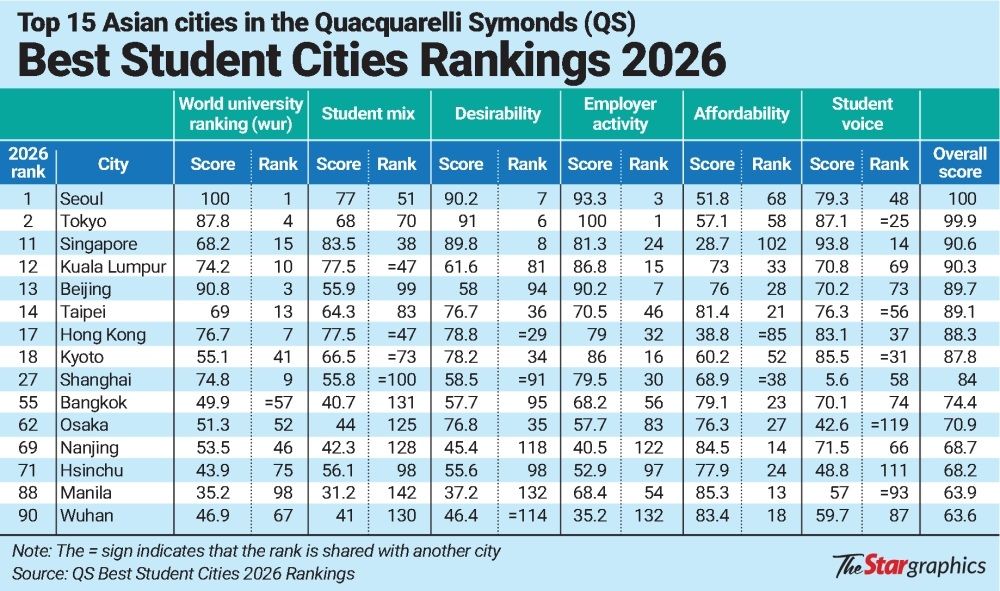
The achievement, which places the city fourth in Asia after Seoul, Tokyo and Singapore, is Malaysia’s best showing since it entered the rankings in 2016 at 53rd place.
The recognition, said National Association of Private Educational Institutions (Napei) president Datuk Lau Wai Cheng, has strengthened the country’s credibility in the international higher education market.
“It’s a sign that Malaysia’s higher education sector is gaining real international recognition.
“We are already attracting many international students with our multicultural environment, English-medium instruction, and cost-effective, quality education.
“This further strengthens our case for positioning the country as a competitive destination for global learners,” she said.
With a high concentration of private higher education institutions (PHEIs) in the capital, KL naturally stands out as a hub of student life and academic opportunity, she added.
These institutions offer modern campuses, comprehensive student support services, and a lifestyle that appeals to young people from around the world, she explained.
“Their diverse student body helps create a dynamic learning environment, which in turn enhances QS indicators such as internationalisation and student experience.
“Public universities (IPTAs) have also begun to attract a growing number of international students,” she said.
Improving the rankings
The QS Best Student Cities Rankings 2026 measure performance across six indicators: university rankings, student mix, desirability, employer activity, affordability, and student voice. KL improved in four areas, with strong results in employer activity and notable gains in student mix and desirability.
The city climbed 10 positions in the QS World University Rankings indicator to place 10th globally and sixth in Asia (see infographic). However, the student voice metric, which captures international students’ likelihood of recommending the city and staying on after graduation, dipped slightly to 69th.
Malaysian Association of Private Colleges and Universities (Mapcu) president Datuk Parmjit Singh said this underscores the importance of employment opportunities.
“The student voice measure represents an opportunity for the government to take the cue and liberalise opportunities for all students to work in Malaysia post-graduation, for at least a year,” he said.
In desirability, KL rose eight places to 81st (see infographic). The metric captures perceptions of safety, inclusivity, friendliness, transport, culture, and corruption.
“While KL is still not as strong as more ‘desirable’ cities, the jump shows it is moving in the right direction. Member universities are actively enhancing campus life, ensuring student feedback, and improving safety and inclusion,” he said.
According to a press release on July 15, QS said affordability remains a key factor for prospective students when choosing where to study and live.
The rankings show that 25 of the 30 most affordable student cities are located in Asia, highlighting the region’s relative cost advantage.
“The government and local authorities should also promote KL’s multicultural, vibrant lifestyle, affordability, and safety via student-focused marketing campaigns – points that contribute strongly to desirability,” Parmjit said, adding that improving perceptions of safety requires a “whole-of-community” approach.
“Collaboration among the police, City Hall and the wider community is vital to create an atmosphere where international students feel safe and protected at all times, while enjoying clean, healthy living in a green city with well-designed public transport interconnectivity,” he said.
Asian cities rise in standings
The Quacquarelli Symonds (QS) Best Student Cities Rankings 2026, which feature 150 cities and districts, also reveal a notable shift in the global landscape, with Seoul overtaking London to become the world’s best student city for the first time.
Tokyo retains its second place, while London, which held the number-one position for six consecutive years, falls to third place, largely due to a significant drop in the affordability indicator, where it slipped 11 places to rank 137th globally.
Rounding out the global top 10 are Munich (4th), Melbourne (5th), Sydney (6th), Berlin and Paris (joint 7th), Zurich (9th), and Vienna (10th).
Notably, Asian cities continue to rise in prominence. This year, 39 cities from the Asia-Pacific region (excluding Australia and New Zealand) are featured, including three newcomers.
Kyoto and Osaka make their debut as individually ranked cities, having previously been grouped under the Kyoto-Osaka-Kobe metropolitan label.
Among the 34 Asian cities ranked last year, 26 have improved their positions, one remains unchanged, and only seven have declined, with just four falling by more than three places.
Several Asian cities have achieved their highest-ever rankings since the list’s inception, including Seoul (1st), Kuala Lumpur (12th), Beijing (13th), and Taipei (14th), underscoring Asia’s growing prominence as a global hub for higher education.
QS ranks cities with a population of at least 250,000 and with at least two universities placing in the QS World University Rankings.