
Despite having relatively higher rates of employment, technical and vocational education and training (TVET) graduates are more likely to work in jobs they are overqualified for, compared with their counterparts from other pathways.
TVET is a crucial bridge between theoretical and practical know-how demanded by a spectrum of industries yet many graduates from this pathway earn less that what their skills are worth.
This issue, according to a recent Khazanah Research Institute (KRI) report, is characterised by the prevalence of overqualification and underemployment among TVET graduates.
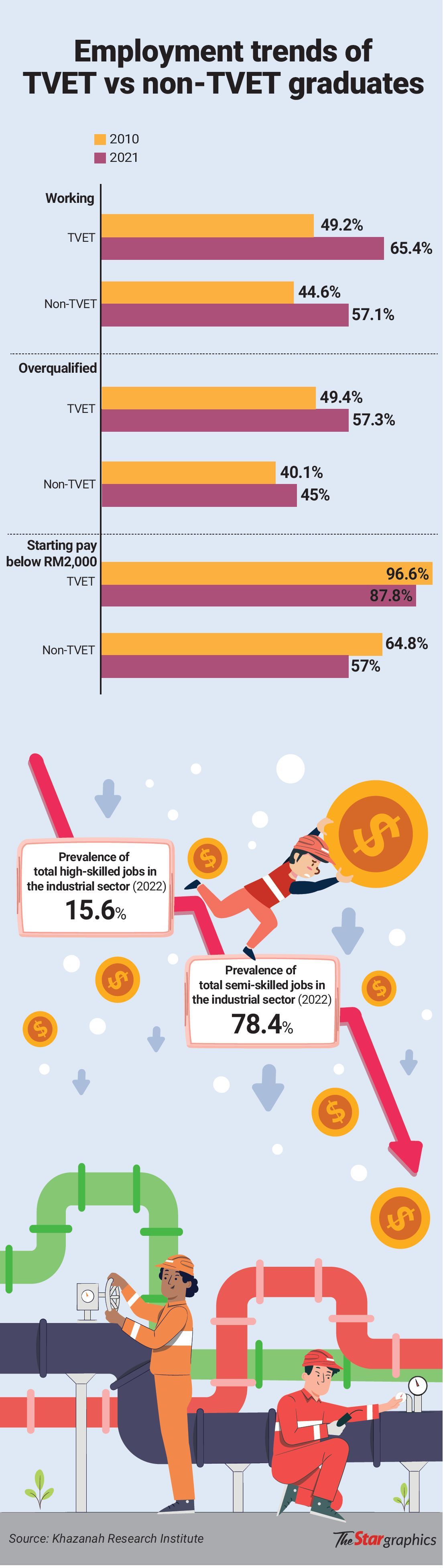
 HariIn 2010, the share of overqualified TVET graduates stood at 49.4% compared with 40.1% for non-TVET graduates, showing an increasing trend, with overqualification rates rising to 57.3% in 2021 (see infographic).Even diploma and TVET graduates with more than five years of work experience find themselves grappling with a skills mismatch, indicating an imbalance within the labour market, the report published in March, read.
The trend, experts say, suggests a systemic challenge in aligning the qualifications of TVET graduates with suitable high-skilled positions.
What’s worrying is that if left unaddressed, the mismatch can lead to situations where individuals possess qualifications that outstrip the demands of their employment roles.
This, said Universiti Tun Hussein Onn Malaysia Faculty of Technical and Vocational Education lecturer Prof Dr Razali Hassan, not only hinders the career progression of TVET graduates, but also restricts the economy’s capacity to harness and utilise their full potential effectively.
“This discrepancy raises a crucial question: if employers value skilled and experienced workers, why does this issue persist?
“One possible explanation is that employers may harbour doubts about the value of TVET backgrounds, which could lead to underestimating the skills and competencies these graduates bring to the table.
“This scepticism may perpetuate the skills gap, as qualified TVET candidates are overlooked or undervalued in favour of those from traditional academic pathways,” he told StarEdu.
He said tackling the problem requires targeted interventions to ensure that graduates are adequately prepared for the demands of the labour market.
 Prof RazaliAmong the measures that can be taken include fostering closer collaborations between TVET institutions, industries and employers, to ensure that educational programmes are aligned with the current and future needs of the labour market.
“Provide opportunities for experienced diploma holders and TVET graduates to participate in industry internships, job shadowing, or on-the-job training programmes to gain hands-on experience and update their skills.
“Similarly, establish mentorship programmes that pair experienced professionals in relevant industries with diploma holders and TVET graduates to provide guidance, advice and support in career advancement,” he said, adding that mentors would be able to offer insights into industry trends, share practical knowledge and skills, and help TVET graduates navigate challenges in securing a job that matches their skill sets, encouraging them not to settle for less.
Bumiputra Private Skills Training Institution action committee chairman Nordin Abdul Malek said career guidance and support services to assist students in making well-informed education and career path decisions can ease their transition into the workforce. He, however, stressed that being overskilled does not mean that one should be complacent.
“Always continue enhancing your versatility as this gives you an upper hand in showing potential employers how those from a TVET background are skilled and deserving of better pay.
“To enhance graduates’ chances of landing a fulfilling job, TVET institutions should focus on the development of employability skills, such as communication, problem-solving, and teamwork.
“It is also important to remember that when considering whether to accept a job offer, graduates must evaluate the overall value proposition of a career with the company they are intending to join.
“Companies tend to design their graduate programmes with training, overseas exposure and career advancement opportunities, in addition to the starting pay offered,” he said, adding that inquiring about job prospects for the first two to three years is a good way to assess the offer.
More high-skilled jobs, please
According to the KRI report, there is a high concentration of diploma or certificate holders within TVET who are often employed in semi-skilled, technical-related jobs.
The industrial sector, the report read, showed only 15.6% of jobs as high-skilled as of 2022, with most industrial jobs being predominantly semi-skilled, accounting for 78.4% in the same year (see infographic).Prof Razali said TVET graduates often form a significant portion of the workforce in industrial sectors such as manufacturing, construction, automotive and engineering.
 NordinHe said implementing supportive policies and incentives for businesses that create high-skilled jobs or that upskill their workforce can subsequently promote the creation of more high-skilled jobs in the country.
“This will attract high-tech industries needing skilled labour, ensuring that the skills TVET graduates have match what employers seek,” he said, adding that this could also potentially reduce unemployment and underemployment.
By creating a favourable environment for these industries, the government can stimulate the demand for high-skilled workers, he said.
Meanwhile, Penang Skills Development Centre (PSDC) chief executive officer Dr Hari Narayanan said the government should continue its focus on manufacturing but with reduced reliance on manual labour.
This, he said, has to be done simultaneously while promoting and incentivising higher value-added activities.
“We continue to be an attractive destination for foreign direct investment but we must ensure that the companies we attract bring in high-value activities and jobs,” he said.
Developing TVET programmes in collaboration with industry stakeholders, said Prof Razali, ensures that the curriculum is aligned with current and future skill demands.
“Industry input helps identify the specific skills, knowledge and competencies required for high-skilled jobs, ensuring that graduates are well-prepared for the workforce,” he said.
Agreeing, Hari said TVET programmes must be completely aligned with current and future industry needs for graduates to have opportunities for upward mobility.
A robust process of validation at the beginning of a programme’s design and development can prevent potential issues of underemployment and skill mismatches, he said.
“TVET talents should have opportunities to upskill and reskill as part of lifelong learning to remain competitively skilled and relevant in the industry,” he said, citing PSDC’s German Dual Vocational Training (GDVT) and industriemeister programmes, which are aligned with industry requirements, as examples.
Nordin said TVET programmes must include investing in infrastructure, equipment, and facilities to give students access to modern technologies and resources. This, he said, would ensure that they are prepared for the future.
“TVET institutions must include advanced digital skills — such as the Internet of Things (IoT), robotics, and artificial intelligence (AI) — and digital literacy in their programmes for students to thrive in the digital age,” he said.
Beat the stigma
According to the KRI report, variables related to graduates’ tertiary qualifications matter. Diploma holders, TVET graduates and government institution students are less likely to experience positive employment outcomes and high salaries.
Acknowledging that the issue of fair remuneration for TVET graduates is complex and can be influenced by various factors, Prof Razali emphasised the importance of striving for equitable wages for all individuals based on their skills, contributions and the value they bring to the workforce.
“Underemployment typically affects the salary range of graduates, as they may end up accepting jobs that do not fully utilise their skills and qualifications, resulting in lower compensation than what they might expect or deserve,” he said, adding that this is why the government, employers and educational institutions must all play a role in solving the remuneration challenges facing TVET graduates.
“Policies that promote the value of TVET education, support skills development initiatives and encourage fair pay practices can help ensure that graduates are adequately remunerated,” he said.
He also noted that salary levels are often influenced by market demand, industry trends and the perceived value of specific skills or qualifications.
The KRI report underscores that although the percentage of graduates receiving low starting pay had decreased from 96.6% in 2010 to 87.8% in 2021 (see infographic), the prevalence of low-paid graduates is significantly higher among TVET graduates compared with their non-TVET counterparts.
While starting salaries for TVET graduates may be lower compared with other professions, there should be opportunities for growth, skill development and increased remuneration over time based on performance and experience, said Prof Razali.
“We have to beat societal perceptions or biases that undervalue TVET qualifications compared with traditional academic degrees.
“This can contribute to lower salary offers for TVET graduates, even though their skills are essential for various industries and sectors,” he added.
Concurring, Hari said while there is a common belief that TVET qualifications hold less value as compared with academic qualifications, a closer look at specific technical skills, such as those in precision machining, reveals that graduates who possess CNC (computer numerical control) machinist, CNC programming, and milling skills earn salaries that are comparable to those with tertiary education.
“As long as TVET programmes are aligned with industry needs, unemployment or underemployment should be minimal.
“It is also critical that TVET graduates have progression pathways to negate the perception that TVET qualifications are the end of the learning journey,” said Hari.
Nordin pointed out that the creation of new job opportunities and increased career development is slowing down, causing an imbalance in supply and demand for TVET graduates.
“For example, the opportunity for a technician to become a supervisor takes longer due to competition.
“Employers often favour hiring individuals with lower skills and qualifications in order to keep wages down, yet they still expect high-quality work, which high-skilled TVET graduates can provide.
“The uncertain global economy has led to an unpredictable business landscape, prompting employers to mitigate risks and cut costs, particularly in labour,” he said, adding that employers need to be genuine in helping educational institutions so that the courses offered meet industry demands.
Career growth
Generally, changing jobs often can lead to better job opportunities for graduates, the KRI report found.
As graduates switch jobs more frequently, the rate of overqualification tends to go down, and the likelihood of earning an income above RM3,000 increases.
Job hopping, however, does not necessarily guarantee faster career growth, regardless if one is from a TVET background or not, said Hari.
“But this also does not mean that staying put in an organisation provides fast career growth. The disadvantage of changing jobs frequently is that one is not able to build one’s bench strength and deepen one’s knowledge, which are important for growth.
“At the same time, someone who is stuck in their comfort zone in an organisation will be perceived as uninterested in career progression,” he said.
From an employer’s perspective, Hari said, losing an employee disrupts its operations, and graduates who job hop because of compensation may be taking a short-term view of career progression.
“There are many cases of talents who chart good progress in their growth trajectory and are compensated well after having been in an organisation for a long time,” he added.
Prof Razali said it is essential for individuals to carefully consider the potential pros and cons of job hopping and to make informed decisions that align with their long-term career goals.
Pointing out the KRI report findings that self-employed TVET graduates tend to earn over RM5,000 as compared with their non-TVET peers, he suggested that self-employment could decrease underemployment among TVET graduates, though it presents challenges.
“Self-employment allows TVET graduates to directly apply the practical skills and knowledge they have gained from vocational training programmes, and enables them to pursue a business in their areas of expertise.
“This offers them the potential to earn a higher income compared with traditional employment, especially if they are able to build a strong client base and offer in-demand services,” he said.
But while TVET graduates may excel in their specific vocational skills, self-employment often requires additional competencies such as business management, marketing, finance and customer relations, which may pose challenges for individuals less experienced in these areas, Prof Razali cautioned.
And although TVET graduates are more likely to obtain better income as entrepreneurs compared to standard employment, Nordin said financial risks of starting a new business and keen competition are factors to consider.
Calling on the government to implement ongoing initiatives that can better match the current TVET curriculum with market needs, he said such measures cannot be a one-off affair.“
There needs to be consistency and dedication. And at school level, skills and knowledge must be integrated,” he said, adding that agricultural science is an important topic that should be given priority in the education system.
Overcoming stereotypes
 There is a misconception that TVET education is meant for those who are not academically inclined, which creates the stigma that TVET graduates are less qualified than those who pursue conventional education. This contributes to a higher unemployment rate among TVET graduates despite their practical skills. This stigma should be addressed by parents and educators through the promotion of TVET education. TVET education should be introduced to every student as a viable path regardless of their academic performance. This can help put TVET education on par with conventional career paths.
– Charis Chiang En-Hui, 21
TVET graduates often face stigma due to employers’ assumptions that they performed poorly in school. Consequently, they’re undervalued in terms of salary, despite possessing valuable skills, especially in our knowledge-driven economy. To combat this, employers need to focus on what truly matters in hiring. Government initiatives can play a crucial role in reshaping employment practices and salaries, benefiting both TVET graduates and employers, while breaking the stereotype of a supposed lack of intelligence.
– Daniel Fadzlan Abdullah, 21