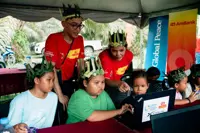
POLICIES have been implemented, and continuous forums and discussions are held, but the education gap between Malaysia’s indigenous and non-indigenous schoolchildren continue to persist.
In a comprehensive study spanning over 10 months, Institute for Democracy and Economic Affairs Social Policy research manager Wan Ya Shin highlighted the disparity in access to quality education for indigenous schoolchildren, particularly Orang Asli students.
Her research areas include education policy, social protection and inclusive growth.
In her paper titled “Educational Policies in Overcoming Barriers Faced by Orang Asli Children: Education for All”, published on Oct 22, she said a report by the Education Ministry revealed that only 59% of Orang Asli students completed their secondary education in 2014.
The paper is the first of a two-part study and examines the evolution of the policies and programmes for Orang Asli children since 1995.
It also examines how effectively the Orang Asli Transformation Plan 2013-2018, under the Malaysian Education Blueprint 2013-2025, is in addressing the challenges faced by these children.
It states that, in 2018, only 76.7% of Orang Asli students move from primary to secondary education, compared to the national transition rate of 96.8% in 2018.
Dropout rates for these students was also constantly above 17% from 2016 to 2018, with 2017 recording a huge leap to 26% of Orang Asli students dropping out. Comparatively, the national dropout rate for the same period was consistently below 4%.
The dropout rates among Orang Asli students are more prevalent in Kelantan and Terengganu, adding further to the disparity between them and their peers around the country.
This could be due to state-level governance of schools and support, which varies between state and district levels, and is causing further disparity in their access to quality education.
“(Additionally), enrolment rates for Orang Asli students are not reported in the Malaysia Education Blueprint annual reports, so the percentage of Orang Asli children who are not attending school can’t be ascertained, ” said Wan.
Even other indicators of Orang Asli students’ access to formal education are still lagging behind compared to the national average. This includes transition rates and completion rates.
The idea to carry out the study began when Wan visited an Orang Asli village to understand their challenges and how they are more vulnerable than their non-indigenous peers in accessing quality education.
Despite the negative narrative she’s often heard about the community, she realised that the children are as active and curious as non-indigenous children their age.
“So why are they lagging behind in their access and attainment of education?”
One of the main barriers she and her research team stumbled upon was that programmes available focus too much on the symptoms such as dropout and attendance, instead of addressing the problem.
To add to the dilemma, implementation gaps such as the lack of training for teachers to execute modules and programmes existed.
In her 40-page report, Wan broke down the main barriers and challenges Orang Asli students faced into four points (see table).
Targeted policies
Through her study and groundwork, Wan saw a need to have education policies that suit the Orang Asli children’s environment.
She outlined seven policy recommendations to provide better access to quality education for them.
The policies are based on the barriers highlighted in previous studies and also an analysis of the government’s policies and programmes for these children.
“There are good existing programmes that should be expanded and continued, such as the Orang Asli and Indigenous Adult Classes (Kedap), which is an adult literacy programme for parents.
“This will help reduce their illiteracy rate and help them be more involved in their children’s studies.
“There should also be platforms and consultations with the Orang Asli communities to understand their challenges and to voice their opinions on policies and programmes.”
Supporting learning centres operated by Orang Asli communities will also empower them to serve, build and increase awareness of the importance of education in their communities.
*See the mindmap below for Wan’s policy recommendations.
Already a subscriber? Log in
Get 20% OFF The Star Digital Access
Cancel anytime. Ad-free. Unlimited access with perks.