SMART traffic lights in Johor are expected to cut peak-hour travel times by up to 30%, with the system to cover 46 intersections across the state by year end.
State housing and local government committee chairman Datuk Mohd Jafni Md Shukor said the system had already shown impact, reducing travel times at several key corridors by adjusting traffic light timings according to real-time conditions.
“Along a 6km stretch of the Skudai-Pontian corridor, which has six traffic light intersections, morning peak travel time was cut from 20 minutes to 15 minutes, while evening peak travel time dropped from 22 minutes to 17 minutes.
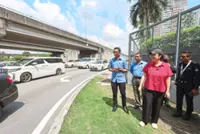
“This represents a reduction of 25% during the morning peak and 23% during the evening peak hours,” he said in a statement after a site visit to observe the smart traffic light system installed at Indahpura, Kulai.
According to Mohd Jafni, the smart system had also produced results along Jalan Seelong in Kulai, where morning peak travel time was reduced from 18 to 14 minutes, while evening peak travel time fell from 23 to 16 minutes.
He said the corridor recorded an overall traffic volume of 19,825 vehicles per hour during the evening peak period.
He noted that the traffic queue from the direction of Kulai was reduced from 650m to 300m, the one from Senai Airport dropped from 300m to 180m, while the queue from Seelong saw a reduction from 600m to 350m.
“The smart traffic light system uses sensors, artificial intelligence-based closed-circuit TV cameras, timers and control devices to detect traffic volume and movement, allowing traffic light durations to be adjusted according to current road conditions.
“The system can also automatically adjust traffic light timings when an intersection has little or no traffic, while giving priority to routes with higher traffic demand,” Mohd Jafni said.
Countdown timers have also been installed for road users’ convenience to prepare for changes in traffic lights, he said.
He added that the status of traffic and traffic light operations could be monitored in real time through local council command centres.
For phase one, 25 intersections involving five local councils have been fully completed as of September.
These include 11 intersections under Iskandar Puteri City Council (MBIP), six under Kulai Municipal Council (MPKu), five under Johor Baru City Council (MBJB), two under Pasir Gudang City Council (MBPG) and one under Kluang Municipal Council.
Another 21 intersections under MPKu, MBPG, MBJB and MBIP are scheduled to be fitted with the system by the end of the year under phase two, the exco said.
Present during the site visit were MPKu president Muhammad Shahril Azizi Abd Gapar and council chief whip Mohd Fadil Misnan.