MOST wars are fought with guns while some are won through food, medicines, letters and earning the trust of the enemy.
For former Special Branch officer Datuk Paul Kiong, these seemingly ordinary things were the tools of elaborate undercover operations that saw him successfully infiltrate the Communist Party of Malaya (CPM) and turn its own supply network against it.
He spent six years living a double life, quietly becoming part of the machinery that kept insurgents in the jungle alive.
He helped source their food and medical supplies, carried their letters and even ferried members around, all while secretly gathering intelligence for the authorities.
And the closer he got to the communists, the more valuable the information was.
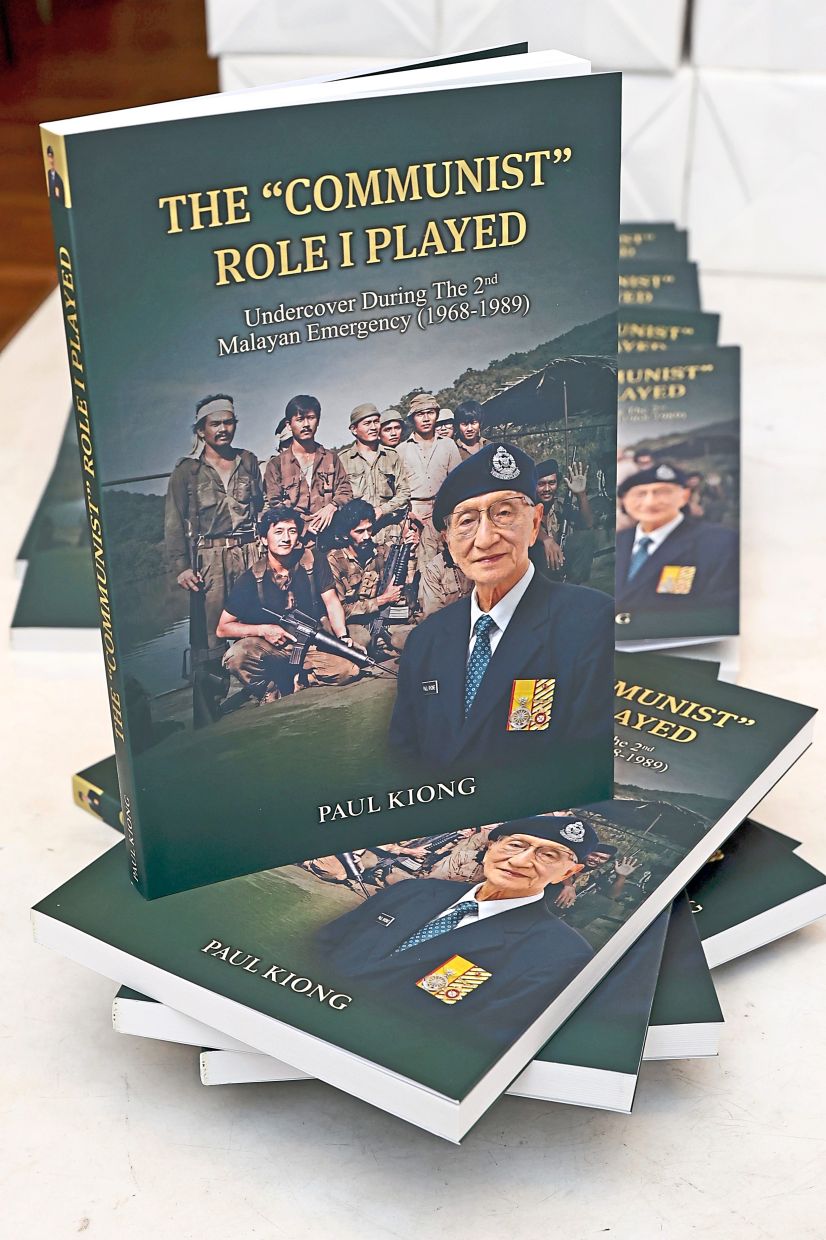
The amount of rice requested could reveal the strength of a unit, while a list of medicines offered clues about their condition, the 82-year-old shared while in Penang to promote his book The Communist Role I Played: Undercover During The 2nd Malayan Emergency (1968-1989).
A letter could also reveal what the CPM were planning to do, he said.
But every errand came with the possibility of discovery. And being exposed could mean death. Fortunately for Kiong, the greatest weapon in his arsenal was his ability to understand and outwit the people he was infiltrating.
“You had to eat with them, live with them and think like them,” revealed the decorated ex-cop, whose work was key to crippling the CPM’s Fifth Assault Unit operating in Perak’s jungles.
This effort, codenamed Operation Bamboo, started in 1976 and ultimately led to the en bloc defection of some 50 communists while their top command remained largely oblivious.
Kiong recalled how their strategy with the communists was simple but effective.
By cutting off supply lines, insurgents would eventually be forced out of the jungle in search of food.
“Hungry soldiers cannot fight. Their minds would begin to question why they put themselves in that position,” he explained. But rather than starving the communists, Kiong made them dependent on his network.
He and fellow operatives would deliberately fulfil only part of the items requested, getting creative with excuses so the fighters did not realise they were being manipulated from within.
Villagers and farmers also became an important source of intelligence, while intercepted correspondence provided clues about CPM movements and plans.
This high-stakes game of deception also required Kiong to ferry the communists around, which he likened to being the e-hailing driver of the day.
“There was always a risk of a firefight if we encountered a police checkpoint, as the communists were indoctrinated to never surrender,” he said.
Kiong could never tell his family about his work.
Whenever his wife saw him off for another assignment, he made a point of not hugging, kissing or saying goodbye.
She would not ask where he was going or when he would return.
Even his own superiors might not know exactly where he was in the jungle, at any given point in time.
“I was afraid, but I turned the fear into courage.
“All I could do was plan well and increase my odds,” Kiong said during the event held at St Xavier’s Institution in George Town, his alma mater.
The talk was organised by Penang Institute, with executive director Datuk Dr Ooi Kee Beng as moderator.
Kiong said the objective was never to simply kill and eliminate the enemy, but to win their trust and persuade them to return to society.
Some of the communists were taken aback by how well they were treated and ultimately laid down their arms.
“People often ask why I did it. It’s because I love my country.
“I knew that if I was successful in my task, millions of Malaysians will have a better life,” he added, while urging current generations to continue treasuring the peace and harmony they enjoy today.
Kiong, who retired in 1998 after 31 years of service, is one of only four surviving recipients of the Bintang Seri Pahlawan Gagah Perkasa (SP), the nation’s highest federal award for gallantry.
His book is available at RM50 per copy. To purchase, contact Victor Tan at 019-480 6556.