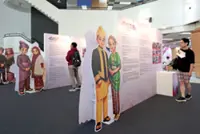
A 389-year-old manuscript and a virtual reality holodeck may seem worlds apart, yet both have a home at the National Library of Malaysia (PNM) in Jalan Tun Razak, Kuala Lumpur.
Together, they capture the institution’s evolving role: preserving centuries of knowledge while finding new ways to make learning relevant to a digital generation.
At the heart of PNM’s documentary heritage is the National Centre for Malay Manuscripts, which holds 5,405 original manuscripts, 3,080 digitised titles and a further 995 titles preserved on microfilm and microfiche.
PNM director-general Edy Irwan Zulkafli said the figures told only part of the story.
“When people hear the words ‘Malay manuscripts’, they may immediately think of old literature or folk tales written in Jawi.
“But these manuscripts contain knowledge covering religion, law, medicine, navigation, astronomy, agriculture and mathematics,” he said.
“They show us that Malay society had a rich and highly developed intellectual tradition hundreds of years ago.”
Among PNM’s most prized holdings is Khalaq al-Sama wa al-Ard (MSS 1517(A)), the oldest Malay manuscript in its collection.
Written in 1637 by Syeikh Nuruddin al-Raniri at the command of Sultan Iskandar Thani of Aceh, the text explores the creation of the heavens and earth, forming a key section of his celebrated work, Bustan al-Salatin.
PNM also holds two manuscripts of Hikayat Hang Tuah – MSS 1713 and MSS 1658 – which were inscribed on the Unesco Memory of the World Register in 2001.
“The recognition shows that Malay manuscripts are not important only to Malaysia.
“They have universal value as part of the world’s documentary heritage,” Edy Irwan said.
Other works open windows into very different aspects of life in the Malay world.
Misa Melayu (MSS 6) records the history of the Perak Sultanate, while Hukum Kanun Melaka (MSS 23) offers insights into early Malay legal system and its Islamic foundations.
Syair Siti Zubaidah (MSS 25) tells of the courage and leadership of a Malay woman, while Kitab Tib (MSS 1292) records traditional remedies using plants, herbs and other natural ingredients.
Preserving such works involves more than placing them in climate-controlled storage.
PNM undertakes acquisition, physical conservation, digitisation, research and publishing to ensure the manuscripts survive and their knowledge is not lost.
“Our aim is not simply to preserve these manuscripts as historical artefacts.
“We want the knowledge they contain to continue to be used for research and education, and to contribute to our understanding of the development of Malay civilisation,” said Edy Irwan.
The public can consult the physical collection through PNM’s reference and research services, while digital copies are accessible subject to stipulated conditions.
Its MyRepositori platform also allows users to explore manuscripts, historical newspapers and other heritage materials online.
Beyond its manuscripts, PNM safeguards rare publications and private collections belonging to prominent national figures.
Through its interlibrary loan service, users may also request materials from other partner libraries across Malaysia and overseas.
“PNM is not only a place to borrow books.
“It is where heritage, research, technology and lifelong learning come together, with something for every visitor,” added Edy Irwan.