
Long before Liberica became a buzzword in Malaysia’s specialty coffee scene, Paloh and its surrounding villages were already growing it.
For many older families here, coffee was part of the landscape.
But as the town changed and younger people moved away, many small plots were abandoned or replaced with other crops, including oil palm.
The decline became more visible in recent years when the double-tracking railway project cut through some of the old coffee-growing areas, removing decades-old trees from land within the railway reserve.
However, that loss became the start of a revival effort by The Big Bean, a coffee plantation.
It takes its name from the larger size of the Liberica bean.
Its founder and chairman, Henry Lim Chin Peng, a former Paloh councillor, transplanted about 300 to 500 coffee trees – that would otherwise have been discarded – to his land about 10 years ago.
The plantation now has more than 6,000 trees and is part of a push to reposition Paloh as a coffee heritage town.
A state-funded road is expected to enable better public access to The Big Bean.
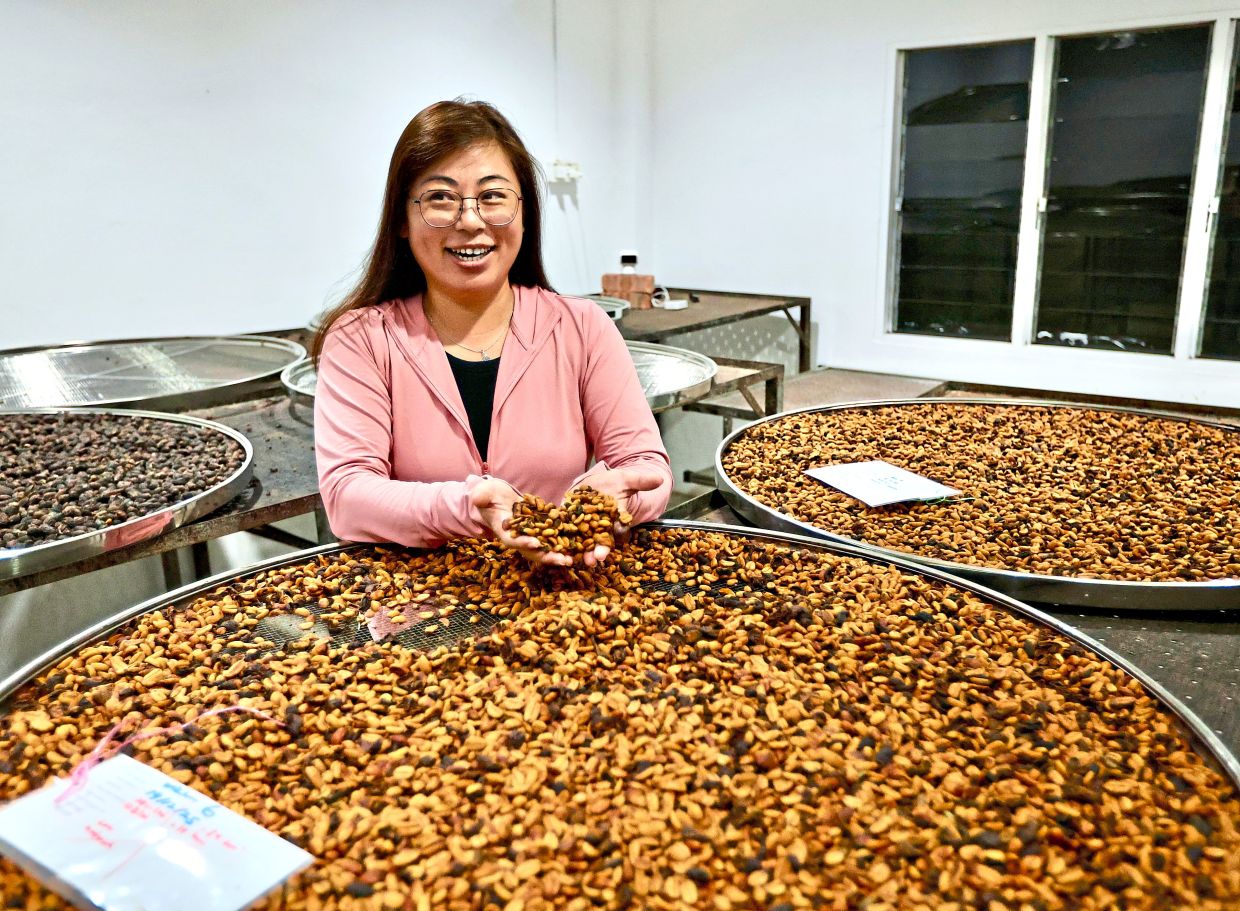
The plantation grows its own Liberica coffee, which is harvested, processed and brewed at the on-site Paloh Coffee Workshop & Roastery.
Its executive director and coffee specialist Caryn Lau Chew Yi said Paloh’s long history with Liberica showed that the crop was well suited to the area.
She said the variety, known locally as kopi besar or elephant bean, had survived here for decades and was suited to Malaysia’s tropical conditions.
Liberica accounts for less than 2% of global coffee production and is known for its large, teardrop-shaped beans, full body and floral or fruity notes.
Lau said the task now was to give the bean a stronger identity and get people to see Liberica not as an old crop, but as a specialty coffee with tourism potential.
Since 2018, she has travelled to Indonesia, Thailand and China to study coffee production, processing and fermentation techniques.
The farm’s coffee operations are also supported by Lau’s partner, French barista Sven Brian Acker, who helps oversee tree care, cupping and bean quality.
The farm promotes a pesticide-free approach, using natural seagrass extracts to nourish the trees.
After the coffee cherries are collected, they are washed and sorted to remove impurities and unsuitable fruit.
The cleaned cherries are then placed in buckets or clean sacks before undergoing honey processing and fermentation in a warm room.
Fermentation usually takes one to two weeks, with the room temperature kept at about 26°C to 29°C.
A dehumidifier is used to control moisture and reduce the risk of mould.
After fermentation, the cherries are rinsed again to remove the sticky mucilage produced during the process before being laid out for sun drying.
The drying stage can take between one and three months, depending on the weather, as the farm relies on natural air drying.
Once a batch is completed, the containers are cleaned and reused for the next cycle, with production depending on the season and harvest volume.
The farm is also involved in the MKL Series, a collaboration with the Malaysian Agricultural Research and Development Institute (Mardi) to cultivate Liberica clones that are more climate-resilient, disease-resistant and suited for higher-quality specialty coffee.
Lim’s longer-term vision is to turn Paloh into a coffee heritage destination, preserving the town’s old coffee story while giving local farmers a reason to return to the crop, said Lau.
The farm now has a viewing tower and a physical store that can accommodate up to 200 visitors.