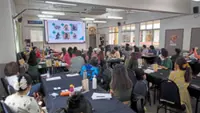
A CHINESE calligraphy course for teachers, supported by the Arts for All Seasons (ArtsFAS) grant under Khazanah Nasional’s Hasanah Foundation, has opened for registration.
“The Art of Calligraphy: Teachers’ Training Programme in Malaysian Calligraphic Heritage and Pedagogy” is being organised by Yan Art Centre, with course coordination by Qin Arts Academy.
Following the successful completion of two cohorts, the programme is now ready to welcome Chinese primary school teachers from across Malaysia who wish to strengthen their professional competencies in Chinese calligraphy education.
The programme is offered free of charge as a public educational initiative, with places available on a limited basis.
Schools are encouraged to nominate two to three teachers to participate together in order to strengthen their school-based calligraphy teaching teams.
The programme in August comprises 24 instructional hours, conducted daily from 10am to 5pm.
The initiative, spearheaded by Yan Art Centre founder Jordant Chang Sao Suo, aims to enhance the quality of Chinese calligraphy education, strengthen teachers’ professional competencies and promote a deeper appreciation of Chinese calligraphy in Malaysia.
It is being jointly supported by New Era University College, while the Malaysian Central Arts Development Society (Koseni) coordinates participant documentation and programme administration.
To date, 80 Chinese primary school teachers from Kuala Lumpur, Selangor, Negri Sembilan, Melaka, Johor and other states have completed the course.
Participants have responded positively to the programme, recognising its systematic curriculum and practical teaching approach.
The training is led by Qin Arts Academy founder and principal Claire Lai Huey Qin, who is assisted by Lee Jia Yuan.
It covers brush techniques, structural analysis, composition, artwork creation, teaching methodologies, calligraphy history and aesthetic appreciation.
Through a balanced combination of theory and practical, participants develop both technical skills and classroom teaching competencies.
It emphasises not only the development of writing skills, but also the cultivation of teaching competencies and cultural understanding.
Participants are introduced to the Four Treasures of the Study, different types of brushes and paper, proper writing posture and brush-holding techniques, basic brushwork and character structure analysis.
Through classroom case studies, artwork critiques and group discussions, teachers explore effective ways of integrating Chinese calligraphy into the teaching of language, history and culture.
In addition to classroom instruction, participants experience traditional cultural activities, including stone rubbing, traditional papermaking, miniature scroll creation and classroom activity design.
These practical sessions encourage teachers to incorporate cultural experiences into contemporary calligraphy education, enabling students to appreciate Chinese calligraphy as both an artistic discipline and an important carrier of Chinese civilisation.
Lai said Chinese calligraphy education should not be confined to writing techniques alone.
“It should also enable students to appreciate the cultural, historical and aesthetic values embedded within Chinese characters,” she said.
“Teachers who possess broader educational perspectives and cultural understanding are better equipped to inspire the next generation and sustain the development of Chinese calligraphy education,” she added.
Chang noted that the sustainable development of Chinese calligraphy education depends on well-trained teachers.
By establishing a systematic teacher training framework, the programme seeks to cultivate educators with both professional calligraphy skills and effective teaching methodologies, allowing more students to experience authentic Chinese calligraphy and culture in schools.
Participants who successfully complete the programme and pass the assessment will receive a certificate of completion and have opportunities to exchange ideas with fellow educators from across the country.
The training is open to teachers who are currently teaching or preparing to teach Chinese calligraphy, as well as educators seeking to enhance their classroom teaching skills.
The programme will be held from Aug 1 to 2 and Aug 8 to 9 at the Ng Ah Choo Multipurpose Hall (Block C, Level UG), New Era University College, Selangor.
Registration for the third cohort is now open.
For enquiries or further information, call 014-926 2697 (Chloe of Yan Art Centre).