
A CONTROVERSIAL proposal for a three-storey business data centre in Kota Damansara, Petaling Jaya in Selangor, remains strictly under evaluation, and has not been granted approval.
Addressing growing community unrest, Petaling Jaya City Council (MBPJ) Corporate Communications Unit revealed it received about 290 formal objections as of July 21 regarding the application for the project.
The site is at Jalan Rimba Riang 9/6, which spans 18 lots of private land and sits adjacent to a government road reserve.
The public feedback period for the proposed development ends today.
In a statement to StarMetro, the unit clarified that following public complaints over incorrect details on the original site notice board, a formal directive was issued on July 15 ordering the developer to rectify the errors.
This effectively extended the public consultation window from July 21 to 27, from the previous July 9 to 15.
“Public complaints revealed that the initial notice contained inaccurate reference numbers and incorrect contact details for the designated officer, preventing residents from submitting feedback effectively.
“To guarantee transparency, MBPJ issued a formal directive on July 15 instructing the applicant to rectify these errors.
“Additionally, on July 17, MBPJ issued a ‘notice of information obtaining specific views’ via registered post to several local stakeholders, granting them a seven-day response window.”
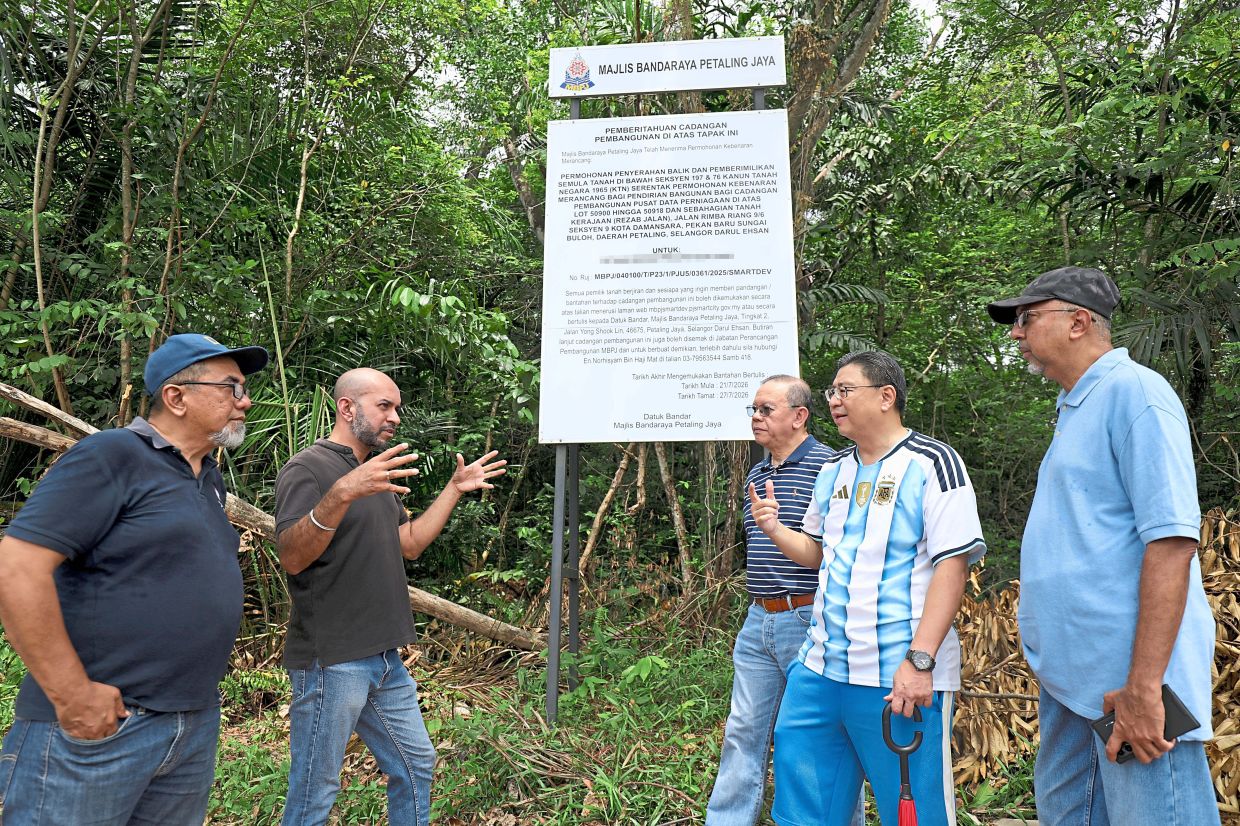
The stakeholders comprised 11 homeowners living within a 20m radius along Jalan Rimba Riang 9/3 and 9/5A, MBPJ stated.
The notice was also sent to the Sungai Buloh MP, Kota Daman-sara assemblyman and office of the MBPJ Zone 3 councillor.
MBPJ also clarified that the project remained strictly in feedback and evaluation stage, and had not been approved or considered by its One-Stop Centre (OSC) Unit.
“Under standard procedures, MBPJ will convene a development briefing meeting for all individuals who submitted feedback within 30 days of the close of the notice period.
“The complete application – supported by the applicant’s development proposal report and traffic impact assessment report, both accessible at MBPJ’s Development Planning and Engineering Departments – will only go to the OSC Unit for consideration after public feedback is obtained and technical agency reviews are completed.”
Under the Petaling Jaya Local Plan 2 (Amendment 3), the land-use of the proposed site is zoned as “business and services” (shop/office building lots) and “transport” (road reserve).
“The site suitability is evaluated against PlanMalaysia’s Data Centre Planning Guidelines 2024, which mandates a 50m buffer zone – comprising features such as roads, building offsets, perimeter planting or parking – between the data centre structure and residential lot boundaries.
“Ultimately, under Town and Country Planning Act 1976, MBPJ holds the statutory authority to approve or reject the application, and any aggrieved party retains the right to submit an appeal to the Appeals Board,” MBPJ stated.
Seeking clarification
Residents have questioned the way they discovered about the project and the short one-week deadline to submit objections.
Kota Damansara Section 9 Phase 1 resident Mohd Razif Mohd Lazim said he happened to be on his morning walk on July 14 when he spotted the notice board.

“The deadline for objection was stated as July 15. I quickly alerted a local residents’ coalition and we submitted a written objection the same day,” he said.
Section 5, Kota Damansara resident Foo Kwan Pheng said based on details on the notice board, the proposed project would extend beyond the privately owned lands and onto government land designated as road reserve.
“Landowners or developers have the right to build on their own land, in accordance with planning requirements and as per the existing approved layout plan. But in this case, the proposal extends past the boundary of the developer’s land.
“Building over a road reserve requires state government approval to alienate the land.
“This approval is entirely at the state’s discretion and is not guaranteed,” said Foo, adding that this would likely restrict future expansions of the existing road.
A coalition representing them called Gabungan Penduduk Kota Damansara filed formal objections against the project, citing proximity to residential areas and possible negative impacts.
The coalition represents communities from Jalan Istana Kota Section 9, Damansara Residency Section 9 and Kota Damansara Section 9 (Phases 1 and 2), comprising over 500 households.
Coalition spokesperson and Jalan Istana Kota Section 9 Residents Association committee member Narindera Pall Singh said their concerns included impact on residents’ quality of life due to potentially increased noise pollution, and 24-hour operations related to the development.
“Then there is the environmental impact, such as heat generated by data centre equipment and high energy consumption, which would affect residents and nearby Kota Damansara community forest,” he said, adding that there were also concerns about impact on traffic and road safety.

Narindera said residents were also unhappy with the short seven-day public objection period, which differed from the 21-day period stipulated under Town and Country Planning Act 1976 (Act 172).
“The 1.1ha project site is zoned as commercial. According to the MBPJ local plan, this commercial zone is meant for shops.
“There was also a plan in 2024 to build a 50-storey condominium, which we protested against,” he said, asking the authorities to stick to the original plan for shops which would serve the community better.
Clearer communication
Narindera also called for better public notification regarding projects affecting local communities.
“In this case, MBPJ should have notified the local councillor to pass the information to us.
“We also hope MBPJ will update us on this matter through our councillor,” he said.
MBPJ councillor for Zone 3 Muhamad Shazwan Suhaimi and Sungai Buloh MP Datuk Seri R. Ramanan said in separate statements that they had submitted formal objection letters to MBPJ regarding the proposed project.
Muhamad Shazwan’s objection listed several reasons why such infrastructure did not belong in a residential area, including non-conformity of land use and planning policy, impact on traffic, road safety, electricity and water supplies, noise pollution as well as lack of public engagement.
He urged MBPJ to halt the application process until all technical reports were disclosed for public review, and a public hearing conducted with residents.
Ramanan said his office had not been included in any discussions on the project, stressing that proposals for large-scale developments must be transparent and involve local stakeholders and elected representatives.
To address the broader issue of data centres being built near residential zones, the Human Resources Minister said he would raise the matter at Cabinet level to push for more comprehensive federal guidelines and mechanisms.