
Teachers at Tamil primary schools have noticed pupils appearing increasingly anxious, withdrawn and emotionally fragile.
At home, parents say they have noticed subtle behavioural changes yet feel unsure how to help, while the children suffer in silence in a culture that exalts academic results and success.
To address this, Rotary Club of Central Damansara (RCCD) in collaboration with Help University’s psychology department, ran the MindConnect programme across six Tamil primary schools in Negri Sembilan and Melaka as an early mental health intervention.
The schools were SJK (T) Lorong Java, SJK (T) Port Dickson, SJK (T) Bandar Springhill, SJK (T) Melaka Kubu, SJK (T) Paya Rumput and SJK (T) Jasin.
In a press statement, RCCD said the programme reached 956 pupils from Year 4, 5 and 6, alongside 300 parents and 70 teachers.
Based on evaluations carried out by the Rotary Club, the pupils reported symptoms of stress, anxiety and emotional distress while parents said they were uncertain how to talk to children about their feelings.
MindConnect project lead and RCCD past president Karthi Palanisamy said children experienced emotional distress but not everyone had access to help.
“MindConnect is designed to meet children academically, culturally and emotionally,” he said.
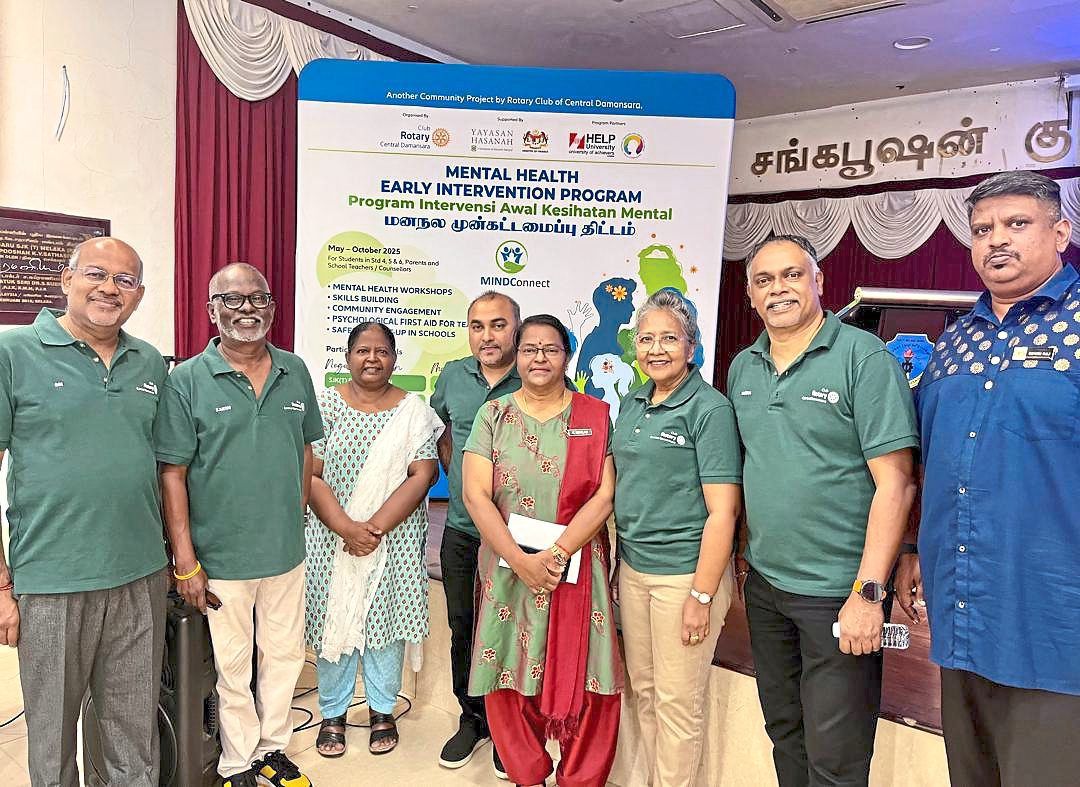
To participate in the programme, teachers underwent Psychological First Aid (PFA) training to recognise early emotional distress, respond without panic, and practise active listening while learning to interpret behavioural signals.
Parents learnt how to recognise patterns they were repeating from their childhood.
They also learned to validate their child’s feelings, without dismissing them, and to be emotionally present.
Meanwhile, the children practised expressing emotions, role-played healthy communication and built peer-support networks grounded in empathy to help them learn their feelings were valid and their voices matter.
In each school, MindConnect set up Safe Spaces or Sudut Minda which are dedicated rooms for students to retreat, decompress and speak with the trained teachers when needed.
RCCD president Balan Nair said for sustainable change to be effective, a system of care must be embedded in the everyday life of a school.
“When children know there is a place they can go, and adults know how to receive them, mental well-being stops being a concept and becomes a lived practice,” he said.
The club’s post-programme evaluations, done through surveys and direct communication, showed teachers gaining greater confidence in managing emotional distress in students.
Parents, too, felt more capable in recognising warning signs and initiating difficult conversations, while pupils were able to express themselves, increased help-seeking behaviour and showed stronger resilience.
Help University programme facilitator Eric Amaladass said, “When parents, teachers and students learn the same emotional language, the whole school ecosystem heals.
“It’s not about being perfect, it’s about being present,” he said.
RCCD Rotarian and National Coalition for Mental Well-being chairman Siti Subaidah Mustaffa noted the importance of early interventions such as MindConnect in primary schools.
“Children who learn to open up sooner will be of help to others with mental health issues, thus growing to care for others,” she said.
MindConnect was made possible through a special grant from Hasanah Foundation and Finance Ministry. — By M. DHAANYA