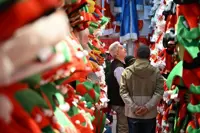
CHINESE New Year decorations featuring calligraphy are more than just ink strokes on red paper, they are a wish for prosperity, harmony and rebirth, and are usually found affixed on either side of and above the main entrances to buildings.
In Kelantan, Chinese calligraphers are still in demand especially one to two months before the celebration with requests and interest coming from schools, shopping centres, associations and even pasar malam traders.
Kelantan Calligraphy Association treasurer Yeap Keng Hwa said chunlian, or Spring Festival couplets, are the ones seen on the sides of premises entrances while hengpi are displayed on the lintel.
The bold red paper featuring the auspicious characters represents courage and good fortune.
“The calligraphy carries greetings, hopes and prayers for the new year.
“For the Year of the Horse, for example, many phrases include elements of the horse symbolising speed, success and luck,” he told Bernama.
Yeap said he is often invited to conduct calligraphy demonstrations and workshops at community events in Kelantan.
He has been a calligrapher for 20 years but his interest was nurtured during primary and secondary school, encouraged by his teachers who saw his talent.
“I was asked to submit my writing three times a week and the teacher would point out what was beautiful and what needed improvement.
“The compliments motivated me,” he said, adding that he was nervous doing live calligraphy at first, but his confidence grew with practice and experience.
The art form goes beyond technique and has to have a natural flow and come from the soul so that it looks alive, he said.
“It must appear as a single whole. You can’t have one word looking beautiful while another feels disconnected.
“Simplicity is the hardest to achieve because what seems simple, often is the most complex.”
Innovation in calligraphy is important too, including forming characters that look like zodiacal animals, but without undermining Chinese character structures.
He was proud to see continuous interest especially among some youths in their 20s from Pulai, Gua Musang who have shown an aesthetic appreciation of the art form that is thousands of years old.
“We hold calligraphy classes once a month. Our hope is that it will continue to be a bridge for heritage and culture.”
Kelantan Calligraphy Association committee member Yeoh Eng Chew said the four main tools in Chinese calligraphy are known as the Four Treasures – the brush, ink, paper and inkstone.
Yeoh, who is from Penang and has been living in Kelantan since 1985, said despite the digital revolution, calligraphy remains relevant for conveying values, culture and identity.