THE fare adjustment for several Rapid KL travel passes, which takes effect tomorrow, is not intended to discourage public transport use but to support the long-term sustainability of a system that remains dependable, safe and accessible.
Prasarana Malaysia Bhd, RapidKL’s parent company, said the revision was implemented after careful study “taking into account the scale of network expansion, service improvements and the need to provide clarity and certainty to users”.
StarMetro reported yesterday that the new prices for several Rapid KL travel passes were causing dismay among public transport users and advocates.
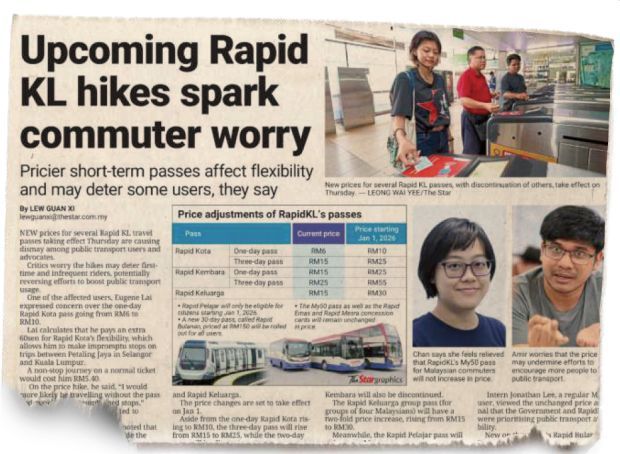
Critics worry the hikes – some as high as 120% – may deter first-time and casual riders, potentially reversing efforts to boost public transport usage.
On why the price adjustment was not done gradually, Prasarana said implementing multiple incremental increases over time would have led to more frequent fare changes, potentially causing confusion and uncertainty among users.
“The Rapid Kota pass, which will be priced at RM10 for one-day pass, offers unlimited daily travel across a network that is significantly larger and more connected than it was previously, and the adjustment reflects this expanded value proposition.
“It is also important to note that the Rapid Kota pass represents a relatively small share of overall ridership, with most daily commuters continuing to benefit from the unchanged My50 pass,” said Prasarana.
Addressing concerns that the fare increase could discourage first-time users considering a switch to public transport, Prasarana said attracting new users remained a key priority.
ALSO READ: Upcoming Rapid KL hikes spark commuter worry
“Entry-level fares and short-distance travel options remain accessible, and when benchmarked against other major global cities, Rapid KL fares continue to be highly competitive.
“Commuter research consistently shows that service reliability, frequency, connectivity and the overall travel experience are primary factors influencing first-time users to switch to public transport, beyond fare levels alone.
“In this regard, Prasarana remains firmly committed to strengthening reliability and service availability through ongoing key initiatives such as the Rail RAMS (Reliability, Availability, Maintainability, Safety) Programme, bus fleet replacement and the Rapid On-Demand (ROD) service,” it elaborated.
Prasarana said the recent fare adjustment for non-My50 pass users affected only a small segment of commuters.
“Of the non-My50 pass users, Rapid Kota pass users account for approximately 10 to 13%, or only 5% when compared to total Rapid KL ridership.
“Overall improvements to rail and bus services have also translated to complaints per million ridership decreasing from 3.21 in 2024 to 2.53 as of November 2025.”
Prasarana highlighted that the Rapid Kembara pass, designed primarily for tourists and visitors, is supported by nearly 50 tourism and lifestyle partners.
“In this context, the revised pricing is reflective of its intended use and value proposition.
“Rapid Bulanan is a new product priced based on an average utilisation rate of RM150.
“This pass is especially beneficial for non-Malaysian residents and frequent daily users such as expatriates, visitors and foreign workers who don’t have access to the My50 pass,” it added.