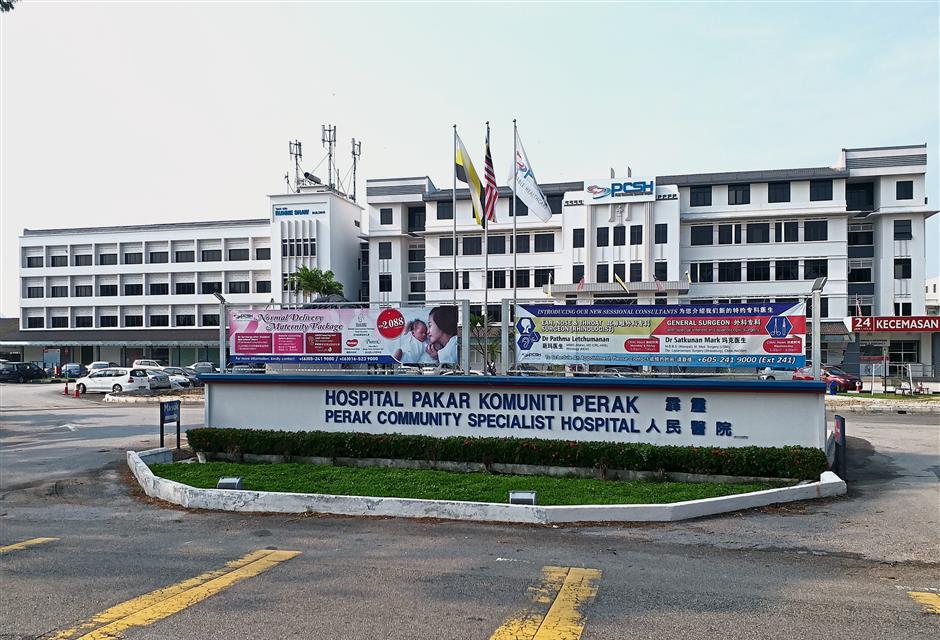
THE 114-year-old non-profit Perak Community Specialist Hospital (PCSH) in Ipoh needs funds to build a new six-storey building to expand its medical facilities.
The total cost for the project inclusive of new medical equipment is about RM65mil.
Formerly known as the Perak Chinese Maternity Hospital, the six-bedded medical centre was located in Chamberlain Road (now Jalan C.M. Yusuf) in Ipoh, run by the Perak Chinese Maternity Association.
In 1939, the hospital relocated to its current site in Jalan Raja Permaisuri Bainun to cater to the increased demand for maternity services and the need to train more midwives.
Association president Datuk Lee Hau Hian said the hospital started as a six-bedded maternity hospital by a group of professionals, supporters and members of the community.
He said free maternity services were provided then, and the hospital was used to train midwives for home deliveries, primarily to the families of Chinese tin miners at that time.
However, he added that over the years, PCSH evolved with the changing healthcare needs of the community into a multi-disciplinary specialist hospital.
“The hospital serves a wider community and provides a range of specialist medical care services beyond just maternity services.
“Our mission in providing affordable, quality healthcare to the community, particularly the lower income group still remains,” Hau Hian said at the hospital’s fundraising dinner in Ipoh.
Among those present were deputy health minister Dr Lee Boon Chye and hospital medical superintendent Datuk Dr Y.C. Lee.
Hau Hian added that those who could not afford the hospital’s fees, which is lower than other private hospitals, PCSH still provided subsidised and free medical care to deserving and needy patients since its inception.
He said as one of the few surviving non-profit hospitals, PCSH depended on financial support from well wishers, philanthropists and the community to fund its needs for growth and expansion.
“For its day-to-day operations, PCSH aims to be financially self-sustaining, while reinvesting profits back into new equipment and hospital development.”
Hau Hian said to upgrade and meet the current changing healthcare needs, PCSH would launch a new building project to include a new Imaging and Heart Centre.
Dr Lee said healthcare remained as the pillar of the hospital’s transformation as nothing could substitute good health of a person.
However, he said due to the prolonged economic downturn and high cost of living, most government hospitals were overburdened and could not offer special medical attention provided by private specialist hospitals.
“This gap has been filled by nonprofit community hospitals like PCSH, which plays an essential role in offering quality, yet affordable healthcare to the community especially the marginalised, poor and needy.
“The hospital has survived the Japanese Occupation in Malaya where its services were halted for five years and when government funds were not provided in 1969.
“(Despite that), the hospital continued to grow,” Dr Lee added.
In its fundraising magazine, several of the hospital’s significant milestones were recorded including its humble beginnings when the tin mining community in particular felt that a maternity hospital was an essential requirement to help deliver babies for the poor and working class.
In 1904, the hospital was set up as a charitable organisation and the founders’ objectives were to provide free and good medical services.
While operating as a six-bedded maternity hospital in a wooden bungalow, later in 1937 funds were raised for the construction of a new building completed in 1939 at the current site.
But in 1941, the first wave of Japanese planes bombed Ipoh and in 1942, the Japanese entered Ipoh and occupied key strategic buildings to set up military administrative centres for their army.
The Perak Chinese Maternity hospital was forced to vacate its building to allow the Japanese army to use part of it as their headquarters.
The hospital moved back to its original location in Chamberlain Road, and when the Japanese surrendered, the British Military Administration (BMA) occupied the hospital.
The BMA returned the hospital building in 1949, and the maternity hospital resumed operations at the premises.
In 1964, a well-known movie tycoon Tan Sri Runme Shaw contributed funds towards the construction of a new building.
In 1969, the hospital had to withdraw its free medical services to the public and started charging patients due to the rising costs, after the discontinuation of government grants.
In 2003, the hospital met the required standard quality management system and became a certified hospital.
The same year, the hospital’s name was changed to the Perak Community Specialist Hospital.
Already a subscriber? Log in
Get 20% OFF The Star Digital Access
Cancel anytime. Ad-free. Unlimited access with perks.