
WALKING through the streets of Kajang on a Thursday afternoon, I watch as a red iron artwork is placed near the sidewalk by a few men.
Intrigued by the piece, I walk closer.
“Where are you from?” a man greets me.
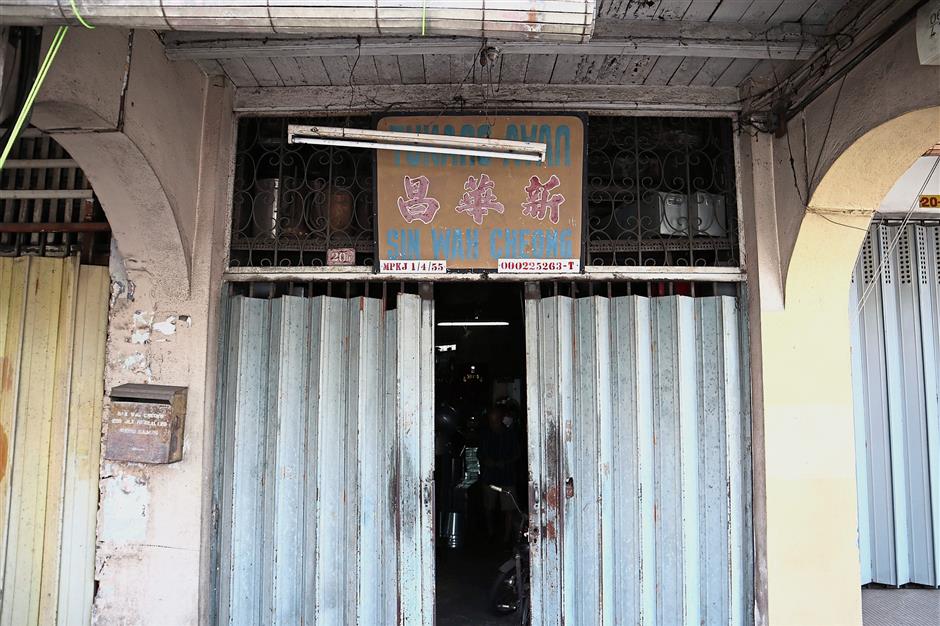
Sin Wah Cheong’s doors have been open since 1935, thanks to Low’s efforts and determination.
Guessing from his question, he must not have met many people who are interested in his activities.
I tell him that I am from the city and happen to be in Kajang to run errands.
“Oh, the city! I don’t see many city folk coming to this part of town often.”
On continuing the conversation, I discover that Lee Kim Sin runs the Kajang Heritage Centre near the artscape where we stand.
He gives me a backstory of the artwork and its significance to the town.
“It is about tin mining activities. Kajang has a lot of history and culture related to it. I wanted to collect the local history. We have some artworks in town and we plan to add another one on the wall right behind the artwork.
“We are going to put up photos of old Kajang town and some old paintings. Every piece has its own story,” Lee explains.
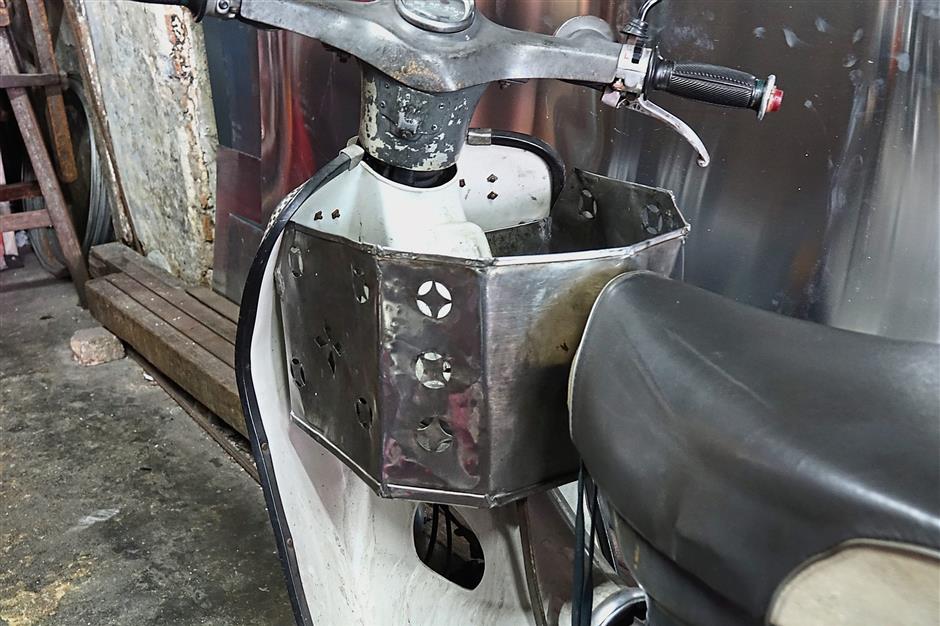
Low has added his personal touch to the utility basket on his old motorcycle.
Kajang town of the past housed many businesses, from traders to craftsmen and other commercial activities, and functioned mainly as a marketplace where rubber tapping and tin mining thrived.
“Have you seen that metal uncle’s shop?” he asks me, pointing towards a nostalgic yellow building opposite where we stood.
“You can hear uncle going ‘clank clank clank’ every day. The business is very old, around 80 years. He is the third-generation owner of the store,” he says.
My curiosity peaks and I cross over to the building where the shop is nestled deep inside, lighted only by natural sunlight.
If you do not look closely, you can miss it.
As Lee mentioned, I hear clattering sounds from inside the shop as I approach it.
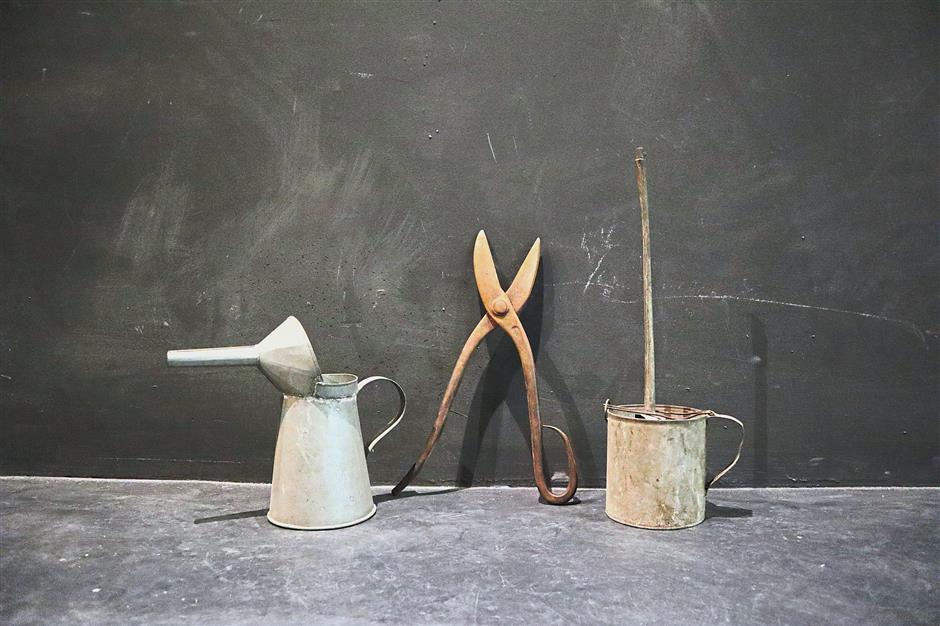
The carbide lamp (right) traditionally used by rubber tappers was the main item produced by Sin Wah Cheong in addition to other household items like tin cans (left) and shears. — Photos courtesy of HING RU CHENG
Looking inside, I see a man sitting on the floor in the middle of the shop, hunched over a rectangle piece of aluminium.
And that is how I came to know of Low Woo Ngee, the 78-year-old owner of Sin Wah Cheong tinsmith, the last of its kind in Hulu Langat.
I then sit down with him to learn more about his life and business.
Moulding the business
Formerly known as Sin Gong Xin, it is Kajang’s oldest operating tinsmith and metal welding business.
The shop remains in its original state since it first opened in December 1935 by Low’s granduncle.
His granduncle was among a large group that came from China in the early 1920s to become contract labourers in British-ruled Malaya.
Upon their arrival from Guang Dong province, the group stayed in Kajang.
It was then that Low’s granduncle started the tinsmith business, seeing it as a good opportunity because of the rubber estates nearby.
“When my father came to Malaya, he did not know anyone. So he sought refuge at my granduncle’s place and learnt the business from him.
“Eventually, the business was passed down to my father, who changed the name to ‘Sin Wah Cheong’,” explains Low, who took over the business from his father in 1967.
Asked whether he was obligated to continue the family trade, Low disagrees.
Having started learning the trade at the age of 11, his reasons for taking over were purely out of his own interest in the trade.
“I found the business (more) interesting compared to studying. That’s why I dropped out of school in Standard 5 and starting learning the trade.
When I was young, every time I asked my father for tips, he would ignore me and let me discover it myself. So I spent around three years trying to learn the basics,” he recalls.
“Normally, we would produce tools for rubber tappers like the kapai (carbide lamp), but ever since the rubber estates made way for development, I have only made products like household items,” he says, taking down decades-old items such as trays, wall-mounted envelope holders, signage and tools to show me.
Low, whose workplace is also his home, usually starts his work day around noon.
“I open the shop and start working on the orders. It usually takes me at least half a day to finish one item,” he says, adding that he opens the shop on weekends as well if there are many orders to fulfil.
A tough journey
It was never an easy ride for Low, who has faced many tests since the beginning.
When Low’s father passed away in 1967, he had to immediately step into his shoes.
Low was only 27 at the time, married and with three young children.
“Our lives during that period was quite difficult,” he said.
His pillar of strength through all those times was none other than his beloved wife, Chen Se Eng.
“She would go to the rubber estate in the morning, come back in the afternoon and help me cut aluminium,” he says, looking lovingly at his wife as she watches television.
Anyone who sees the couple will agree that they complement each other.
She corrects him whenever he makes a mistake or when he misses something out during our conversation, and Low occasionally looks to her for explanation.
Low has had accidents on the job.
“Thirty years ago, there was this one time when I was drilling holes on iron and my ring finger (left hand) got stuck in the machine. It’s gone now,” he says, showing his hand.
“Being a tin smith requires a lot of effort and strength. The process of producing an item is long. If you make a careless mistake, you may hurt yourself.
“The most important thing I can tell you about my business is to be patient and to practice every day, because practice makes perfect.”
Pausing and looking up for a moment, he continues, “I remember my father asking me back then if I would regret doing his business.
“I answered no because I really liked this job. I didn’t think too much about it. As you know, the older generation is used to a simpler life,” he smiles.
Craftsman at heart
“When producing these items, do you ever think of yourself as a craftsman?” I ask, looking at all the elderly man’s cherished accomplishments at the shop.
To this, Low chuckles and says no.
Walking around his workspace, I discover many beautiful things that the humble man has created, including a traditional Hakka lantern.
As I study the creation in awe, Chen comes up from behind and tells me, “He doesn’t do these lanterns anymore.
“It’s too hard for him to do as it involves too many intricate details. It would take a toll on him,” she says.
Turning around, I find something else that interests me.
In front of me is an old motorcycle, but it is different in that it has a touch of Low to it.
The motorcycle does not have the standard basket, instead it has been replaced with a metal one with cutout patterns on it.
More than just a man who moulds pieces of metal together into different items, I come to clearly see that Low has the hands of a craftsman.
Chasing spiders
Besides his business, Low talks about other aspects of his life, including a rare hobby he used to pursue called “spider fighting”.
“Back then, I used to collect spiders from trees usually by the riverbank.
“After that, I would put two male spiders in close range and have them fight. In Chinese, the game was called “Da Bao Hu” (fighting spiders),” he explains animatedly.
The spiders, he says, normally hid behind the leaves where they built their webs.
Low would carefully observe these leaves to see if there were any spiders. If he found any, he would pluck the leaves and try to catch the spiders.
He did not always succeed but on the occasions that he did, there was much excitement.
If you want to find them, you can. They still exist, but not as many as in my younger days,” he adds.
Preserving a legacy
The tinsmith is fortunate that all his hard work has paid off.
Low has been able to sustain his business until today, relying on his regulars who come from near and afar.
“Many of my customers are not from Kajang. They even come from Shah Alam, Puchong, Cheras, and other parts of the Klang Valley,” he says.
One question at the back of my mind is whether the business will go on after Low retires. I pluck the courage to ask him about the fate of the trade.
“No, I don’t think there will be anyone (tinsmith) after me,” he says, the sadness clear in his tone.
“There are no longer people practising these skills. Even if there are, they would be elderly people in their 70s and 80s.
“There is one shop in Kuala Lumpur that I know of but it has closed down,” he adds.
Building and city projects replacing rubber estates have affected the business, along with the high use of plastic products.
Low understands that the business cannot continue but he still harbours hopes that more people from the younger generations will learn about this once-thriving trade.
Already a subscriber? Log in
Get 20% OFF The Star Digital Access
Cancel anytime. Ad-free. Unlimited access with perks.