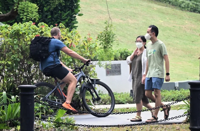
Hazardous homes in PJS 9


DESPITE having proper guidelines to prevent overcrowding in houses converted to student hostels, the issue is still a growing problem in some neighbourhoods.

This is evident in Subang Jaya, especially in housing areas near universities and Bus Rapid Transit (BRT) stops.

An example is PJS 9, which is not only surrounded by at least three institutions of higher learning but is also next to a BRT stop.

“There are about 840 houses here and from our checks, more than 100 have been converted into student hostels,” said PJS 9 Rukun Tetangga (RT) chairman Mohd Noor Ahmad.

He added that most residents do not object to the hostels being in the neighbourhood but they were not in favour of those that did not follow the guidelines laid out by the Subang Jaya Municipal Council (MPSJ).

The guidelines gives a clear list of the maximum number of occupants per student hostel according to the size of the premises.

For low-cost houses measuring 60 sq m with three rooms, the maximum number of occupants is six while for low-medium-cost houses measuring 69 sq m with three rooms, the maximum number of occupants allowed is seven.

For medium-cost houses measuring between 79 and 93 sq m, with three bedrooms, a maximum of eight people is allowed while houses above 1,000 sq ft with three or four rooms should only contain a maximum of ten occupants.

Apart from rooms, the guidelines also clearly state that the hostel owner must provide facilities such as living room, pantry, laundry room and clothes-drying area.

Consent from the immediate neighbours is also needed and these include the three houses facing the property.

Approvals must be obtained from the Fire and Rescue Department as well as utility companies such as Tenaga Nasional Berhad (TNB), to ensure the house is safe for occupancy.

“Clearly the hostel owners here did not get their immediate neighbours’ consent, otherwise there would be no complaints,” Mohd Noor said.

He added that there was one street in the neighbourhood with more than 20 student hostels and the residents faced a lot of problems including insufficient and haphazard parking, indiscriminate dumping of garbage and noise pollution.

“Sometimes, students will turn on their music really loud and some even sit with friends in their cars and blast the music till late at night,” said resident Stella Chai.

Houses in the area are all double-storey terrace units with a built-up area of about 111 sq m per floor and a height of 2.7m.

Chai lives opposite a student hostel, which she believes has been renovated into at least 12 bedrooms.

“We didn’t even know that the house opposite mine was being turned into a student hostel until I asked the contractor one day and he told me he was building 12 rooms in the house,” she said.

Because it was a private residential premises, curious residents were not allowed to look into the house to see if the living condition inside is safe or comfortable for the tenants.

They only found out what was happening by speaking to contractors and observing the daily activities.

“The students are so inconsiderate that my son cannot even find a place to park when he comes home after work,” she said.

Now, she has resorted to placing a cone outside her house to reserve the parking spot.

Residents had also seen garbage trucks turning away from the road because it could not drive through.

“The truck actually reversed out and left our rubbish uncollected.

“Once, a fire truck could not get in to put out a blaze that broke out in the TNB substation here,” said resident Lim Ka Tin.

When StarMetro visited the area, it was difficult to find a parking spot despite it being a working morning when a majority of the residents would have either left for school or work.

When walking along the street, the student hostels looked like any other house.

The main gates at most hostels were left ajar but the curtains on the windows were drawn tight and the front door has security features such as a key card system.

From the outside, the various room partitions could be estimated based on the number and placement of air-conditioning compressor units.

“We went around counting and we noted that most houses had more than 10 air-conditioners,” said Lim.

The air-conditioning units were more visible at corner lots, with more than six attached to the side wall, two under the front roof and another two under the back roof.

Some even have two or more units attached to the front porch, indicating that the living room had been turned into partitioned rooms.

Lim said that one of his neighbours opposite his house had complained to him that there was someone peeping into their bathroom.

It was then that they found out the hostel has an extra room built in the “attic”, which is the shared roof area linking all the houses.

“Some of the houses even have individual power meters for each room, which I think is to help the owner charge the tenants separately for electricity usage,” he said.

This discovery was made when one of them managed to look into one of the houses.

“This is just unacceptable, what’s worse was that at 9.20am when I wanted to go to the bank, the junction turning into my area was congested with cars trying to come in.

“The cars were all occupied by students who were looking for parking spots and their cars would be left there until evening,” said resident Siva Nesan.

Sometimes, residents see cars left for more than a week, believed to belong to friends of hostel tenants who left their vehicles there to go on holiday.

Residents had even reported the stationary cars as possible missing vehicles because it had been left there for too long.

“We are expecting more of these student hostels to be built here because it is a very strategic place,” said resident Elaine Quah.

Her house is surrounded by student hostels, which she does not object to but hopes that the owners follow the proper guidelines.

“The students are not exactly friendly; when we approach them to move their cars, they just ignore us,” she said.

Currently, residents are helping the Subang Jaya Municipal Council (MPSJ) identify the student hostels for the officers to check if it has been registered.

They also urged MPSJ to be stricter in enforcing their guidelines and to take action against house owners who did not follow the guidelines.

Get 20% OFF The Star Digital Access

Monthly Plan

RM 13.90/month

RM 11.12/month

Billed as RM 11.12 for the 1st month, RM 13.90 thereafter.

Best Value

Annual Plan

RM 12.33/month

RM 9.87/month

Billed as RM 118.40 for the 1st year, RM 148 thereafter.

Follow us on our official WhatsApp channel for breaking news alerts and key updates!

Others Also Read