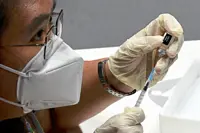
Why do some people still refuse to get the Covid-19 vaccine?


In Hong Kong, efforts to boost the city’s lacklustre inoculation drive includes allowing only vaccinated customers into entertainment centres like night clubs and karaoke joints. — PAUL YEUNG/Bloomberg

Despite all those pesky surveys – ours included – telling us the vast majority of people wish to travel internationally right now... do we, really? And what caveats apply?

One question we continue to pose to our global audience is whether international air travel should be limited to vaccinated passengers. We continue to receive a mixed bag of responses with just a little over 60% demanding full vaccinations for travellers (“Of course, are you stupid?” – from Canada) but a substantial 40% resisting (“I am waiting for an enterprising aviation company to offer air services for those who cannot or will not get vaccinated” – from Hong Kong).

These two quotes sum up the extremes of thinking in the two camps. Those voting against vaccinations come from regions as diverse as Indonesia, Hong Kong, Portugal, Sri Lanka and Australia, while those in favour tend to be from India, Thailand, China and the United States.

ALSO READ: Is vaccine optimism in the air for tourism sector in Malaysia?

The no vote underlines both the inability to access vaccines (or vaccines of choice in some cases) as well as a deep distrust of governments, often accused of conflating health with other mysterious agendas.

In Hong Kong, where the government has a poor record of communication, it was earlier whispered vaccines were a nefarious attempt to grab citizens’ DNA (something that could be easily accomplished by visiting any barbershop to sweep up the hair). A microchip was to be inserted along with the Covid-19 vaccination to track your movements.

Well, the Hong Kong smart ID card (as in other countries) already carries all the bearer’s information and any smartcard transaction on a bus, train, or at a convenience store, reveals movements and purchases in real time.

With all those CCTV cameras from London to Beijing and face-recognition AI, swanning around by stealth is not really an option anywhere. Are you hamstrung by humbug?

Rumour and misinformation is rife from the US to Hong Kong and India where chat groups have muscled out newspapers and magazines that actually bother to check facts. In many countries, language limitations have further isolated people from international news currents. Large numbers have been left behind in echo chambers easily exploited by hackers, radicals, or those disenchanted with any regime. Politics has wrongly become a litmus test of fact for many.

“But Hong Kong is safe,” one friend told me, “and there are side effects to the vaccine.” To this I simply say, read the international news (not chat forums) and look at Taiwan, or Singapore, or India. There’s a tsunami sweeping the globe. It’s time to leave the beach and head to safer high ground. A vaccine can get you there.

Side effects are common even with spicy hotpots that send people to hospital with alarming regularity. Yet no one thinks twice about dipping into a fiery communal slurp. If you really buy into scary movies, read the fine print on over-the-counter medicines and peruse the list of potential side effects that may kill you. This is true of antipyretics for fever, cough syrups and even penicillin. Even innocent kissing can give you mononucleosis, or mono.

What has become clear to many corporations – and governments toying with everything from free burgers to dating deals to promote vaccinations and restart business – is that holidays and cash incentives can only go so far. The real leap has to be made with education and good, honest information that transcends national borders.

Nor is vaccination a lifestyle choice “for when I decide to travel”. It is a life-saving decision that protects you and those around you.

The online social ecosystem feeds on fear, outrage and snark humour. Outrage and fear drive clicks and this determines the nature of the discourse online. It is time to stop living in fear. It is time to step out of Google, Facebook, WhatsApp, LINE and WeChat, for a contemplative moment, in the real world. Other journeys await as well.

I came across Michael Crichton’s Travels sometime in the early 1990s. An avid Crichton fan since his gripping Andromeda Strain, I fell upon it to discover this was no giddy giggle about swaying palm trees and 400-thread-count hotel linen. The book detailed the author’s serendipitous journeys into self-discovery and inner travel – mysticism, sharks, conversations with a cactus, mountain climbs, rainforests, psychic adventures, chakras and astral wanderings.

A Harvard doctor who fainted at the sight of needles and abandoned medicine for writing, Crichton was a huge success and not just for his towering 206cm(!) “rainforest canopy” frame. Yet he felt the need to get away from himself, from things familiar, in order to find himself.

The farther you go from home, the better you understand yourself. Things come into sharp focus. It may seem like an odd thing to say but it is only when you’re at a remove from that quotidian bedlam that you see yourself for what you actually are.

In Delhi, whenever asked where I was from, I’d say, Hauz Khas, a residential district. In South India, I would say I was from the north. In Thailand I said I was Indian only to be presented with a most curious statement (a compliment, I was later told), “But you don’t look Indian at all!” I was never sure whether to laugh or hurl insults back or to leap on the nearest elephant and ride off into the sunset playing a sitar.

In London I found myself comfortable in the cloak of South Asian anonymity and, in the US – where I was perceptively asked if there was an embassy for Kentucky in my country – I was just a bog-standard Asian. It simplified things.

It occurred to me then that only if I found myself asked the same question on Mars, would I point and say, Planet Earth. Thus it is, our identity expands and contracts with travel. The more we travel the more reasonable we become as we see the big picture and the more we blend in.

The one universal lesson to be learned from Covid-19 is that as life has slowed it has become extraordinarily rich. More people now see the value of relationships over stuff, be it diamonds or Dior. When loved ones depart we cut through the clutter in moments of instant clarity. And thus we shall return to our travels and humdrum travails, strengthened, not weakened, by this timeout.

Get that inner spring-cleaning done before the clicks and emojis overwhelm you once more. Hug someone. And do stock up on colourful masks. Have vaccination will travel.

Vijay Verghese is a Hong Kong-based journalist, newspaper columnist, and the editor of AsianConversations.com and SmartTravelAsia.com.

Get 20% OFF The Star Digital Access

Monthly Plan

RM 13.90/month

RM 11.12/month

Billed as RM 11.12 for the 1st month, RM 13.90 thereafter.

Best Value

Annual Plan

RM 12.33/month

RM 9.87/month

Billed as RM 118.40 for the 1st year, RM 148 thereafter.

Follow us on our official WhatsApp channel for breaking news alerts and key updates!

Next In Travel

Airports, airlines warn new EU border checks disrupt summer travel
A rising interest in offbeat destinations across Asia
Hello from the other side: Why Penang's Bukit Mertajam is worth a visit
To better understand the American Revolution, go to Barbados
Explore the world with local airlines' holiday campaign, expanded reach
Activists launch new case against luxury lodges in Maasai Mara
Promoting eco-tourism products in Kedah and Penang
Tourists soldier on in Rome despite the blistering heat
Thailand gets serious about chasing high-spending tourists
Floating markets in South-East Asia to check out

Others Also Read