


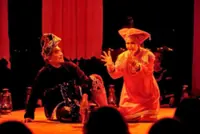
The beauty of traditional Minangkabau clothes in Negri Sembilan


Apart from the unique architecture, the clothes are also an important aspect of the Minangkabau, who make up the majority ethnic group in Negri Sembilan. - Tourism Malaysia

Siti Syahidah Husaini remembers wearing a bright headdress to a Merdeka Day celebration at school. Made from gold and silver songket cloth, the headdress turned some heads that day.

“I felt so special wearing the most recognisable Minangkabau clothing item – the headdress. At the same time, I was really happy I got to showcase my Minangkabau heritage, ” said Siti Syahidah, 32.

Known as Tengkuluk Tanduak or Tikuluak Tanduak, the headdress is an important symbol of the Minangkabau culture in Negri Sembilan. The headdress is shaped like a double-pointed horn, decorated with either gold ornaments or gilt brass.

An Ibu Soko wearing a Tengkuluk Tanduak (Tikuluak Tanduak), a double-pointed horn headress — Photos: TUAN PUTERA JEFRIZAL
The full headdress of a Minangkabau woman, usually worn in Adat Perpatih ceremonies, tells a great deal of one’s background and social status. The hat made from embroidered balapak cloth will reveal whether or not the woman is a Bundo Kanduang (or Ibu Soko), as well as which suku (clan) and region she is from.

Ibu Soko are the well-respected senior female leaders of a clan, according to Adat Perpatih traditions. Negri Sembilan is the only state in Malaysia that practises Adat Perpatih, a combination of practices and rules that govern various areas of social life that originated from the Minangkabau Highlands in Sumatra, Indonesia.

Matrilineal customs are observed and women are held in high regard. One of the most unique – and visible – aspects of the Negri Sembilan Minangkabau culture is the colourful garments.

The clothes worn by Minang men and women to special ceremonies are often woven with motifs that can be translated into a series of proverbs and epigrams.

For Siti Syahidah, the Minangkabau clothes are a source of pride. Wearing the colourful outfits gives her a sense of belonging.

“My mum was the one who taught me about our heritage. She said that the clothes are a symbol of pride for our community as the world’s largest matrilineal society, ” she shared.

Three years ago, Siti Syahidah even made her own Minangkabau attire for a traditional costume competition.

To her, making and wearing the traditional clothes are her ways of keeping the heritage alive in today’s modern world.

Layered meanings

Negri Sembilan is indeed the cradle of Minangkabau culture. Travellers to the state would immediately be taken in by the “buffalo horn” architecture that are prevalent there.

Minangkabau women from Luak Ulu Muar in simple Minangkabau costumes.
But apart from the unique architecture, the clothes are also an important aspect of the Minangkabau, who make up the majority ethnic group in the state.

Tuanku Jaafar Royal Gallery curator Mohd Khairil Hisham Ashaari said the Minangkabau clothes hold a wealth of traditions.

“Wearing and learning about Minangkabau attire are unique ways to experience Minangkabau tradition and culture while visiting Negri Sembilan, the land of adat,” he said in an interview.

The gallery in Seremban held an exhibition on Minangkabau heritage just before the latest movement control order came into effect. “This would be a good platform for the people to understand the Minangkabau heritage which is widely associated with Negri Sembilan,” said Mohd Khairil of the exhibition.

According to him, it is important to preserve the clothes and learn of their symbolism. Elders need to pass down their knowledge to the younger generations to keep the heritage alive. “Despite the fact that there are only a few tailors who can make full Minangkabau costumes in Malaysia today, there are many Minang people who still wear the traditional costumes to attend ceremonies such as leaders’ inauguration and wedding receptions, ” he said.

Khairil says that wearing Minangkabau costumes is one of the best ways to experience Negeri Sembilan. — MOHD KHAIRIL HISHAM ASHAARI
The design of the clothes are quite specific, especially those worn during adat ceremonies.

Mohd Khairil revealed that male leaders dress in black velvet to symbolise leadership, and their outfits are decorated with “minsie” (a gold or silver piping) around the neck, sleeves and cuffs, to portray a democratic spirit.

The other components of the clothes – keris, ikak pinggang (ceremonial waist sash), destar (headgear), sasampiang (kain samping) and sarawa (pants) – all have their individual meanings too. “Commoners are not allowed to wear the same designs of destar worn by royalty. Some examples of royal attire are ‘cilieng manurun’ (coastal king destar), and ‘destar raja’ or ‘destar ameh’ (king destar). “The penghulu uses ‘destar gadang’ and ‘desta saluak batimbo’, ” Mohd Khairil explained.

For women, there is the Limpapeh Rumah Nan Gadang attire (also known as pakaian adat) which symbolises the wife, who is the core of the family.

While the above are used in ceremonies, simple baju kurung or kebaya is worn daily. The most common is the Baju Kebaya Setengah Tiang, which is made of thinner cotton to represent moderation.

Baju kurung with detailed decorations like brocade are also worn by commoners during wedding receptions and other ceremonies. Some may also wear Baju Kebaya Pendek and Baju Kebaya Panjang with kain sarung balapak.

Commoners would stick to wearing simpler accessories, too, while the Ibu Soko would wear more lavish ones, particularly during adat ceremonies.

Passing the knowledge

Although born into a Minangkabau family, Tuan Putera Jefrizal, 35, did not speak the dialect nor wear the traditional costumes as a child.

That changed as he got older and began to realise the uniqueness of his heritage. With his interest piqued, Tuan Putera looked for reading materials, met older generations and attended adat ceremonies to better understand the Minangkabau culture.

“Minangkabau crafts and traditional clothing are the most visible parts of the culture. The Minang cloth always has its own characteristics, and symbolises life values. At present, the clothing tradition is vital in Minangkabau culture and reflects the world as it is today, ” said Tuan Putera, who is the president of Waris Keturunan Anak Minang (Wakam).

Wakam aims to ensure the continuity of Minangkabau culture for future generations, as well as create more awareness among the general public in Malaysia, as well as internationally.

“Although the clothes are not commonly worn today, some younger people are beginning to don the destar, although without the complete traditional outfit, ” Tuan Putera said.

He recalled feeling very proud when he wore his native costume for the first time a couple of years ago.

Once, he even wore the traditional costume while commuting in Kuala Lumpur, and got many queries from curious locals as well as international travellers.

“The costume is unique and is always an ice-breaker. Its motifs are based on our folklore that is full of wisdom and the natural world’s philosophy, ” he said.

Many songket motifs used by Minangkabau people possess delightful meanings.

One of the most popular motifs is itiak pulang patang (ducks go home at dusk). The name refers to the way ducks move together in lines and is used to demonstrate the way a person should follow adat closely wherever he or she goes.

Meanwhile, the iconic triangular pucuak rabuang (bamboo shoot) can be interpreted in several ways. One of the most popular is that a man should always be humble despite his accomplishments, and be useful in all stages of his life. “The Minangkabau traditional costume, including the headdress, carry deep meanings. This is something we can’t afford to lose, ” Tuan Putera said.

He hopes that in the future, Minangkabau costumes won’t be something that are only found in museums.

Restyle for continuity

Ros Mahwati wants designers to bring traditional Minangkabau attire into the modern world. — ROS MAHWATI
The desire to see Minangkabau clothes thrive is shared by Dr Ros Mahwati Ahmad Zakaria. The research fellow at Universiti Kebangsaan Malaysia’s Institut Alam & Tamadun Melayu (ATMA) said fears of the costumes being forgotten is warranted as the younger generation is not exposed to the Minangkabau culture.

“Actions must be taken to ensure traditional cultures thrive in the modernisation wave, in order for them to continue flourishing in the future, ” said Ros Mahwati. The researcher proposed that local fashion designers inject modern elements and creativity into the current costume designs. At the same time, standard features – such as the headdress and tailoring style – should be maintained.

“The core values of the Minangkabau people and culture must not be overlooked when ‘re-imagining’ the traditional costumes. It must always adhere to the concept of Adat bersandi Syarak, Syarak bersandi kitabullah, ” she said, explaining that one needs to do everything according to the Islamic code of life, which is central to their culture.

Ros Mahwati stressed the importance of preserving the tangible cultural heritage, and that parents should take the lead when it comes to teaching children about their culture.

“For instance, children can be taught about the variety of costume components and its meanings, which might lead to an interest in wearing the outfits, ” she said.

Get 20% OFF The Star Digital Access

Monthly Plan

RM 13.90/month

RM 11.12/month

Billed as RM 11.12 for the 1st month, RM 13.90 thereafter.

Best Value

Annual Plan

RM 12.33/month

RM 9.87/month

Billed as RM 118.40 for the 1st year, RM 148 thereafter.

Follow us on our official WhatsApp channel for breaking news alerts and key updates!

Next In Travel

Hello from the other side: Why Penang's Bukit Mertajam is worth a visit
To better understand the American Revolution, go to Barbados
Explore the world with local airlines' holiday campaign, expanded reach
Activists launch new case against luxury lodges in Maasai Mara
Promoting eco-tourism products in Kedah and Penang
Tourists soldier on in Rome despite the blistering heat
Thailand gets serious about chasing high-spending tourists
Floating markets in South-East Asia to check out
This airline has an in-cabin wellness zone for its nearly 20-hour direct flight
Chinese travellers choose South-East Asia destinations this summer

Others Also Read