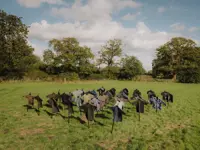
The warmer climate in England this past few months gave rise to the cultivation of some unlikely crops: tea, cantaloupe and vintage T-shirts.
William Cotterill has been tending to that last variety on a 15-acre (two-hectare) plot of land about a half-hour from his shop, Millennial Vintage, in Stockport, England.
The field is dotted with posts draped in old band T-shirts, which he hoses down with salt water and dries in the sun.
He repeats this process twice a week for six weeks, then dismounts the garments once they’ve achieved a satisfactory level of discolouration.
Admiring his handiwork, he said he had had “fantastic harvests” this year on his “fade farm”.
Cotterill, 34, is part of a group of savvy sellers speeding up the appearance of patina themselves to meet the demand for distressed vintage garments.
As some shoppers have grown tired of corporate fast fashion and bland quiet luxury, they’ve become enthralled with tattered, moth-eaten and sun-bleached garments that show traces of the original owner’s habits and lifestyle.
Less appealing to some, though, is having to wait years to put in the wear yourself or to pay the premium for authentically aged clothes, priced like fine wine.
Fade farming achieves a similar effect in a truncated time frame, allowing Cotterill to take a stack of dead stock, never-worn caps from the 1990s and make them look as if your dad had worn them to mow the grass your entire childhood.
Left unfaded, “they might sit on a shelf for another 20 years”, he said. “Whereas these sell quite quickly because distressing is very in right now.”
He started building his fade farm in March of last year after seeing one in the Italian countryside on Instagram.
Tthe owner of that Instagram page (@oldirtyyy), which others cited as their inspiration, did not respond to requests for comment.
Raking in hundreds of thousands of views with a series of updates every two weeks of T-shirts gently flapping in the sun, the videos have inspired vintage sellers – those with the land and the wherewithal – to attempt something similar.
Since then, fade farms have cropped up in West Virginia, France, Thailand and beyond.
In a community preoccupied with what counts as “true vintage” and dozens of other fine distinctions, the practice is a subject of debate. Those who prize stained work jackets from the 1930s as the height of authenticity see fade farming as dubious.
“I sell clothes to people who want to feel something,” said Jack Richards, a 20-year-old business student from Orlando, Florida, who sells torn, splattered and faded vintage T-shirts for as high as US$675 (approximately RM2,780) under the handle Jolly Jack.
“You can always tell it’s a fade-farmed tee because it’s too perfect. They’re cheating their way to the end.”
James Brassard, 19, left some of his personal vintage T-shirts on hangers out in his parents’ backyard in Montreal before going on vacation for three weeks in June.
Wanting to “create a fade here and there”, he also found the results put him at an advantage in the “race to get the shirt with the craziest fading and the craziest distressing” in his local vintage community.
But where available, Brassard prefers a natural fade.
“I go to the bins a lot,” he said, referring to the large crates at places like Goodwill. “So most of the clothes I wear, I’d say, are natural fades and real distressing.”
Other fade farmers argue that the practice is more virtuous than the ones undertaken by mall brands like American Eagle, Gap or Banana Republic, which helped the distressed style gain mainstream appeal in the 1990s and 2000s by letting big factories put in the rips and frays.
Even those with varying notions of verisimilitude generally agree that such mass-produced pre-distressing occupies the bottom rung in the hierarchy of cool.
Trevor Shue, 23, who fade farms and is a co-owner of Lucky Dog Vintage store in Winston-Salem, North Carolina, said his DIY practice was “hands down better than what some big clothing brands are doing”.
He pointed to Abercrombie, which has started reissuing Y2K-era pre-distressed garments as part of an archive collection, as one corporate brand trying to capitalise on the appeal of the thrashed vintage look.
“I think that is where the criticism should be projected,” he said.
Some also appreciate the elements of physical labour and craft that can go into the practice, which requires someone to spend time outside in the sun, wrestling clothes on and off wooden stakes.
Since he started posting online about the small fade farm on the rooftop of his parents’ home in Wonju, South Korea, Se Jae Park has been getting messages from interested buyers, as well as inquiries for custom fades.
“I originally didn’t start doing this to sell clothes or take commissions,” Park, 35, said in an email.
“Maybe the people who like my clothes are people like me, who can’t stand buying something new.”
Richards, the Florida business student who started out more skeptical, said he saw fade farming as a slower, natural alternative to machine pre-distressing, a method used by brands trying to make a lot of product.
“It can be cool, but only when sellers are making sure people know that a piece has been fade farmed,” he said.
“Because 80% of the T-shirt’s value is because of the heart, the sweat and the work that actually went into making that fade.”
Cotterill is open about what pieces have been out on his farm. The listings for some of his items read like a butcher explaining a dry-aged piece of steak: “Faded outside in a field for six weeks.”
The farm-to-table method comes with higher prices – a dead stock, single-stitch, black T-shirt from Cotterill’s store may sell for £25 (RM135), but one that came from his fade farm runs about £45 (RM243).
That’s still on the cheaper side, as far as convincingly distressed garments go.
Some who feel the draw toward pricier vintage – or designer things made to look vintage – use fade farming as a way to make more affordable dupes.
One of Park’s most popular tutorials, for instance, is how to replicate the fading on a waffle-knit henley shirt from RRL on one from Uniqlo.
“Of course, I have a daughter now, so there are plenty of other things I need to spend money on,” Park said.
He sells his fade-farmed henleys for about US$120 (RM495) on a site called Fruits Family, an online marketplace akin to Grailed.
Cotterill said he tried to keep his stock relatively affordable to ensure the clothes “go out and are worn by somebody, because that’s the whole point of vintage”.
But he is also factoring in his own time preparing the land and setting up the posts, and the amount of research and development that’s gone into it.
The online reception to Cotterill’s age-induced garments is sometimes critical, he said. But plenty of people walk into his showroom and ask about his rack of fade-farmed clothing, perking up when he shows them his video updates and his notes on humidity and UV exposure to achieve the results. – ©2026 The New York Times Company
This article originally appeared in The New York Times.