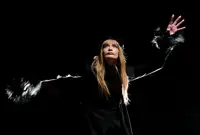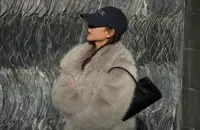
Vera Von Lehndorff, who as Veruschka, one of world’s first supermodels, blurred the lines between fashion and art and, in the process, became a pop-culture icon of the Swinging Sixties far beyond the confines of the runway and magazine spreads, died Tuesday (Nov 24) in Berlin. She was 87.
Her death was announced on the website of Grafin Von Lehndorff, a clothing company owned by her sister Catharina Kappelhoff-Wulff.
For more than a decade, the German-born Veruschka was the stunning standard-bearer for a rapidly changing cosmopolitan culture, defined by bright colours, strong women and the collapsing barriers between high art and pop sensibilities.
At six-foot-one (185cm tall) and just 125 pounds (56kg in weight), she literally stood above the crowd, even when she was wrapping her body in complex athletic poses, draped in diaphanous shifts and gowns for star photographers such as Richard Avedon, Irving Penn and Helmut Newton.
At one point, she was said to be the highest-paid model in the world, commanding US$10,000 (approximately RM41,200) a day.
“There are imitations of Sophia Loren, only not as good,” Avedon once said, “And a new Garbo is discovered every decade, but there is and will always be only one Veruschka.”
More than just a muse, Veruschka was a collaborator, often going directly to Diana Vreeland, the powerful editor of Vogue in the 1960s, with detailed suggestions for photo shoots.
Read more: A Prada runway past? This US politician has quite the fashion backstory
“I could call her up and say, ‘Diana, I have an idea,’ and she would listen to it, and if she liked it she would say, ‘Great! Let’s do it,’” Veruschka said in a 2000 interview with Dutch, a fashion magazine.
She considered herself an artist and saw modelling as an extension of her creative vision.
“I transform myself,” she told The New York Times in 1996. “My body is my instrument and with that I work.”
In New York City, she took acting classes to understand her body better.
She said that Veruschka – the Russian diminutive of Vera – was a character she made up for her career, an alter ego that hid her private self.
“I like to attack modelling as acting,” she told The Honolulu Star-Bulletin in 1966. “When I model, I make a story up.”
That same year, she had a brief but memorable role in the hit film Blow-Up, directed by Michaelangelo Antonioni.
She played herself, posing suggestively for a photo session with a swinging London fashion photographer (David Hemmings) that ends with him, camera clicking away, bestride her as she writhes on the floor – an instantly iconic image that became the centrepiece of the film’s poster.
By one count, she appeared on some 800 magazine covers. But she was most closely associated with Vogue and Vreeland.
She was on the cover of US Vogue 13 times in 10 years, and in hundreds of photos inside its pages.
Many of her shoots pushed the boundaries of what fashion could be.
In one shoot, she posed in body paint; in another, at the Grand Canyon, she wore outfits pieced together from wires. Artist Salvador Dalí covered her in shaving cream to create a “living sculpture.”
Although intensely private, Veruschka occasionally dropped hints about her aristocratic roots, which only added to her air of mystery.
She was born Vera Gottliebe Anna Grafin Von Lehndorff-Steinort on May 14, 1939, in Konigsberg, then part of East Prussia and now known as Kaliningrad, in Russia.
She was raised at her family’s estate, Steinort, in what is now part of Poland.
Her father, Heinrich, was a member of the Prussian nobility, as was her mother, Gottliebe (Von Kalnein) Von Lehndorff-Steinort.
At the start of World War II, Joachim Von Ribbentrop, the German foreign minister under the Nazi regime, requisitioned Steinort as his headquarters.
The family was allowed to stay on, and Nazi propagandists captured film footage of young Vera playing with Von Ribbentrop.
Her father was a member of a 1944 plot by Prussian nobles to assassinate Adolf Hitler.
It failed, and he was captured and executed in Berlin. Gottliebe Von Lehndorff-Steinort, pregnant with her fourth daughter, was arrested, and Vera and her two sisters were placed in a concentration camp.
The family reunited after the war, living in refugee camps before settling in Hamburg.
Vera enrolled at the Hamburg University Of Applied Sciences in 1958 to study design but soon left to pursue painting in Italy.
While living in Florence, she was approached at the Uffizi Gallery by photographer Ugo Mulas, who suggested that she consider becoming a model.
Through his connections, she was soon in front of cameras in Paris and New York, but said that she felt self-conscious about her height and size-11 feet.
Read more: Celebrity Style: Is Robert Pattinson Hollywood's dark knight of fashion?
Eventually, she returned to Italy, where she began a relationship with photographer Franco Rubartelli.
Together, they worked on developing her modelling skills – above all, how to use her height to her advantage by contorting and extending her limbs.
By 1964, she was in high demand on both sides of the Atlantic.
She worked closely with Vogue and with a small number of photographers, but resisted signing long-term contracts, for fear of losing her artistic independence.
Even at the height of her fame, Veruschka said she was ambivalent about modeling; she found it boring, grueling and invasive.
As the expansive energies of 1960s fashion gave way to a more sober, monochromatic sensibility in the early 1970s, she began to think about quitting.
Vogue fired her greatest supporter, Vreeland, in 1971, and Veruschka clashed with Vreeland’s successor, Grace Mirabella.
When Mirabella insisted that she cut her hair short to look more au courant, she quit working with the magazine and left modelling altogether in 1975.
Veruschka was linked romantically with celebrities such as Dustin Hoffman and Al Pacino, but she never married.
Along with her sister, she is survived by another sister, Gabriele Von Plotho. A third sister, Nona Von Haeften, died in 2018.
After leaving modelling, Veruschka returned to her career as an artist.
In 1986, she and photographer Holger Trulzsch published Veruschka: Trans-Figurations, in which she appeared in body paint patterned to make her disappear into the background – a door, a tree, a wall, the sky (Susan Sontag, a longtime admirer, wrote the foreword).
Veruschka also acted occasionally, in art-house films such as Dorian Gray In The Mirror Of The Yellow Press (1984), by Ulrike Ottinger, in which she played the title character.
She also had a cameo role in the 2006 James Bond film Casino Royale, in which she appears as a glamorous card player during a high-stakes poker game.
After spending several years in New York City, she returned to Germany in 2005, settling in a quiet suburb of Berlin.
She occasionally returned to the fashion world, walking the runway at a 1994 show for Chanel and appearing in the Autumn/Winter lookbook for Acne Studios in 2019.
“I never wanted to be a model, a meaningless object,” she told the German newspaper Bild in 2008.
“Fashion never really interested me. I only used it to transform myself. My dream has always been to be able to disappear when I don’t feel comfortable, to be absolutely free.” – ©2026 The New York Times Company
This article originally appeared in The New York Times.