
The watch world erupted in controlled chaos on May 16 when Swatch and Audemars Piguet (AP) launched Royal Pop, a collaboration that turned one of haute horlogerie’s most revered designs into bioceramic pocket watches costing less than S$600 (RM1,800).
The launch generated enormous buzz and visibility, but it also underscored the growing power of engineered scarcity in luxury marketing and the willingness of consumers to queue for hours − despite limited availability and no guarantee of securing a piece − even when the watches are not officially limited editions.
For weeks before the official announcement on May 12, cryptic teasers in newspapers and on social media hinted at something “iconic” and “unexpected”.
Fans filled the gaps with speculation and artificial intelligence-generated mock-ups spread rapidly across Reddit, Instagram and watch forums.
Strict non-disclosure agreements, tightly controlled teams and minimal advance materials, however, meant that credible images and details did not surface before the reveal.
The secrecy intensified speculation, sending anticipation into overdrive.
When Royal Pop was finally unveiled, it caught almost everyone off-guard.
Instead of wristwatches, Swatch and AP introduced eight colourful bioceramic pocket watches that borrowed some of the most recognisable elements of Gerald Genta’s Royal Oak design: the octagonal bezel, “Petite Tapisserie” dial pattern and eight exposed hexagonal screws.
The collection came in two configurations: Lepine models with a crown at 12 o’clock, and Savonnette pieces with a crown at 3 o’clock and a small seconds subdial.
lnside, the watches used hand-wound SISTEM51 movements, mechanically interesting for their minimalist design but far removed from traditional haute horlogerie.
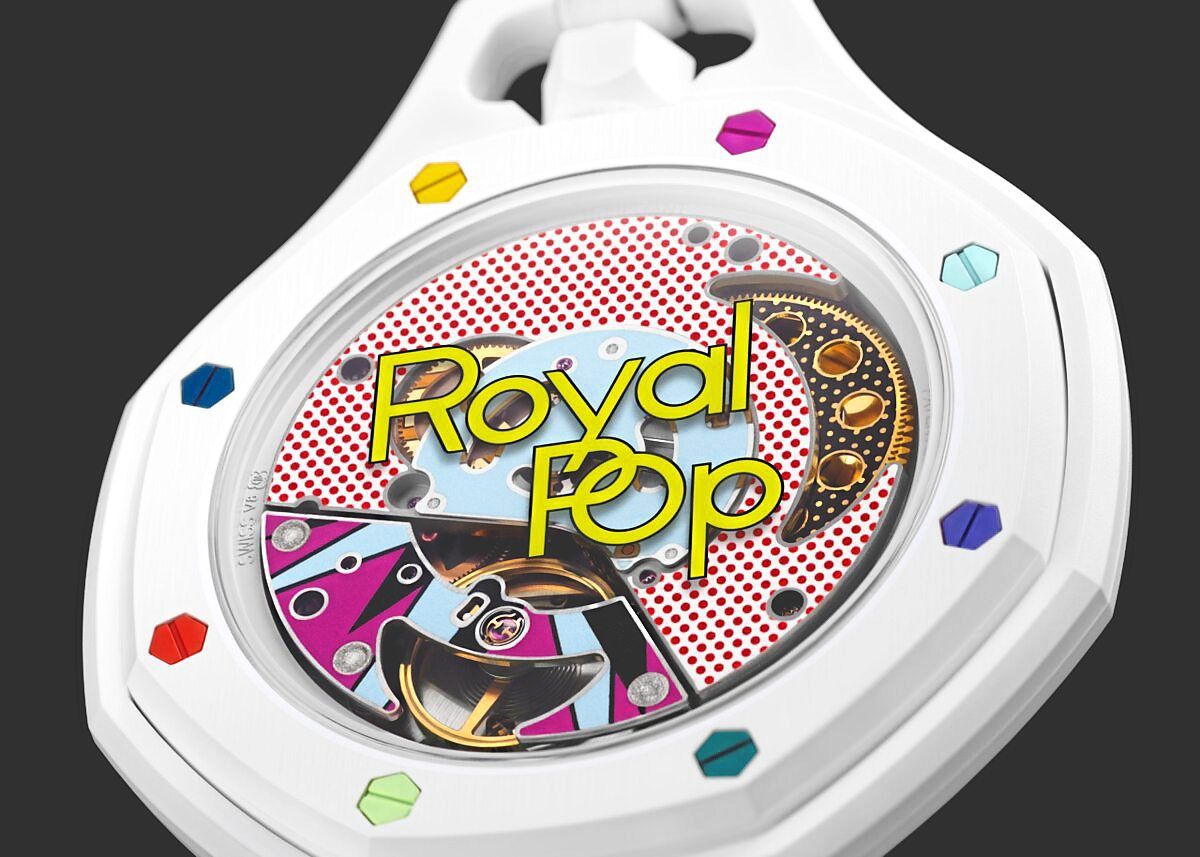
The bioceramic cases reinforced the collection’s playful, almost toy-like character.
That distinction mattered. Royal Pop was never really positioned as an “affordable Royal Oak”, but as a cheeky reinterpretation of the Royal Oak’s design language in an entirely different format.
With entry-level Royal Oak timepieces priced at close to S$30,000 (RM94,881), a low-cost wristwatch collaboration with Swatch could have posed a far greater threat to the brand’s exclusivity.
By turning the project into a pocket-watch collection − a niche, nostalgic category far removed from AP’s core business − the brand could play with the Royal Oak’s design codes without directly undermining its main wristwatch line.
For Swatch, Royal Pop is a natural follow-up to its hugely successful 2022 MoonSwatch collaboration with Omega.
That launch showed the power of pairing an accessible mass-market brand with a prestigious luxury name.
Long queues formed in many global cities, police were deployed to manage crowds in several instances and resellers quickly flipped watches at steep mark-ups.
Controlled scarcity, even at a price point below S$400 (RM1,265), can create enormous hype, cultural buzz and commercial returns.
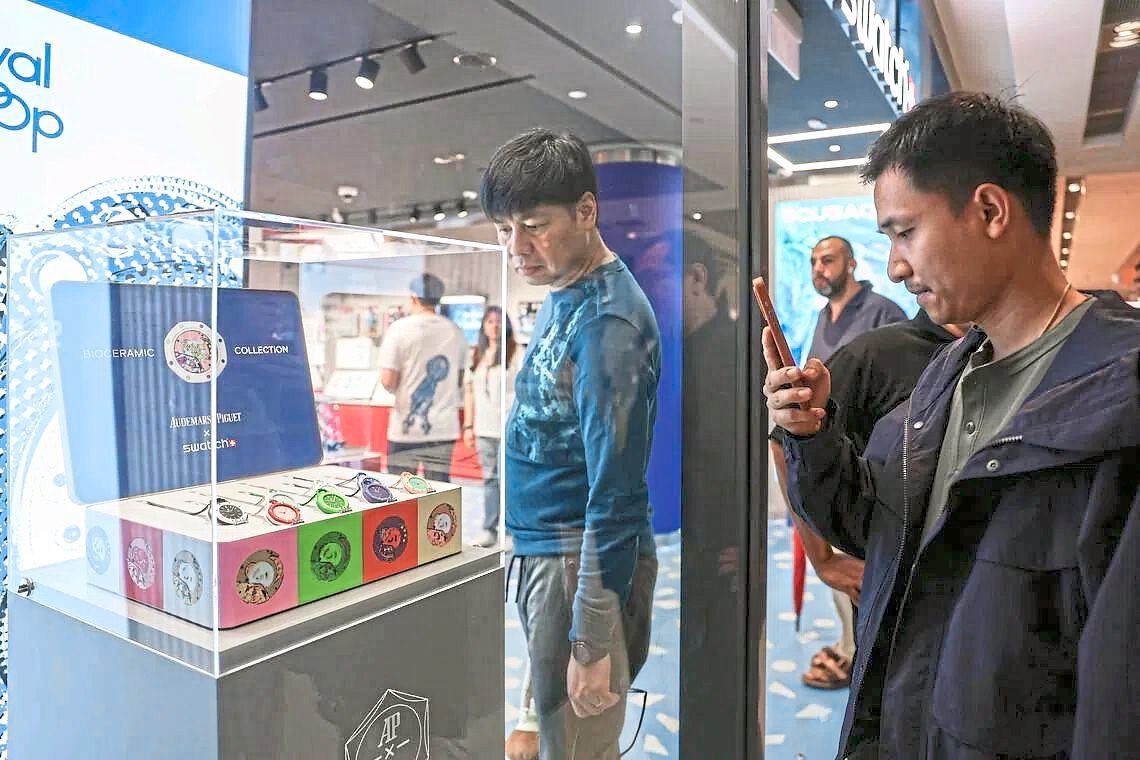
Royal Pop follows the MoonSwatch playbook, but raises the stakes.
Unlike Omega, which belongs to the Swatch Group, AP is independent.
That makes Royal Pop more than just another co-branded release.
It signals Swatch’s growing ambition to position itself as a platform through which elite luxury brands can broaden their appeal without directly cheapening their core products.
As Pat Law, founder of local social marketing agency Goodstuph, puts it: “Luxury today is not just about ownership anymore. It’s about proximity.
“Swatch gets cultural elevation.
“Overnight, a playful plastic watch inherits decades of craftsmanship, heritage and horological snobbery.”
For AP, the risks are more complicated.
Law adds: “AP gets relevance at scale without having to dilute its product line.
“Most young consumers would not walk into an AP boutique.
“But now the brand gets to live rent-free in their heads years before they can afford one.”
Still, studies on luxury brands suggest that while “democratisation” can drive short-term hype and sales, it may also erode a brand’s exclusivity if too many people gain access to its visual identity.
In luxury watches, recognisable design codes are part of the allure, but when they become too widespread, some of that prestige can fade.
Many AP collectors reacted uneasily when news of the collaboration surfaced.
Their concern was not just the watches themselves, but also what they symbolised: Royal Oak’s iconic design appearing in cheap materials and mass-market settings.
For collectors who paid tens of thousands for a steel Royal Oak, seeing a similar silhouette sold in malls − and flipped online by resellers − felt deeply jarring.
Tom Chng, founder of The Singapore Watch Club, admits he initially shared this concern.
But seeing the actual product changed his mind.
In his view, the pocket-watch format acts as a clever safety valve: It evokes Royal Oak heritage without competing with the core wristwatch line.
He frames Royal Pop as a “pure horological toy” − mechanical, manual-winding and deliberately fun − opening up mechanical watchmaking to a generation raised on cellphones and smartwatches.
The charitable dimension matters too: AP’s pledge to donate 100% of its proceeds to initiatives that preserve and transmit traditional watchmaking skills helps recast the project as a cultural investment rather than a cash grab.
Still, the long-term impact on AP’s exclusivity remains unclear.
Royal Pop places AP in front of younger and more diverse audiences − including women, a demographic many watch brands are eager to reach − but it also pushes the Royal Oak aesthetic further into the mainstream.
If the strategy behind Royal Pop was nuanced, the launch itself was not.
Swatch largely repeated the MoonSwatch formula: in-store sales only, one watch a person a store a day, limited initial stock and promises of future replenishment.
Yet launch day spiralled into pandemonium in several cities.
In France, the police reportedly used tear gas outside a Swatch store near Paris.
In Barcelona, the riot police were called.
Launch events in major malls in Dubai, New Delhi and Mumbai were cancelled.
Singapore was comparatively calmer.
Apart from the VivoCity outlet shutting for the day, the disruption was largely limited to long queues at Marina Bay Sands and Ion Orchard, frayed tempers and disappointed collectors leaving empty-handed.
Critics argued that Swatch had learnt little from the MoonSwatch experience, where stores in cities like Melbourne and London closed shortly after opening amid similar safety concerns.
Swatch said in a statement: “There were problems because the lines were extremely long and the organisation by some shopping centres was not sufficient to handle the rush.”
From a visibility standpoint, Royal Pop was a huge success, reportedly drawing 11 billion clicks to the Swatch website.
But from an operational and customer-safety perspective, the roll-out could have been handled better.
Royal Pop’s most uncomfortable lesson lies in the behaviour it triggered.
Scenes of adults camping out for days, shoving through crowds and immediately flipping watches online at huge mark-ups echoed the darker side of sneaker and streetwear culture.
In Singapore, the frenzy drew comparisons to past McDonald’s Hello Kitty promotions, which triggered snaking queues, traffic jams, shattered glass doors, and police intervention.
The pattern is familiar: When brands manufacture scarcity and turn products into cultural events, rational buying behaviour often gives way to chaos driven by FOMO (fear of missing out).
Royal Pop also highlights how access − or simply the feeling of being close − to luxury can matter as much as the product itself.
For many buyers, the appeal laid as much in the hype, social signalling, and resale potential as in the watch’s design or mechanics.
It also shows how brands increasingly turn launches into spectacles designed for queues, social media and viral attention.
The buzz was undeniable.
Whether it justified the tear gas, shuttered stores and crowd chaos was another question.
In the end, Royal Pop says less about watches than about the modern economy of attention and desire.
It shows how carefully brands engineer cultural moments and how willingly consumers line up to be part of them, even when the real cost has less to do with money than with the desire to belong. — The Straits Times/Asia News Network