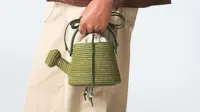
Artisans in white coats greeted guests at the Tod's fashion show in Milan Friday (Feb 27), crafting the "Made In Italy" leather and needlework items for which the company – and country – is renowned.
But despite that display of handcraft, there has been little mention at Milan Fashion Week of some of the industry's forgotten workers – whom prosecutors found were working in sweatshop conditions at subcontractors for many Italian luxury brands, including Tod's.
With the glamorous runways, celebrities and excess of finery on display, the possibility of the recent investigations uncovering labour abuses being on anyone's mind appeared slim.
After the show, Tod's founder and chairman Diego Della Valle said that the company's decision to highlight its artisanal heritage was in no way linked to the recent investigations.
"No controversy – I think we'll do good things together with the courts and trade associations. I think we're on the right track," Della Valle said.
On Tuesday (Feb 24), Tod's submitted to a Milan court a list of measures it was undertaking to reinforce its supply chain, including the creation of a platform to better trace supplier activity and expanded audits.
"I think that by working together like this, everyone will be involved in finding a solution," he said, adding that Italy's laws needed revising "to protect people and artisans".
Read more: The sad runway rewind: Fashion is sliding back to ultra-thin ideals
'Product first'
Many international guests at the show had not heard mention of the accusations of migrant labour exploitation levelled last year at over a dozen of luxury's biggest names, including Gucci, Loro Piana, Prada, Dolce & Gabbana and Ferragamo.
Allegations include around-the-clock working hours and substandard pay, breaches of safety measures and makeshift sleeping areas inside small workshops.
Asked whether it would matter to the luxury consumer, the vice president and fashion director at Nordstrom, Rickie De Sole, suggested the answer might be yes and no.
"I think the integrity of "Made In Italy" is incredibly important and I think that at the end of the day, to the customer, it's product first, right?" she said.
Influential fashion critic and journalist Suzy Menkes, sitting in the front row, cautioned that she hadn't followed the cases in Italy but said "people do care when there are specific things that have come to light".
"But I don't think it's any different from food and various other things, where one hopes that the bigger the company is, that the more they're serious about it."
A guest from Hong Kong dressed head to toe in Tod's, 26-year-old Stephanie Hui, said people were "desensitised" to stories of sweatshop conditions in the fashion industry, with consumers feeling powerless to effect change.
"It takes a lot of people to band together to like really make a change. It's not really in our control, but definitely I think if consumers stop spending as much they'll kind of give the brands a wake-up call," she said.
Read more: Remaking the body: How fashion is embracing extreme new silhouettes
'Want to be seen'
Fashion industry insiders say that controlling every link in the supply chain is more complicated the bigger the company.
Stefano Aimone, CEO and creative director of Agnona, said in an interview this that it depends on the company's scale.
"When you're smaller, you have more control and can really check and know all your employees and consultants by name. When you're dealing with 400, they're just numbers, and it's unthinkable to control everything," he said.
"Something will slip through regardless, because even if you have contracts with such-and-such subcontractor, you don't know what they then do in turn," said Aimone.
Asked whether fashion customers paid attention, Aimone said that despite some headlines, it remained "a B (business) to B (business) issue".
"The end customer doesn't know."
And even if supply chains were better known, the customer might not care, said Iuliana Stetco, 21, a fashion marketing student in Milan.
"They want to be seen, they want to be seen wearing a certain type of brand, a certain label, and so as a result they don't care much." – AFP