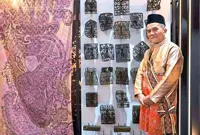
These Malaysian designers are passionate in keeping traditional batik alive


Nik Noor Amira Nik Najib is one of a growing number of young, local designers who are finding inspiration in the ancient art form they grew up with. Photo: The Star/Yap Chee Hong

Nik Noor Amira Nik Najib was working as a sales executive, dressing up in typical office wear – plain skirts, collared shirts and blazers – when she started getting bored of donning the same wardrobe every day.

Unable to find corporate attire that appealed to her, she decided to fuse her love for batik with corporate attire, and designed a pencil skirt using batik.

“To my surprise, a lot of my friends and colleagues asked me about it, saying it was elegant and attractive, ” relates Amira, who began designing blazers, dresses and tops, among other clothing, under her label Sridewi Batik.

The 33-year-old has always loved batik, and remembers many a function she would attend as a child, her entire family clad in this traditional print.

One of Sridewi Batik's bestselling items is their pencil skirt. Photo: Sridewi Batik

“Since then, I have received a lot of requests for clothing, especially for official functions, ” she adds.

Amira is one of a growing number of young, local designers who are finding inspiration in the ancient art form they grew up with.

Used to create patterns on fabric for apparel, accessories, and these days, even face masks, batik has experienced a revival among fashion enthusiasts regionally, especially here in Malaysia.

The Indonesian wax-resist dyeing technique, which originated from the Java island, uses hot wax to block out areas on a piece of fabric (or paper, wood or leather), after which, a dye is applied and the parts covered in wax “resist” the dye, and the original colour remains.

Contemporary batik is produced using a variety of wax and dye application techniques, there’s spraying, etching, marbling and cracking, using many types of tools.

These days, motifs range from flora and fauna to more abstract prints, but many designers choose to stick to more traditional-looking prints.

People are constantly craving the next best thing, and several designers have found it closer to home.

A modern take on tradition

A tailored approach to everyday fashion is the driving force behind Kapten Batik, a contemporary take on men’s fashion using batik designs.

The lads behind local label Kapten Batik, Ekram Faiz and Farhan Omar, are both engineers by profession, who started the label in 2017 with a focus on classic slim fit men’s shirts.

A tailored approach to everyday fashion is the driving force behind Kapten Batik. Photo: Kapten Batik

Their range has since evolved to include modern motifs which include geometrical and floral themes, mixing the classic with the contemporary in the form of batik pieces that can be worn pretty much anywhere.

“Our batik can be styled in various ways, such as, as an inner in suiting, over a jacket, or just to be worn on its own, ” say founders Ekram and Farhan.

They have just opened a new flagship store, offering batik shirts, t-shirts, bags, pouches, face masks and sandals.

Brothers Akmal Arif Jamian, 35, and Johan Arif Jamian, 38, specialise in mens batik wear under their brand Kontal & Kantil Batik, an expansion of their mother’s line, Bebenang Suci.

Unique, one-off pieces are Kontal & Kantil Batik’s specialty. Photo: Kontal & Kantil Batik

They hope to elevate batik to a level where it becomes one’s first choice for formal events, as well as day-to-day corporate life.

Their limited and one-off pieces feature bold colours in Indonesian batik motifs, and they plan to expand their collection to include ladies’ and kids’ attire.

“Our batik collection is exclusive, by having limited pieces, and one design, one size. Our designs aim at giving wearers an elegant air while still maintaining a casual look. We use vibrant colours and bold design for those who want to look masculine, ” says Akmal.

“I believe batik can be styled anywhere, anytime and any occasion. Colourful motives and design of batik can elevate moods, and can be great to promote positivity, ” he adds.

Batik is even finding its way into activewear, thanks to pioneers of this trends like Rasta Rashid, the woman behind Batek By Rasta Rashid.

“Batik is traditionally used for formal functions but I prefer to create something modern, fresh and classy, ” says Rasta, whose most popular items include men’s batik shirts, cheongsams and custom-made dresses.

Batek by Rasta Rashid ranges from from formal to activewear. Photo: Batek By Rasta Rashid

“There are occasions where I design the batik motif myself and create the custom design fabric for corporate requests for companies, ” adds Rasta, whose designs were featured in Miami Modest Fashion Week in November 2019.

Preserving heritage and culture

For the duo behind Kapten Batik, the process of producing their pieces is painstaking, and it’s all part and parcel of keeping culture alive.

“Before they reach our customers, our products go through an extensive process. Design inspiration is traced onto a piece of paper and is redrawn by our team of designers, who will recreate the design by injecting their creativity into the art, ” explains Ekram.

All those designs are then sent to a metal artisan to create a copper block, and a single block takes between two to three weeks to complete.

“After our blocks are in the hands of our batik artist, they will continue to print the design onto our custom ordered fabrics. Most of our fabrics are made of yarn from India and Indonesia, and our cotton buds are imported from the US and China”.

Ekram and Farhan are on a mission to preserve heritage through their trendy designs.

“We believe that we are capable of changing this current trend of only the older generation wearing batik. By tapping into our tailored, custom slim cut as a start, we hope to get everyone to wear batik, ” relates Farhan.

Kapten Batik’s Farhan Omar (left) and Ekram Faiz. Photo: Kapten Batik

“We have a mission to preserve our heritage, make them become trendy and worn by everyone as a daily outfit, ” he says, adding that batik has its own ecosystem and supply chain.

“A lot of lives will be affected if we don’t preserve our heritage, ” he adds.

To Amira, her brand’s name represents the history of the fabric’s designs.

“I chose the name Sridewi Batik as I want the women who wear my designs to feel like royalty. Sridewi is the Javanese goddess of harvest, which is about life and fertility. Hence Sridewi is about giving life to women who intend to be more than what is traditional, yet elegant and respectable in society, ” she explains.

“In many parts of South-East Asia, women were always draped in batik to represent respect and tradition. It is my hope that all races in Malaysia will wear batik just like they do in Indonesia”.

She adds: “Malaysia is and has always been home to diverse cultures since before the Malacca sultanate. The creation of batik incorporates different materials that were available since yesteryears, forming its own identity locally. These design features and artistic drawings are commonly identified as being South-East Asian, and to ensure traditions are not forgotten, we decided to combine western fashion trends with Asian designs and materials. By doing so, we are bringing batik out into the world”.

Rasta believes batik can be incorporated into anything.

“We need to always promote to all Malaysians to wear our local batik and be proud of our culture and heritage. Especially our younger generation who can carry batik with a modern twist like on hoodies, ” she opines.

Akmal and Johan hope to elevate batik to a level where it becomes one’s first choice for formal events, as well as day-to-day corporate life.

“Batik fabrics and costumes are classic and traditional to the archipelago. As Malaysians, we should be proud of embracing these values. Thus we endeavour to spread these values to all batik lovers, ” says Akmal.

To Akmal and his brother, it is important to remember where we come from, and batik is a part of preserving traditions.

“By continuing to produce traditional clothes in batik and songket, we are preserving our culture, ” he adds.

Get 20% OFF The Star Digital Access

Monthly Plan

RM 13.90/month

RM 11.12/month

Billed as RM 11.12 for the 1st month, RM 13.90 thereafter.

Best Value

Annual Plan

RM 12.33/month

RM 9.87/month

Billed as RM 118.40 for the 1st year, RM 148 thereafter.

Follow us on our official WhatsApp channel for breaking news alerts and key updates!
batik , malaysian designers , fashion , trends

Next In Style

Dior versus Chanel: Which fashion house won the celebrity bridal battle?
Framing fashion: Bibo Aswan, the photographer shaping Malaysia's visual style
Has Taylor Swift’s wedding just outshone the Met Gala in fashion stakes?
Fashion awaits Taylor Swift's bridal look, but here's what the guests wore
The American dream, dressed: A look into 250 years of fashion and aspiration
Why letting go of a wedding dress can be among fashion’s hardest choices
Fashion sees clearly as glasses emerge as the chic accessory of the moment
The bikini at 80: Fashion is still pushing the limits of this swimwear classic
Two shirts, one outfit: Is this fashion’s smartest layering trick yet?
A shirtmaker so extraordinary that a luxury fashion house is buying the brand

Others Also Read