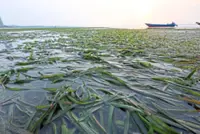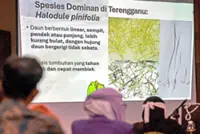
Before the pandemic, it was typical for Dr Jillian Ooi to spend up to 10 days every month exploring seagrass meadows off the coast of Johor and its surrounding islands.
An expert on seagrass, the marine scientist and senior lecturer with Universiti Malaya’s Geography Department has been passionate about bringing the little-known marine species to the fore for more than a decade.
The unsung hero of the marine world, she explains, plays a very important part in our lives – seagrass meadows serve as a form of nursery for fishes and also attract a lot of the fish we consume on a daily basis.
Through her research, Ooi, 49, hopes to share everything she learns about the flowering plants that live in coastal waters and feed marine life.
Coupled with the research done by her team of seven post-graduate students she currently supervises, she hopes they will play a role in conserving the seagrass ecosystem that is endangered not only by polluted ocean waters but also development.
However, Ooi admits that it is very hard to lobby for something that not many people know or care about.
“Seagrass is so invisible. Also, among the marine ecosystems, seagrass is not as visually dynamic or spectacular as other ecosystems like coral reefs, for example, until you get to know it well. It’s like the lalang in your yard, basically. But seagrass meadows are really vital to the ecosystem and to fish, ” she says. “If you care about the fish and seafood you consume, you should really care about seagrass.”
Ooi certainly has her work cut out for her as it isn’t easy to convince even colleagues to see seagrass the way she does, let alone collaborate on projects.
Even her husband, Affendi Yang Amri, a coral reef ecologist and research officer with Universiti Malaya’s Institute of Ocean and Earth Sciences, took some convincing, jokes Ooi.
“We took a bet some years ago, ” she reveals. “I was so frustrated about how difficult it was for me to get funding for my seagrass research projects while on the other hand, it was always so easy for him to get big funding because everyone loves corals.
“So when one of our students was out on a field trip and was about to place cameras to study the seagrass ecosystem, we placed a wager about the type of fish that both ecosystems would attract.
“We found that coral reefs attracted a lot of big, beautiful fish... fish that contributed to the aquarium trade. Meanwhile, the seagrass meadows attracted a lot of colourless fish that were not beautiful at all and no one would want in their aquariums. But these were fish that we eat... your snappers, bream and so on. All the fish that ends up on our table was at the seagrass meadows, ” she explains. “So, we really should care about our seagrass because they are what the fish we eat feed on!”
But there was also another important discovery.
“We found that there were six times more baby fish in the seagrass meadows than in coral reefs. The seagrass meadows are like nurseries and feeding grounds for many juvenile fish, which then move over to coral reefs when they become adults, ” she enthuses.
A passion for conservation
Ooi first became interested in environmental conservation as an undergraduate at Universiti Malaya’s Arts Faculty in the early 1990s.
“That was just about the time when environmentalism was growing and it caught my attention, ” shares Ooi, who majored in Geography.
“I was interested in the environment but it took me a while to determine what I wanted to focus my undergraduate study on. I finally realised that I was really drawn to the ocean, and then I found seagrass, ” she shares.
Always a person to root for the underdog, Ooi knew that she’d found her niche with seagrass.
“I like to fight for things that people don’t think there is value to and seagrass is the underdog of all the marine ecosystems, ” Ooi explains.
Apart from supervising postgraduate students, Ooi spends a majority of her time teaching and mentoring undergraduate students. And that, she discloses, is where the other half of her passion lies – teaching.
“After completing my PhD at the Western Australia University in Perth, I was really tempted to stay on there because Australia is really the perfect place for a scientist studying seagrass. But, I knew I had to come back to share all that I have learnt with students back in Malaysia.
“I realised that this could be my value to my country. Not just teaching students the science of seagrass but also teaching them to question, argue, protest and be confident enough to speak out and speak up.
“There really isn’t this culture among our students. Most undergraduates want you to give them the answers. They believe everything a person of authority tells them. But that’s not how it should be and I feel it is my responsibility to nurture not just an interest in the environment and seagrass but to nurture more critical students, ” says Ooi.
Though she has won numerous awards and accolades for her work, her students, she says, are the milestones in her career.
“We have trained some truly amazing students who have gone on to do great work and advocate for seagrass and the environment, ” she says with pride.
One with the environment
Ooi admits that work-life balance is something she struggles with.
“I work on public holidays and weekends; I start early and work late. Most days I am working till midnight. It’s not easy being an academic in the university in Malaysia right now because our teaching load and research demands are high as UM wants to maintain its position in the top 100 list of universities.
“I am also really interested in what I am doing so I push myself more. I follow the students in all their field trips even though it’s not required but I really like going and being out there, ” she says.
Her greatest challenge, she reckons, is making people see that seagrass matters.
“Every project we do incrementally adds a little knowledge about what we know of seagrass. And it takes a really long time to build up this knowledge because research is hard work. The science is hard and it’s also very physically tough. We have to be out there on the boat under the hot sun and in dangerous conditions. We have been swept away by strong currents many times. And being underwater can also be dangerous and we are responsible not only for ourselves but our students, ” she adds.
But the rewards come in the form of the discoveries made, the progress in raising the profile of seagrass and also, working with people who are as passionate and dedicated about the environment and the ocean as she is.
This, of course, includes her husband, Affendi.
“We work together a lot because, firstly, we like travelling together and secondly, we’ve realised that the work is more interesting when we look at multiple ecosystems instead of just one, because everything is connected.
“Also, for me, I’m hitching seagrass onto the back of corals since the public and policy- makers give a lot more attention to corals. It’s my sneaky way of getting seagrass onto the conservation agenda, ” she quips.
Already a subscriber? Log in
Get 20% OFF The Star Digital Access
Cancel anytime. Ad-free. Unlimited access with perks.