Dog Talk: What science says about happy, naughty dogs


Dogs have lived with us for 20,000 to 40,000 years but we’re still having heated discussions about chewing, stealing and messy eating. Thankfully, dog lovers do get to grips with these issues and behavioural science is helping to suss out underlying issues.

The furry thief

Minnie is a sweet little thief. — Molly Ooi


Molly Ooi who lives in Penang has had a steady procession of rescue animals living with her all her life. Her pets have the run of the house and garden, and are never caged or chained. As such, they have plenty of scope getting into mischief.

“All of our pets have their little habits, but one of the sweetest little thieves has to be Minnie, the Pinscher-mix, ” Ooi recalls.

“Although small, she decided early on that she was queen of the house. She was very good about our things, but anything that landed on the floor, she considered hers. Whenever she came across a dropped rubber, pencil, ruler or other item, she’d quietly pick it up and hide it under her mattress.”

The humans figured out soon enough where their belongings were disappearing to. When conducting mattress searches, just like in the films, they’d lecture the little dog.

“When we’d tell her it was our stuff and she wasn’t to take it, she’d listen and look apologetic. She’d stop a while too. But then she’d very quietly revert to old habits, ” Ooi laughs.

For us, the concept of ownership is clear, and guilt is a response to having done something wrong. For Minnie, ownership was established along the line of "finders keepers". So did she understand what her humans were saying? And do dogs feel guilt?

That apologetic look, flat ears and big eyes, has been the focus of several studies recently, and animal behaviourists now believe that this part of our communication is still misunderstood.

In an elegant study in 2015, Alexandra Horowitz, associate professor of psychology at Barnard College, New York, presented a group of pet dogs with an opportunity to steal treats. Then she videotaped owners either pretending not to know or pretending to scold their dogs.

The dogs reacted with the apologetic look only when the owners were visibly upset. As such, Horowitz suggests that pets don’t feel guilty. However, they do know when we are upset. Also, they learn that the big eyes and flat ears make us smile.

So, in effect, our pets are saying, “You’re upset, and I’ve no idea why, but hey, let me do this so we can smile again.”

The messy eaters

Jolene Tan, Sustainable Lifestyle and Mental Health Advocate living in Klang, has five dogs: Coco, Happy, Marco, Cookie and Butter. The little one, Butter, is a Toy Poodle just six months old.

“Toy Poodles are like children; they play with their food before they eat. Butter takes her food out of the bowl, puts it on the floor and makes a mess. I think she wants to play with it, and maybe she wants attention too.”

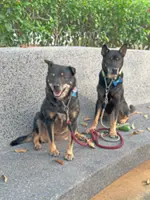
Cookie and Butter, messy eaters. Photo: Jolene Tan

Animal behavourists point out that play in wild dogs is significantly different from play in pets. Current theory is that this is partly due to our preference for breeding animals that retain puppy behaviour into adulthood, and partly because dogs are very social and are therefore keen to bond with us, their human families.

An excellent paper by vets John Bradshaw, Anne Pullen and Nicola Rooney at the University of Bristol, England, points out that pet dogs use play in complex ways. Sometimes it’s about prey instinct but more often it’s social. Interestingly, dogs also have pretend-play like little human kids where adult dogs pretend to be puppies and puppies pretend to be adult dogs. Dogs also watch and copy games they see other pets and humans play.

Dogs may play with food out of a predatory hunting instinct or because they are bored.

Interestingly, there is a third possibility. Dogs also learn very quickly how to get attention from their humans. So when clever pups learn that putting their food on the floor has their best human over to look, the doggo sees dinner time as a pawsome bonding opportunity.

Put it into context with the mismatch in communication, and it may be that we humans say, “Oh lord, you are a messy pup” is interpreted by our pets as, “Let’s have a happy time together messing about with meat!”

The destructive chewer

Josephine Lui, a consultant image professional in Selangor, lives with Benji, who is 12 years old. Although Ben is now a beautifully behaved gentleman, he was a super naughty pup with a strong chew instinct.

“I adopted Benji from the SPCA when he was about one year old, ” Lui remembers. “He chewed shoes but also the autogate wire.

Benji was a big chewer when he was a pup. — Josephine Lui

“After we had to get it fixed, I put up bricks to conceal the wiring. Five minutes later, Benji had removed the bricks and chewed again.

“I then found a plastic cover that protected the wiring, and he was okay – until we went out. The second we were out of the gate, he chewed off the cover and the wire.

“We had to embed the wiring into the wall, cementing it in. But when friends came, he chewed their shoes. He only chewed the soles, not the top, and one shoe out of each pair – but our guests were not happy. But he’s a dog, right?’

Unfortunately, Benji wasn’t interested in chew toys. So Lui tried training. “Of course, don’t hit or scold, as he won’t understand. He’s a dog and they chew. What I did was watch, and when he chewed something forbidden, I would put him on the leash for an hour.”

It took some months but it worked and adult Benji is a Good Boy.

All dogs chew and they must do so for their physical and mental health. In the wild, adult dogs gnaw on bones for fun and relaxation but also to keep their teeth and gums clean. Likewise, pet adult dogs need a steady supply of bones and dental chews in order to keep them happy and to prevent periodontal disease.

For dogs under two years old, there are three chewing stages. Tiny puppies get their milk teeth when they are two to three weeks old. Their adult teeth grow in when they are about four four months old.

During both times, your pet’s gums hurt and chewing helps relieve the pain. So, it’s really important to have chew toys and bones around 24/7 – just like human babies need their teething rings.

When your puppy is about eight months old, it should have adult teeth. However, over the next 12 months or so, the teeth have to be set firmly into the jawbone. Again, this takes more chewing.

Basically, any young dog is going to chew. A lot. And while you can distract dogs with toys, and put your shoes up high, you can expect some destruction.


Stopping unwanted behaviour


It is not possible to train a dog to be un-doglike. However, below are tips to eliminate undesirable canine behaviour:


Be reasonable. Dogs will chew, shed, drool, bark, run around, and be their canine selves. Also, puppies are like tiny babies. Don’t expect amazing behaviour instantly.

Never punish. Hitting or shouting just makes your pet afraid of you. It’s not just cruel; it’s not useful. Instead, redirect behaviour and reward-wanted behaviour.

For example, your pet will chew, it has to obey its natural instinct and have healthy teeth and gums. So watch your puppy and reward it with praise and petting for chewing of bones and toys. If it takes your shoe, remove the shoe (nicely!) and hand over a chew toy. Then praise. Also remove temptation like autogate wires.

Bored and lonely dogs may end up barking inappropriately. Photo: 123rf.com

Be social. Dogs love company and they need it for their mental health. Bored and lonely dogs will be sad. Extreme loneliness can result in canine mental health issues, and they may end up biting their fur, barking inappropriately, and so on.

Healthy dogs need several hours a day minimum with you, and that time has to be spent bonding. For dogs, quality bonding means going out for a walk together, playing a game, or sitting together and petting. If you have only a few hours a day, get two dogs so they keep each other company.


Adopt Me

Photo: PAWS/Celine Chum


Jack is one year old, happy, healthy, vaccinated, neutered and flea-free. He is a medium-sized boy, super playful and affectionate. He enjoys walks, games and chilling with people. He is looking for a happy forever home. Interested adopters please contact PAWS Selangor and ask for Jack, Tag No: P539 (120920). Note: Due to the pandemic, please call first and make an appointment. PAWS Selangor, Pilmoor Estate, Subang Airport Road, 47200 Subang, Selangor (phone: 03-7846 1087).

Get 20% OFF The Star Digital Access

Monthly Plan

RM 13.90/month

RM 11.12/month

Billed as RM 11.12 for the 1st month, RM 13.90 thereafter.

Best Value

Annual Plan

RM 12.33/month

RM 9.87/month

Billed as RM 118.40 for the 1st year, RM 148 thereafter.

Follow us on our official WhatsApp channel for breaking news alerts and key updates!
Dog behaviour , dog training

Next In Living

Security education should start early, especially for girls, say experts
Sunny Side Up: None of us can be blank slates
De-extinction company hatches live chicks from an artificial eggshell
Food vendors across Asia struggle over rising costs of plastic
Solar-powered charging station in central Cuba brings life to a darkened island
'Wiped out': Ukraine's bird lovers long for peaceful skies
Are rapeseed oils safe? Scientists and nutritionists say they are
Large-scale restoration effort of California's giant sequoias launched
Contradictheory: When science goes to the cats and dogs
Sucker fish are hiding in manta rays' rear ends, new study reveals

Others Also Read