
When the Beaufort was erected on West 57th Street, in the early 20th century, it was to provide living and working quarters for artists, one of several such buildings going up in Manhattan, New York, the United States at that time.
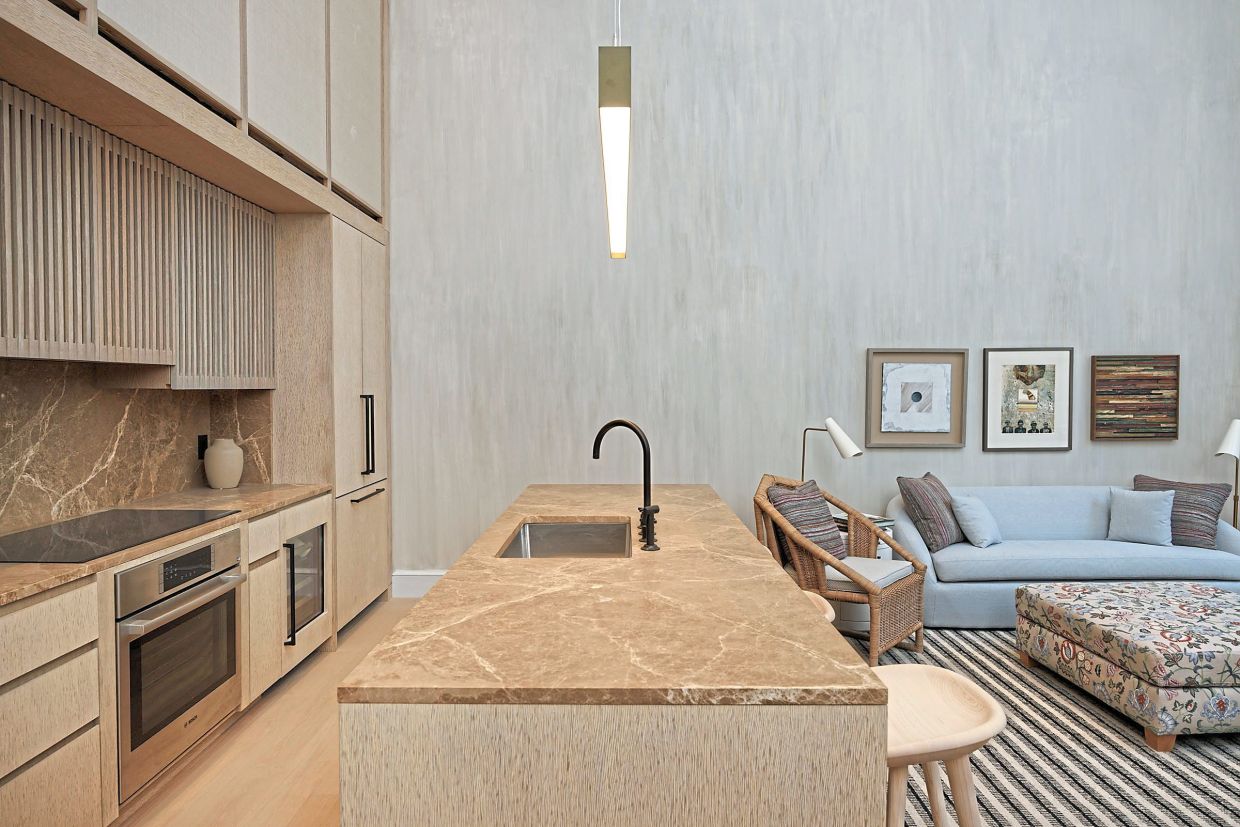
Big, double-height rooms on the north-facing front of the building were conceived as art studios. Sixteen-foot-tall (4.9m) bay windows let in the steady northern light esteemed by painters and sculptors, with single-storey living spaces behind.
But interior designer Stephen Sills said he had been thinking less about artists and more about art buyers when he set out to decorate one of these units.
That space is now a model one-bedroom apartment in a luxury condominium named Parc Beaufort. And Sills had hung collages, paintings and prints seemingly haphazardly on the warm-toned walls of a combined living and dining room, as if put up by an imaginary resident over time.
"I invented a fictional person from Los Angeles or Dallas who might have an apartment in the building as a weekend getaway,” he said, explaining the chunky elm table, crinkly curtains of ocher performance taffeta and sectional sofa upholstered in violet twill.
"If they came to auctions or galleries while they’re in town, they might buy one piece and start collecting.”
Sills added, "The outside of the building is so beautiful. I wanted to have a romantic history going into the interiors.”
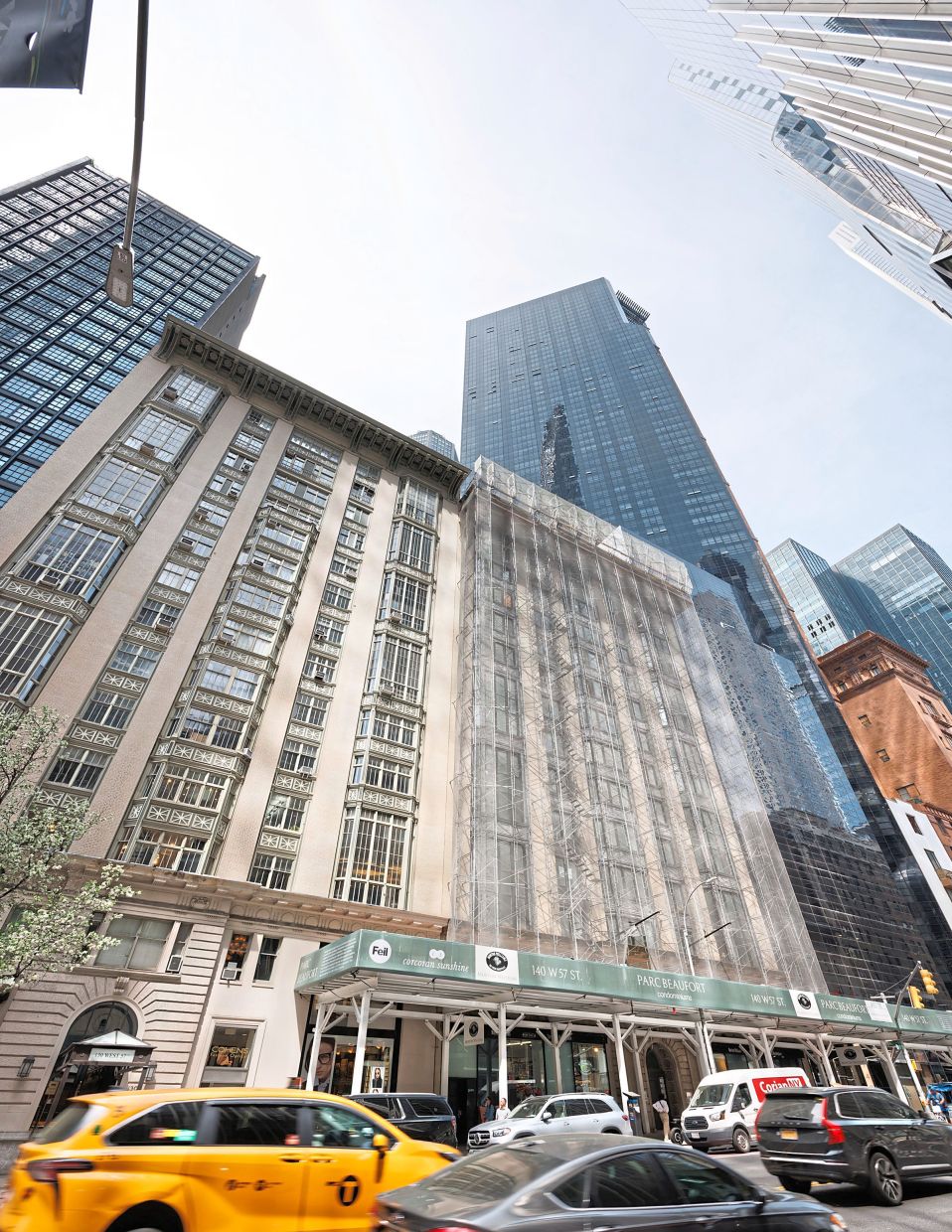
Indeed, the project, occupying a 14-storey landmark of beige brick and limestone, is a retort to the glassy condo towers that have gone up in the vicinity in recent years.
It is meant to have more of a boutique feel than those contemporary insurgents, with units significantly smaller and less stratospherically priced.
"It’s like a hybrid, it’s the old with the new,” said Jonathan J. Miller, the president of Miller Samuel Real Estate Appraisers and Consultants, who keeps tabs on residential real estate in New York and is among those who have wondered if old-school co-ops may be making a comeback as luxury condos fall out of favour.
But even when the building first came on the scene in 1907, it was hardly intended for starving artists.
The Beaufort was constructed at 140 W. 57th St along with its nearly identical next-door neighbour at 130 W. 57th St, both designed by architecture firm Pollard & Steinam, which specialised in what were called "art studio” buildings.
The West 57th Street twins were erected on the south side of the block between Sixth and Seventh avenues, with the wide east-west corridor ensuring maximum light for the studios. The buildings fit in with what was then a thriving arts district that included Carnegie Hall, steps away, and the Art Students League, one block west.
It was a time when the city’s population was exploding, Manhattan development was marching uptown and affluent New Yorkers were still acclimating to the idea of residing in apartment houses rather than single-family homes.
The art studio buildings, it was believed, would help them warm to the new way of living. They were set up as co-ops, a financial arrangement then gaining traction in New York, in which residents held shares in the properties.
Because co-ops required a substantial investment – a downpayment followed by installments – they were seen as a more elite form of multifamily housing, distinct from crowded tenements for people living in poverty.
And the West 57th Street look-alikes were certainly handsome, constructed with large cast-iron roof cornices and geometrically ornamented window frames.
Inside the Beaufort, 10 apartments incorporated the lofty studios, which allowed artists not only to create work, but to display it for prospective patrons; the spacious units were interspersed with more modest ones. The building also offered the early 20th-century’s version of amenities. There was, for instance, a central vacuum system so residents, or their housekeepers, could plug a hose into a wall opening to whisk away dust and debris.
The Beaufort did indeed attract artist residents, as intended – including opera singer Beniamino Gigli and sculptor Ernest Durig (he was best known for forging drawings by Auguste Rodin) – along with lawyers and stock brokers.
The building’s first major change came in 1944, when the apartments became rentals, and that was essentially where things stood when Macklowe Properties bought it in 1981.
The developer planned what would become Metropolitan Tower on an adjacent site and vacuumed up the air rights above the Beaufort so it could send its angular black-glass building even higher into the sky.
For a time, the company had plans to reface the Beaufort in the same shiny material.
That affront thankfully never came to pass, and once the city declared the building a landmark in 1999, the exterior was protected forever. But alterations of a different sort unfolded inside.
Macklowe bought out the last of the residential tenants and, with help from MdeAS Architects, converted the building to offices. Brian J. McCarthy, an interior designer, had one incorporating a former studio that Architectural Digest described as "a calming world of order and grace”.
The Feil Organization, which acquired the Beaufort in 2009, went back and forth for years over whether to keep the offices or jump on the luxury-condo bandwagon.
The pandemic finally settled the matter: As remote and hybrid work patterns took hold, companies gave up space and the office market tanked, Feil joined other developers in the drive to convert offices to residences – which, in the Beaufort’s case, means taking the building back to its original use.
MdeAS returned to the property to work with Sills on the US$45mil (RM183mil) project. An exterior restoration re-created the cornice, which had been removed years ago; this time it has been rendered in lighter aluminium and painted grey to match the window frames.
Inside, there is a coffered, barrel-vaulted plaster ceiling over a floor of burgundy marble and brown sandstone.
The vacuum gizmo and other circa 1907 features are long gone; 21st-century condo amenities – gym, lounge and roof terrace – took their place.
Of the 47 units in the building, well over half are one-bedrooms, ranging from 700 to 1,100sq ft (65 to 102sq m) and priced from US$1.3mil (RM5.3mil) to US$2.5mil (RM10.2mil), according to Corcoran Sunshine Marketing Group, which is handling sales. There are also studios, two-bedrooms and three-bedrooms.
Miller predicts that prospective buyers would find those prices attractive.
"This is like a throwback to the pre-uber-luxury focus of new development,” he said.
The smaller units, he added, make sense for the midtown location, which has tended to attract a transient population. (Sills inferred as much when he decorated the model unit as a pied-a-terre.)
Apartments with the former studios, whose ceilings reach 19ft (5.8m), will likely be among the most desirable.
"All those beautiful duplexes,” said Dan Shannon, managing partner of MdeAS. "Who wouldn’t want to live there?” – ©2026 The New York Times Company