
One day last summer, Vin Cipolla, the president and chief executive of the nonprofit preservation group Historic New England, and Allen Kolkowitz, an architect and a new trustee, stood at the foot of the driveway of the Gropius House, the crisp white cube built in 1938 on a gentle hill in rural Lincoln, Massachusetts, the United States.
Something needed to be done.
Here was one of the icons of modernism, the pioneering structure that German-born architect Walter Gropius designed and built for his family when he was hired to teach at the Harvard Graduate School of Design in nearby Cambridge, Massachusetts.
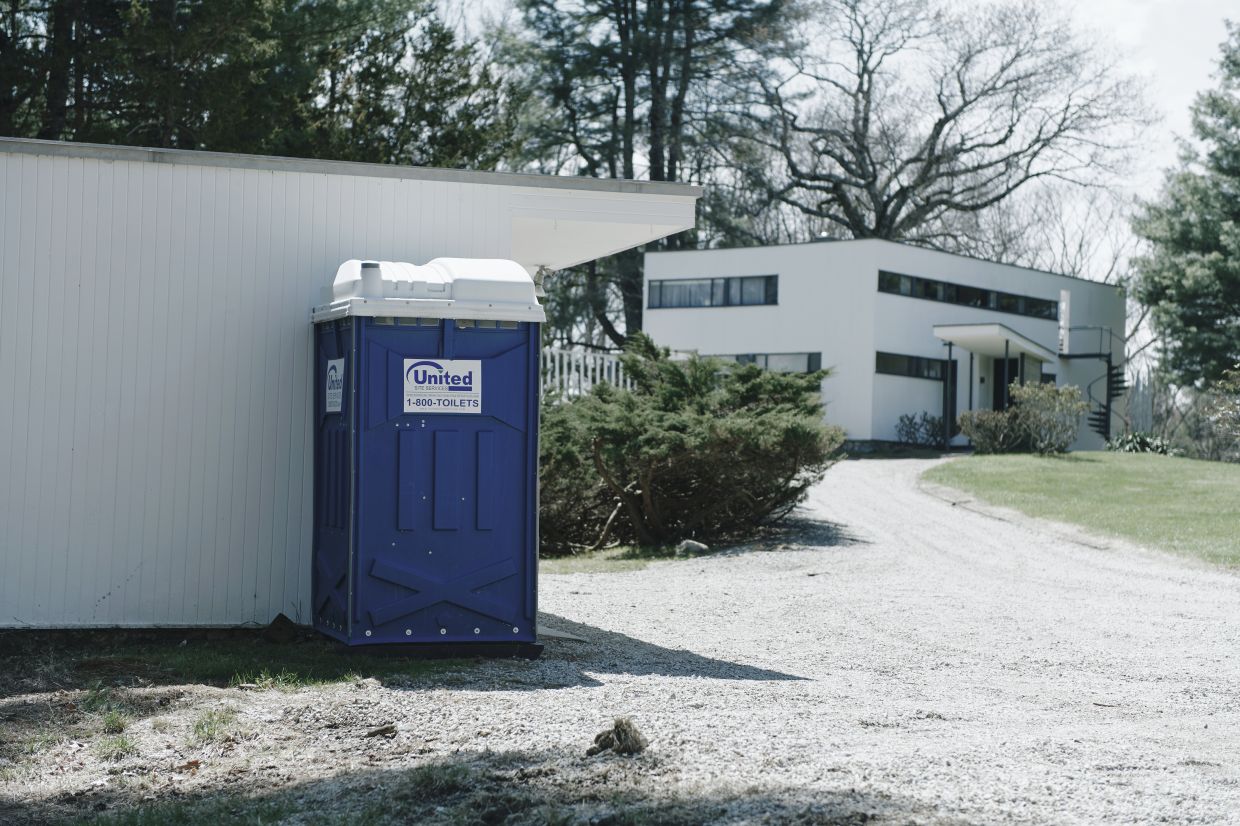
But the first thing visitors encountered upon arriving at the property in recent decades was a portable toilet. The fixture was shoved against the Gropius’ garage, which had been repurposed as a visitor centre after Historic New England opened the site as a house museum.
Those with a reserved spot on a guided tour could use a restroom in the house. But if nature called when they were hanging out on the grounds before or after a tour or just wanted to picnic on the site, the only facility available was that inelegant blue plastic outhouse.
“We can do better,” Kolkowitz said.
In November, Historic New England launched a “Bauhaus Bathroom” competition underwritten by Kolkowitz, who sought a solution that would be in keeping with the principles of the Bauhaus, the influential school that Gropius founded in Germany in 1919 and led until 1928. (In 1934, with the rise of National Socialism, he fled the country.)
And while designing what amounts to an outhouse might not be considered the most sought-after commission, more than 280 proposals from 40 countries poured in – testament to the reverence for Gropius and Marcel Breuer, his collaborator on the home, and the far-flung influence of the Bauhaus, which embraced functional design and experimental materials and construction methods.
Now a winner has been selected – and she comes from 30 minutes away.
Isabel Strauss, 35, an architectural designer and an assistant professor at Smith College in Northampton, Massachusetts, won the five jurors over with a proposal to restore the garage – where Gropius kept his beloved Buick – while also replacing one of the garage doors with a swing door set into a solid wall.
Next to the garage, she imagined a public restroom with the same volume but rotated so its entrance faces the woods rather than the house. This would give those headed to the bathroom “more privacy”, Strauss said in a phone interview, as well as clearly distinguish it as a structure that is not original to the property.
“It’s an acknowledgment that this wasn’t here before,” she said.
The proposed restroom materials telegraph both newness and respect for the old. Strauss took inspiration from the fieldstone foundations of the house and garage and the dry mortar construction of retaining walls in the area, except her idea is to use stone as cladding.
Skylights and transom windows would provide light and air to the interior, which would be covered in square glazed white tile, paying homage to the house’s simple bathrooms and facilitating power washing.
“What we wanted was function on the inside and to fade away to the landscape on the outside,” said Suzanne Stephens, an adjunct professor in the Barnard College architecture department and one of the jurors.
But visitors will need to wait a little longer for relief. Strauss – who will receive a US$5,000 (RM19,838) award – has only designed buildings on paper and will need to refine her proposal.
Historic New England must obtain approvals to add a structure to the site, which is a National Historic Landmark. Funding for construction must be raised.
“This is the beginning of the process,” Cipolla said.
For now, his group plans to exhibit the competition proposals at its Haverhill Center this summer and eventually make them available for viewing online. – ©2026 The New York Times Company