
More than 1.1 million households in Dallas-Fort Worth, in the United States, owned one or more canine companions in 2021, according to the US census.
With that many dogs – and that much love to go around – one surprisingly common injury can show up: damage from an overenthusiastic tail.
When a dog repeatedly wags and whips its tail against hard surfaces, the tip can split open, bruise or break. Veterinarians call it happy tail syndrome, which sounds cute, but can be painful, messy and stubborn to heal from.
Here’s what you need to know to keep your canine companion safe and healthy.
A dog’s tail isn’t just a fluffy mood barometer – it’s an extension of the spine and a complex piece of anatomy.
The tail is made of vertebrae that are larger at the base and gradually get smaller toward the tip, with soft discs between the bones that provide cushioning and flexibility.
When a tail takes repeated hard hits – against a wall, furniture or a kennel – the damage can go beyond the surface. The skin can split, and the underlying bones, muscles, nerves and blood supply can be injured, leading to abrasions, lacerations, fractures and even nerve damage, according to VCA Animal Hospitals, a network of veterinary clinics including in Dallas.
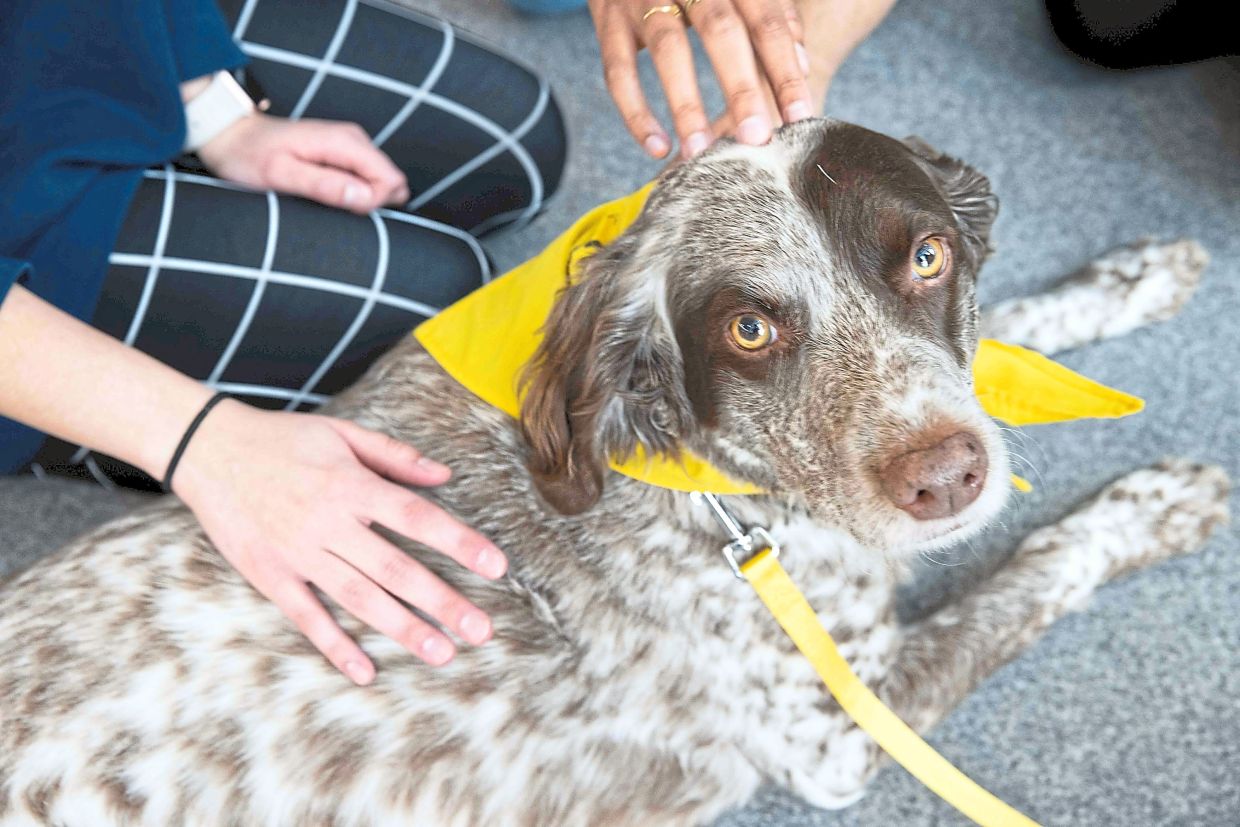
Happy tail syndrome tends to show up in dogs with long, slender, short-haired tails, such as greyhounds. A 2014 study found working breeds appeared to be at higher risk of it than nonworking breeds. But it isn’t limited to one type of canine – veterinarians also see happy tail syndrome in larger, high-energy breeds such as Labrador retrievers, Dalmatians and Great Danes, according to the American Kennel Club.
A 2010 study from the Royal Veterinary College in the United Kingdom also found dogs with a wider tail-wag arc – essentially, swinging farther side to side – were more likely to injure their tails.
That’s because a bigger swing likely increases the chance of contact and the force of impact. The researchers also found dogs kept in kennels were at markedly higher risk: In tight quarters relative to a dog’s size, tails are more likely to repeatedly strike the sides.
Because the syndrome can lead to painful, hard-to-heal wounds that may keep reopening, it’s good to see a veterinarian as soon as you notice something in your dog’s tail that seems off. Things to watch for include hair loss, swelling, persistent bleeding or a cracked tip.
Treatment typically starts with clipping the fur around the injury, cleaning the area and, if needed, suturing the skin. Many cases can be managed with antibiotics, anti-inflammatories and protective dressings, the 2010 study from the Royal Veterinary College reported. But a dog may need its tail amputated, especially after repeated bouts of happy tail syndrome or if the wound doesn’t heal and the tail starts rotting away.
What can I do to protect my dog from happy tail syndrome?
Because dogs wag their tails when they’re happy – and often won’t stop even when it hurts – preventing happy tail can mean working around a dog’s natural enthusiasm.
Some options focus on the dog’s environment, such as adding padding or corner bumpers to sharp furniture edges and other hard surfaces a tail might repeatedly hit. Keeping the skin on the tail healthy – and treating underlying dermatologic issues that cause dryness or irritation – may help reduce cracking and the chance of open wounds or infection, according to The Farmer’s Dog Digest, a dog food delivery service that has a blog for canine health.
Some owners even wrap their dog’s tail in a pool noodle for padding. Fair warning: Your dog might not appreciate the accessory. – The Dallas Morning News/Tribune News Service
Miriam Fauzia is a science reporting fellow at The Dallas Morning News. Her fellowship is supported by the University of Texas at Dallas.