
“What's your MBTI?”
If you’re a Gen Z, you’ve probably been asked this question more than once.
For young people, the Myers-Briggs Type Indicator (MBTI) – a test that sorts people into 16 different personality types based on how they think, feel and interact with the world – has become a cultural phenomenon.
According to The Myers-Briggs Company, it is a psychometric tool created to help people better understand themselves and those around them.
It provides insights into personality preferences, including where humans direct their energy and attention, how they gather and process information, make judgements and decisions as well as perceive the world.
The four-letter code that indicates one’s MBTI type such as ISFJ, ENTP, ESTJ has turned into an easy way to describe who they think they are.

But is it an authentic personality quiz or just another trend that temporarily makes individuals feel seen?
Clinical psychologist Kelly Jia Li Chan says that the MBTI is best understood as a popular self-reflection tool rather than a scientifically rigorous test.

“It lacks strong evidence for validaty or reliability, unlike the Big Five personality traits – a psychological model that describes five broad dimensions of personality: agreeableness, conscientiousness, extroversion, neuroticism and openness to experience,” she says.
“While it places personality into neat categories, which can be interesting, human behaviour is much more fluid and complex.”
“MBTI can help someone know more about themselves, but it is essential to note that it is not the final answer for any form of personality concerns or diagnosis,” she adds.
Why then are young people so obsessed with those four letters?
Sense of self
MBTI often serves as the start of one’s journey towards self-awareness.
For Michelle Martha, 22, she first knew about MBTI back in high school after listening to her friends discuss their types.
“I was initially sceptical, but after reading the full MBTI results, I became very intrigued by its accuracy and wondered if it was really that easy to figure someone out,” she says.
Michelle has been taking the test every year since learning about it.
“I believe it does describe me, maybe not 100% but just enough for my own evaluation. Interestingly, up until last year, I always got the same result of ENFP but this year it turned out to be INFJ,” she says.
“I did notice a lot of recent changes in me so this switch was sort of comforting because it gave me validation that my self-observation was right.”
Nur Arisah Aishah Nor Azman, 20, heard about MBTI in 2020 after she watched her favourite K-pop idols doing the test and thought she should also give it a try.

“My first MBTI result was INFP and after reading its traits, I found that it was quite similar to my personality,” she says.
“Over time, I began to feel different and no longer identified with INFP qualities. I then took the test again and found that I became an INTP. This new result made me happy and relaxed because it better matched how I am.”
While young people interpret the change in their results as self-growth, Chan claims that it instead highlights the test’s limited reliability.
“Differing results do not mean one’s personality has changed drastically; rather, they show how one’s behaviour can vary depending on current situations such as environment, mood, stress and stages of life,” Chan says.
For 22-year-old Chia Xin Bey, who became curious about MBTI at the age of 16, she sees it as a method to quickly determine one’s identity and considers its types to be fairly precise but not all-inclusive.
“It’s impossible to box a person’s personality so rigidly because you can’t expect people to react in ways only related to their MBTI,” she says.
Meanwhile, Yasmin Athirah Mohd Nor, 23, is not fond of the generalisation based on MBTI.

“I can be more than what is described about me,” she says.
“Although the MBTI labels me as introverted, I can be social when I need to. People are flexible.”
Chan adds that MBTI is a good entry point for self-discovery, but it isn’t sufficient for those who want to gain a deeper understanding of themselves.
“There is still a need for evidence-based interventions like therapy or validated personality assessments to make more reliable and informed judgments about one’s current state,” she says.
“Young people can also try journalling to identify patterns they want to strengthen or change but most importantly, they should explore new things and not let labels rigidly define them.”
Creating connections
Beyond personal reflection, MBTI has become a shared language among the young generation.
From a positive side, Chan says, MBTI labels can help people foster connections as they can bond over shared types or use them to appreciate different perspectives.
MBTI types are usually mentioned when Chia and her friends talk about men.
“They’ll make remarks like don’t go for the Ts, you need someone who can understand your feelings, so go for the Fs,” she says.

Chia also believes that MBTI is an entertaining topic that can bring individuals together since they get to discover interesting facts about themselves and others.
Likewise, Nur Arisah Aishah often discusses types with her twin. “We love to guess people’s MBTIs and then check if we’re right. It makes analysing people’s personalities more fun,” she says.
She additionally notes that it lets fans feel more connected to their favourite K-pop idols because MBTI is such a big thing in South Korea.
Michelle, however, doesn’t use MBTI much in social settings.
“My conversations are normally really short because it’s more of a relatable moment like “Oh, we have the same MBTI!” she says.
But she does agree that it helps Gen Z develop relationships with each other because it allows them to feel included.
“My generation loves having a sense of belonging. When they meet people who are like them, it’s as if they’re in a group only for them,” she adds.

Even Yasmin Athirah, who doesn’t care much about MBTI, admits it ties society together.
“I see how people get excited when they find out they have something in common with others,” she says.
Ultimately, Chan says that engaging with MBTI is definitely fun and can create a sense of connectedness.
However, she cautions that when youngsters start to take the labels too seriously, it can create stereotypes and reduce their uniqueness by categorising them into roles that do not reflect their whole personality.
“MBTI labels act as a double-edged sword. They can bring youngsters closer, but at the same time, the labels may give them a fixed definition which limits their understanding of one another.”
“Our personality is more than the four-letter labels that MBTI offers. Youngsters should not interpret the MBTI types as a final judgement about themselves,” she concludes.
The world's most popular personality test
The Myers-Briggs Type Indicator (MBTI) was developed by American writer Katharine Cook Briggs and her daughter Isabel Briggs Myers during the early to mid-20th century.
Briggs’ initial interest in personality types was sparked after noticing how her future son-in-law had an unusual way of seeing the world.
This prompted her to conduct extensive research on temperaments and personality differences to gain a deeper understanding of them.
According to The Myers-Briggs Company, Briggs came across Swiss psychiatrist Carl Jung’s Psychological Types in 1923, which proposes that people have different innate preferences that he categorised into eight primary psychological types.
Briggs and Myers considered Jung’s framework to be superior and wanted to make it available to a wider audience.
With many women newly entering the industrial workforce during World War II, the mother-daughter duo recognised the importance of helping people better understand their personality preferences to find jobs that suited them.
Myers’ determination in providing individuals with access to their psychological type led to the idea of a type indicator.
She dedicated the rest of her life to developing its questionnaire, alongside validating the instrument and theory.
The creation of the MBTI as a practical tool for identifying psychological types was first published in 1962.
It has since been published, studied and updated by The Myers-Briggs Company following Myers’ passing in 1980.
Decoding your inner self
The MBTI is a personality test that gives people insights into who they are.
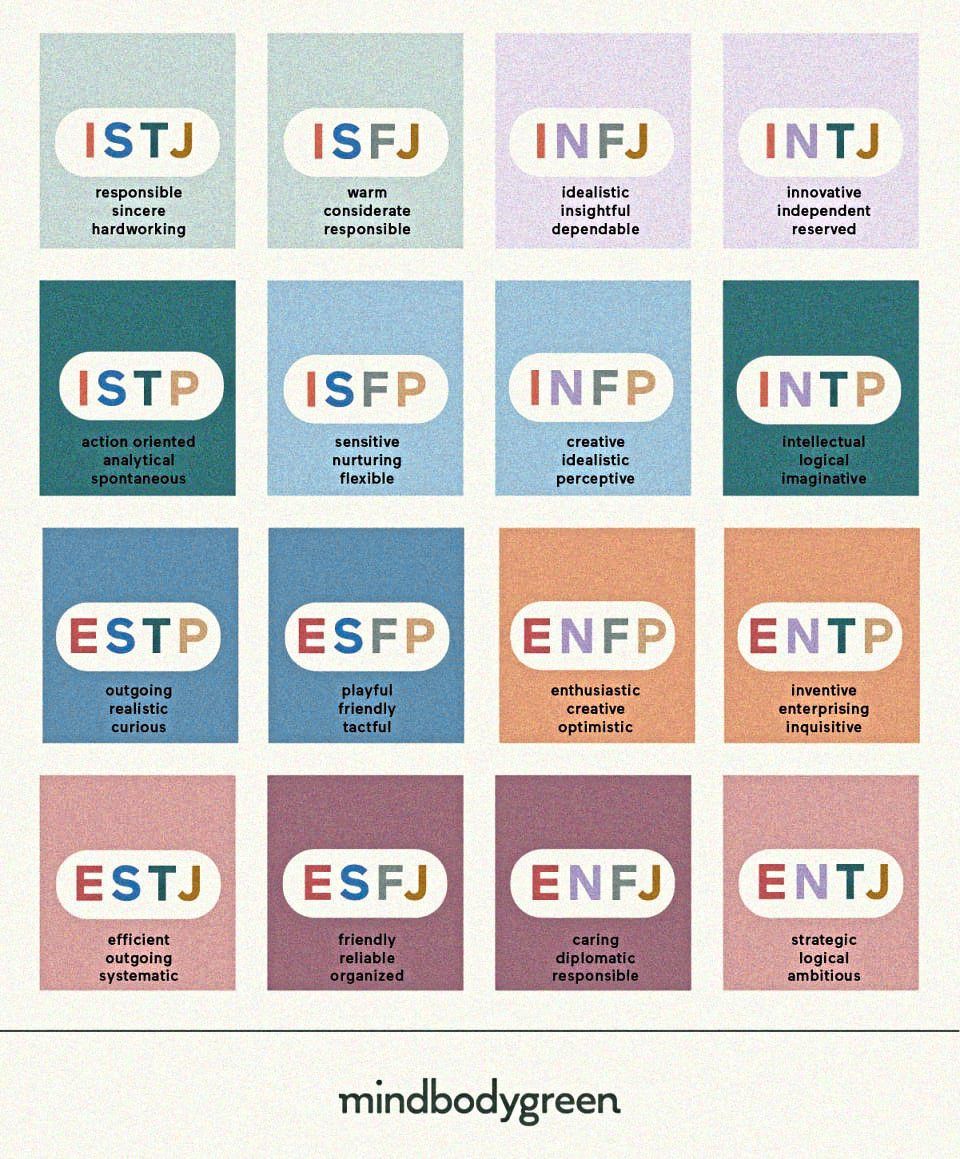
It groups individuals into one of 16 personality types based on four preference pairs: Extraversion (E) vs Introversion (I), Sensing (S) vs Intuition (N), Thinking (T) vs Feeling (F) and Judging (J) vs Perceiving (P).
From the first pair, extraverts are energised by social interaction and the external world, while introverts feel recharged by spending time in their own thoughts and reflections.
In gathering information, the sensing types rely on concrete facts and details, but the intuitive types prefer patterns and possibilities.
When making decisions, thinking personalities prioritise logic, objective analysis and fairness, whereas feeling personalities focus more on personal values, empathy and the impact of their choices.
Lastly, judging types are individuals who prefer having their lives planned, structured, and organised, while perceiving types are individuals who thrive on flexibility, spontaneity and adaptability.
After the assessment is complete, each person is assigned a letter from each set, resulting in a unique four-letter code – such as ISTJ, INFP, ESTP, ENFJ – that represents one’s personality type.