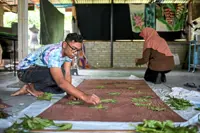
Malaysian technician quits job to pursue his passion in ecoprint fabric


Proud moment: Ezry (second from right) and Mezba (right) posing with their Piala Seri Endon award together with their friends Badrul Hisyam (left) and Mohd Izswan Sidek. Photos: Zulhelmy Hamdan

Zulhelmy Hamdan has been in high spirits ever since he emerged as first runner-up at the Piala Seri Endon Batik Design Competition (handicraft category) for ecoprint fabric two months ago.

Winning the trophy meant a lot to the Kulai, Johor-based Felda youth, as it serves as an affirmation that he made the right choice to quit his earlier job as a senior technician to heed his passion.

“I never imagined that I’d walk away with this prestigious award. I’m happy that I’ve pursued my dream. I’m slowly reaping the rewards of my hard work.

“I’m happy I went ahead with my decision to venture into ecoprinting. The secret to success is to follow your heart and never give up,” said Zulhelmy, fondly known as Ezry, 37, during an interview in Felda Inas, Kulai recently.

Six years ago, Ezry quit his technician job at a factory in Senai, Johor to venture into a home-based business focusing on ecoprint fabrics.

Ezry was determined to pursue his dream because he was confident that ecoprinting had great potential as an alternative to chemical dyes.
His colleagues couldn’t understand why he would give up a steady job and venture into fabric printing.

“Although I was happy to work in the factory, I wanted to advance my career. I was in my early 30s, and my salary as a technician was less than RM3,000. Many people said there was no future in botanical printing.

“My dad, a Felda settler, died in 2016. As the only son among four siblings, I had added responsibilities to care for my mother and sisters. The only way was to equip myself with a skill,” he said.

Empowering youths

In 2016, Ezry signed up for two courses – business operations and fashion/designing – at a community college in Pasir Gudang, Johor.

“I enjoyed the fashion/designing course the most. I learned many aspects of designing, including fashion illustration, fabric technology, computer-aided design and sewing. One of the subjects was botany and ecoprinting.

“I found the course intriguing, especially the idea of how tannin-rich leaves and flowers leave their shapes, colours and traces on the fabric. Armed with some background knowledge in business operations, I was inspired to kickstart my home business in ecoprinting,” explained Ezry, who also does batik canting (hand-drawn batik).

An ecoprint canvas bag, one of Ezry’s most popular items.

He received several grants from government agencies to kick off his business, which he co-founded with his friend Mezba Hussalam in 2017.

Today, Ezry produces ecoprint shirts, blouses and scarves using cotton, silk and linen. He uses tannin-rich plants like guava, teak, noni and Malayan cherry leaves to make ecoprint fabric, obtaining his fresh materials from his neighbourhood.

Ezry shared that he was determined to pursue his dream because he was confident that ecoprinting had great potential as an alternative to chemical dyes. He feels there’s so much potential in this industry.

“Those who are more environmentally conscious place higher emphasis on natural colourants because they produce sustainable clothing. Plus, they reduce the risk of chemical contamination in water and soil,” he said.

Ezry runs his business at a makeshift structure in his mother’s backyard. He has 10 permanent staff, including single mothers and youths.

Ezry quit his job as a senior technician at a factory to venture into a home-based business, focusing on ecoprint fabrics.
“By providing them with jobs, youths and single mothers can learn a skill. This is my way of giving back to the community,” said Ezry, adding that many of his customers are from Brunei and Singapore.

He works closely with several factories around Johor Baru to transform the ecoprint canvas fabric into handbags, pencil cases and shoes.

Besides sharing his work on his Instagram, Ezry also participates in fairs and bazaars such as those organised by Kraftangan Malaysia.

He hopes more government agencies and non-governmental organisations will take more initiatives to promote natural dyes and ecoprint fabrics.

“Malaysia has many traditional handicrafts, including songket, batik, rattan weaving and woodcarving. Now, we have ecoprint fabrics. Therefore, government agencies need to organise more courses related to natural dyes.

“Most importantly, homegrown artisans need support from Malaysian consumers to purchase local crafts,” he said.

Get 20% OFF The Star Digital Access

Monthly Plan

RM 13.90/month

RM 11.12/month

Billed as RM 11.12 for the 1st month, RM 13.90 thereafter.

Best Value

Annual Plan

RM 12.33/month

RM 9.87/month

Billed as RM 118.40 for the 1st year, RM 148 thereafter.

Follow us on our official WhatsApp channel for breaking news alerts and key updates!
Ecoprint , Zulhelmy Hamdan

Next In Living

'Wiped out': Ukraine's bird lovers long for peaceful skies
Are rapeseed oils safe? Scientists and nutritionists say they are
Large-scale restoration effort of California's giant sequoias launched
Contradictheory: When science goes to the cats and dogs
Sucker fish are hiding in manta rays' rear ends, new study reveals
Those World Cup tourists loving American food? They’re not all what they seem
Vast areas of coral reef could resist climate change: study
Heart And Soul: The measure of a man
'Jumping genes' in sloths may help scientists better understand human ageing
Martini time in Penang: 8 twists of the classic cocktail to try on the island

Others Also Read