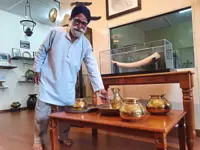
Most senior citizens prefer to spend their retirement reading the newspapers, tending to their garden or taking care of their grandchildren.
But not Kuala Klawang-based plantation owner Manmohan Singh Randhawa, 79.
Whenever the octogenarian isn’t busy with his business, he spends his time at Virsah (which means community in Punjabi) Gallery, a heritage studio that he set up in 2019.
“The gallery has over 400 items which I collected over 50 years. It includes cooking utensils, swords, and books from Punjab, as well as other heritage items from the Malay, Chinese and Indian communities,” said Manmohan during a chat in Kuala Klawang. This sleepy town is a 30km drive from the state’s capital, Seremban.
ALSO READ: She's 101, he's 28, they're flatmates and having the best of times
Manmohan understands the importance of preserving and recording Malaysia’s rich heritage for future generations. The grandfather of five wants his gallery to play an integral role in providing people with an opportunity to put the past and the present into context.
“I have always been interested in history, heritage and culture since my youth. I am interested to learn about the heritage of different communities. It’s interesting to learn how communities like Malays, Chinese, Indians and Punjabi take pride in their traditional cooking utensils, books or musical instruments,” said Manmohan.
The father of three was born in Amritsar, Punjab, in 1942. He emigrated to Malaya when he was 14 years old. His forefathers were plantation owners, and Manmohan took over the family business when he was in his 20s.
The spacious gallery is located on the first floor of a shop lot on Jalan Dato’ Syed Ali.

A large portion of the gallery focuses on cooking items used in North India (specifically Punjab) and South Indian homes.
They include utensils made from stone, clay, ceramic, wood and metal (copper, brass and cast iron). Adding more colour to the veteran collector’s gallery are vintage weighing scales, books, musical instruments, folk games and an antique vault box. Some items are over 100 years old.
“There are mixed items in the gallery including Malay, South Indian, Punjabi and a few Chinese items. Most of the items are part of my family’s collection. Some items are from different parts of north India,” shared the soft-spoken man, adding that his gallery is open to the public.
The owner of a rubber and oil palm plantation has dedicated one room to display olden-day farming tools, including rubber-tapping knives like jabong and V-groove, clay latex cups, and wooden racks used for drying latex sheets.

“Although there are newer and modern equipment in the market, it is crucial to learn about these age-old tools used by our forefathers decades ago,” said Manmohan.
He stored most of the items in his home basement before opening the gallery.
Many visitors from the Klang Valley, Melaka and Negri Sembilan have visited this quaint gallery since last October when interstate travel was allowed again.
“People, especially the Sikh community from Kuala Lumpur, have visited my gallery. Some of them had never seen most of the things, and they were satisfied with what I have.
“Most of them were impressed with my stamp and coin collections. Many people were equally surprised that I have the banana money (Japanese government-issued dollar notes) used in Malaya during World War II (1942-1945). I am always happy when they tell me they’ll bring their friends over to visit my place,” said Manmohan.

While Virsah Gallery is up and running, Manmohan isn’t ready to rest on his laurels. So during his free time, Manmohan and his two sons occasionally travel long distances to hunt down vintage items to display in the gallery.
“During the December floods, I saw vintage items in the homes of some flood victims. Sadly, these items were thrown outside their houses. Even though I offered them cash, they weren’t willing to part with the items,” he said, shrugging his shoulders.

It took much effort to design the place, polish the brassware and label every item in Punjabi and have it transliterated. It’s a lot of effort, especially for Manmohan, who will turn 80 in September.
“This is my sewa (community service in Punjabi) for the community. When I’m no longer around and if my children or grandkids don’t want it, I want these items to be donated to different societies. My wish is for these items to be displayed for future generations to come.”
Already a subscriber? Log in
Get 20% OFF The Star Digital Access
Cancel anytime. Ad-free. Unlimited access with perks.