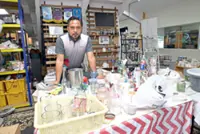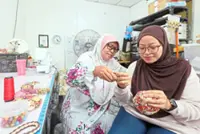
If all goes according to plan, Harrith Hasmadi will soon have a zoo on his hands. No, he isn’t talking about live animals but rather, animal plushies in every shape, size and colour imaginable.
Or at least, what your old clothes and a bit of creativity can offer.
Together with Muhaimin Hadi, 25, the two guys embarked on an upcycling project earlier this year, which saw them transforming old articles of clothing into bags and pouches, and most recently, animal plushies.
Their first attempt at making the plushies yielded a stingray and a whale, much to the delight of their young cousins.
“They are obsessed with sea creatures, so we thought it would be great practice to make them something. The moment they laid eyes on the plushies, they exclaimed, ‘A whale and stingray!’

“It felt amazing to have a kid recognise what the plushies were, as it meant that we did a pretty decent job!” relates Harrith, 23. That gave the duo the encouragement they needed to continue with their plushie pursuit.
Currently, they have a whole herd of elephants to their name. There is even a pillow made from a fabric collage of what were once denim pants.
“We have this idea of coming up with a ‘market’ where we will have an array of sea creatures such as fishes, starfish, crabs and squids. We might even include some fruits and vegetables. We are also looking forward to coming up with toys, bags and pencil cases shaped like animals for the little ones, ” says Harrith.
Upcycling refers to the act of taking something “old” or no longer in use, and modifying them into a “new” product, giving it a new function and a second life. The upcycled item is typically more useful or valuable than its previous version.
In repurposing items or materials that would otherwise be discarded or regarded as obsolete, their lifespans are extended and waste is reduced.
Retaining nostalgia
The concept of upcycling is one that is close to the young men’s hearts. It all started when Harrith was cleaning his room at one point and found that he had accumulated a pile of clothes that no longer fitted, or that he no longer wanted.
Recalling an article he recently read on how clothes are filling up landfills and leading to multiple environmental problems, he had an epiphany that those clothes could be given a new lease of life.
“That’s when I thought of repurposing them and I asked my friend, Muhamin, who was a fashion student then, whether he could transform those articles of clothing into something else. He said, ‘Sure!’ and that was how the first five bags we made were created entirely from shirts and T-shirts from my own closet, ” shares Harrith, who is currently working towards a degree in TESL (Teaching of English as a Second language).
To date, they have worked with shirts, T-shirts, pants, skirts, blazers, aprons, blouses, kimonos, kain batik and pelikat, baju kurung, baju Melayu and sweaters.

“Initially, we scoured bundle shops in search of materials, but then, as our business grew, we were lucky enough to have supportive family members and friends who donated large quantities of their unused clothes, ” says Harrith.
While repurposing clothes for their projects, Harrith and Muhaimin often retain part of the old in their upcycled items.
“For instance, we try to highlight the garment’s special feature, like the lapels of a blazer, in the new product. People love that, they love seeing the obvious details that were once part of an article of clothing, ” he explains.
To Harrith, this project is also something close to home. His mother is a teacher in a rural school and occasionally collects clothes from relatives to pass on to her students.
But there would be many pieces of clothing that end up sitting in storage if no one wanted them.

“I remember once when my mother brought bags filled with clothes to school and after people took what they needed, the leftovers were locked up in the school storeroom and forgotten.
“What we are doing is not new, as there are tons of recycling and upcycling ideas out there. But it is one way to help reduce the amount of unwanted clothes being thrown away and ending up in our landfills, ” he says.
Weaving memories
While upcycling can take more time and effort than simply purchasing something new, many people have embraced it as a creative DIY project that can produce truly unique products.
One such person is Jessica “JJ” Chuan, who has found a way to repurpose old cassette tapes while retaining the sentimentality we associate with familiar tunes and the personal stories behind them.
Her MusicCloth, an innovative handwoven “fabric” made from discarded cassette tapes, not only keeps waste out of landfills, it serves as a functional way to keep memories alive.
“Each MusicCloth is tracked by the original cassette tapes that we weave it from. Therefore, each piece tells a story and is associated with the cassette album. We select the tapes according to the customer’s purpose of gifting – for instance, whether it is a birthday or proposal – which makes them feel more connected to the products, ” says the Malaysian-born, Singapore-based Chuan.
To make MusicCloth, the polyester film with metallic coating in cassette tapes – otherwise considered waste – is handwoven in a basket weave pattern using a felting needle.
This sheet material is then fashioned into a variety of items, including scarves, coasters, city maps, bags, art pieces, silhouette portraits, notebooks and playing cards.

Chuan, 35, who is currently an adjunct lecturer at the Nanyang Academy of Fine Arts in Singapore, has also found a way to make use of the empty tapes once their insides have been repurposed for MusicCloth.
She transforms them into Tweet Tapes, a unique form of greeting cards with a 140-character customisable message option.
“Many people feel touched or even cry when they receive our MusicCloth products or Tweet Tapes. We believe music is a universal language that can bring everyone together. Being environmentally conscious does not mean we have to be too serious every time; we are here to create a brand new way of exchanging music, and we invite everyone to join us in this journey, ” she says.
Unwasted effort
Like Harrith, her upcycling venture was sparked by a major room-cleaning session.
At a time when smartphones and social media were non-existent, Chuan and her best friend – who lived in Australia – communicated with each other through recordings on cassette tapes that they sent each other.
“We were students then, and international calling cards were too expensive for us. Our solution was to record what we wanted to say and send cassette tapes to each other. Compared to writing a letter, a voice message made us feel closer to each other, ” she recalls.

As the years passed, the cassettes were relegated to a corner of the room, only to turn up in 2016 when Chuan embarked on a cleaning spree.
“I was not good at handcrafting when I was a teenager. I still remember that the only subject that I failed was sewing in my first year of high school. But knowing that these cassette tapes are non-biodegradable, I came up with the idea of using them to weave into a piece of cloth. I wanted to make waste and memories beautiful, ” she says.
Together with her mother, they started on their mission and nine months later, they successfully worked out a proper way to weave the films into MusicCloth. They started with a modest number of 10 tapes and now have thousands waiting to be repurposed.
“According to a report from the Massachusetts Institute of Technology, 56 million kilogrammes of plastic have been used to make physical cassette tapes since they were first introduced to the world in 1963.
“I wanted to reimagine a new way of exchanging music by addressing our global waste issue and transforming it into a new medium that inspires the global community, ” says Chuan, adding that the current culture sees many people downloading and consuming entertainment digitally.

Of craft and activism
All the cassette tapes used by Chuan are donated by the public. But she has to be somewhat selective because of limited storage and quality control concerns.
“For example, we do not accept mouldy tapes, and we prefer original tapes rather than recorded ones because the latter will affect our MusicCloth quality, ” she says.
In the early days, Chuan called themselves “craftivists” – coined from the words “craft” and “activist”.
“It is a form of activism. As craftivists, we don’t take to the streets to protest, but we use craft to urge people to join us (in championing a cause). From there, we gradually became a social enterprise that also does good for the world, ” she shares.
The organisation’s projects are centred around the concept of upcycling and reducing waste production.

According to a United Nations report released last year, the world produces 50 million tonnes of electronic and electrical waste a year, of which only 20% is recycled.
“Instead of constantly creating and producing new stuff, we need to change our mindset and look at what has already been created in the world, and how we can use them in our daily life. That is the essence of upcycling.
“During this time of pandemic and lockdowns, I think many of us have started realising that what we need as human beings is just the basics. And most of us have more than what we need in our everyday life, ” says Chuan.
What happens to MusicCloth when the world runs out of cassette tapes to weave?
No one would be happier than Chuan herself.
“It would mean that our mission is complete. That would be a good ending, because we would have helped reduce and eliminate part of global waste and turned them into beautiful products which people can appreciate and use today in a new form.”
She shares a quote from Finnish architect and designer Alvar Aalto, which aptly reflects her work: “Nothing old is ever reborn but neither does it totally disappear. And that which was once born, will always reappear in a new form.”
Already a subscriber? Log in
Get 20% OFF The Star Digital Access
Cancel anytime. Ad-free. Unlimited access with perks.